House Spiders

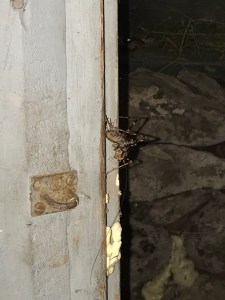
I give them names, the spiders who choose to live in our house.  That’s how I named Henry, shown in the photo.  I grew up with an almost debilitating arachnophobia, and as with most of my fears, worked hard to overcome it.  So when a spider moves in, I let them stay.  Unless they’re too big.  Here’s where it becomes interesting.  Like quantum mechanics, there seems to be an arbitrary point when something is “too big” for the rules to apply.  What is that tipping point?  The other day I bumbled into the kitchen early to get some water, having given up coffee years ago.  There was a spider that I could see from across the room.  It was very large.  It’s a sign of how much I’ve overcome my phobia that I was able to walk around the counter and to the sink to fill up.  I kept a wary eye across the room, however, in case Octavian made any funny moves.
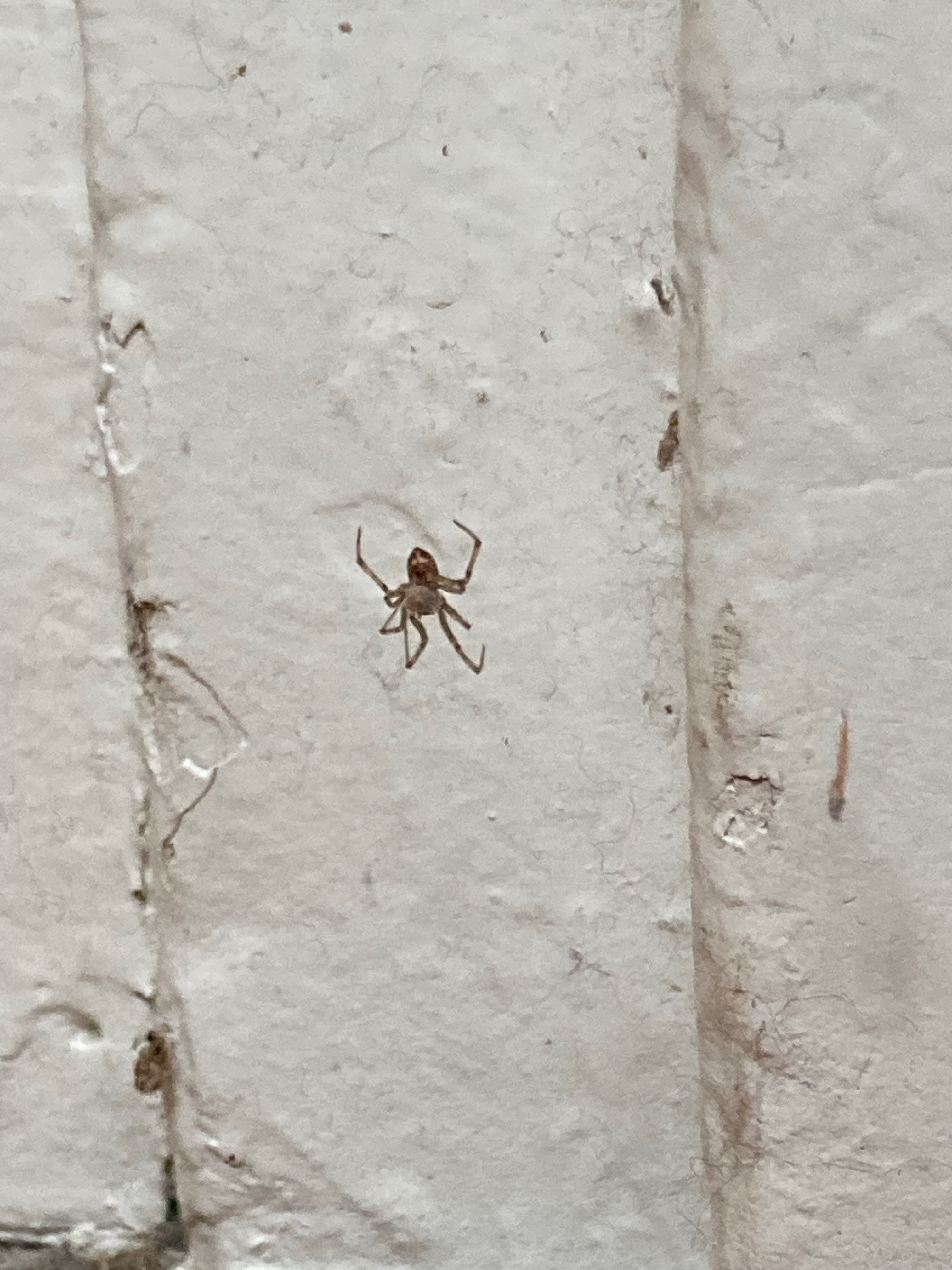
The spider held very still, as arachnids often do when they know they’ve been spotted.  I sometimes wonder if they know how scary they are to other creatures.  I searched around for a jar large enough to catch and release, without pinching any legs, and crept over.  Turns out Octavian was faster than I am first thing in the morning.  And, honestly, I was still recovering from a vaccine that had knocked me out the day before.  At least I can blame that.  I wonder if that’s one of the reasons fear of spiders is so widespread—they’re fast.  Or is it something inherently menacing about those eight legs?  I’ve never experienced any kind of octopus phobia, so I can’t think that it’s merely the number.  The jointed legs?  That seem disproportionate to the body size?  Whatever it is, days later I’m still cautious in the kitchen.

I have a great appreciation for spiders.  I don’t like to be startled by them, but otherwise, if they keep their distance, I’m fine with them.  I do wonder what they think, living in a world of giants.  Some insects, in the same size range as arachnids, seem ignorant of the human threat.  It’s not unusual for an ant to find its way inside and walk right up your foot and leg, oblivious to the danger.  They seem to have no fear.  Spiders, however, do.  They’re very good at running and hiding.  I like to think they know our house is generally a safe space, until the vacuum cleaner comes out.  When I’m behind it, I always try to give Henry and his friends a chance to get out of the way.

Spider Thoughts

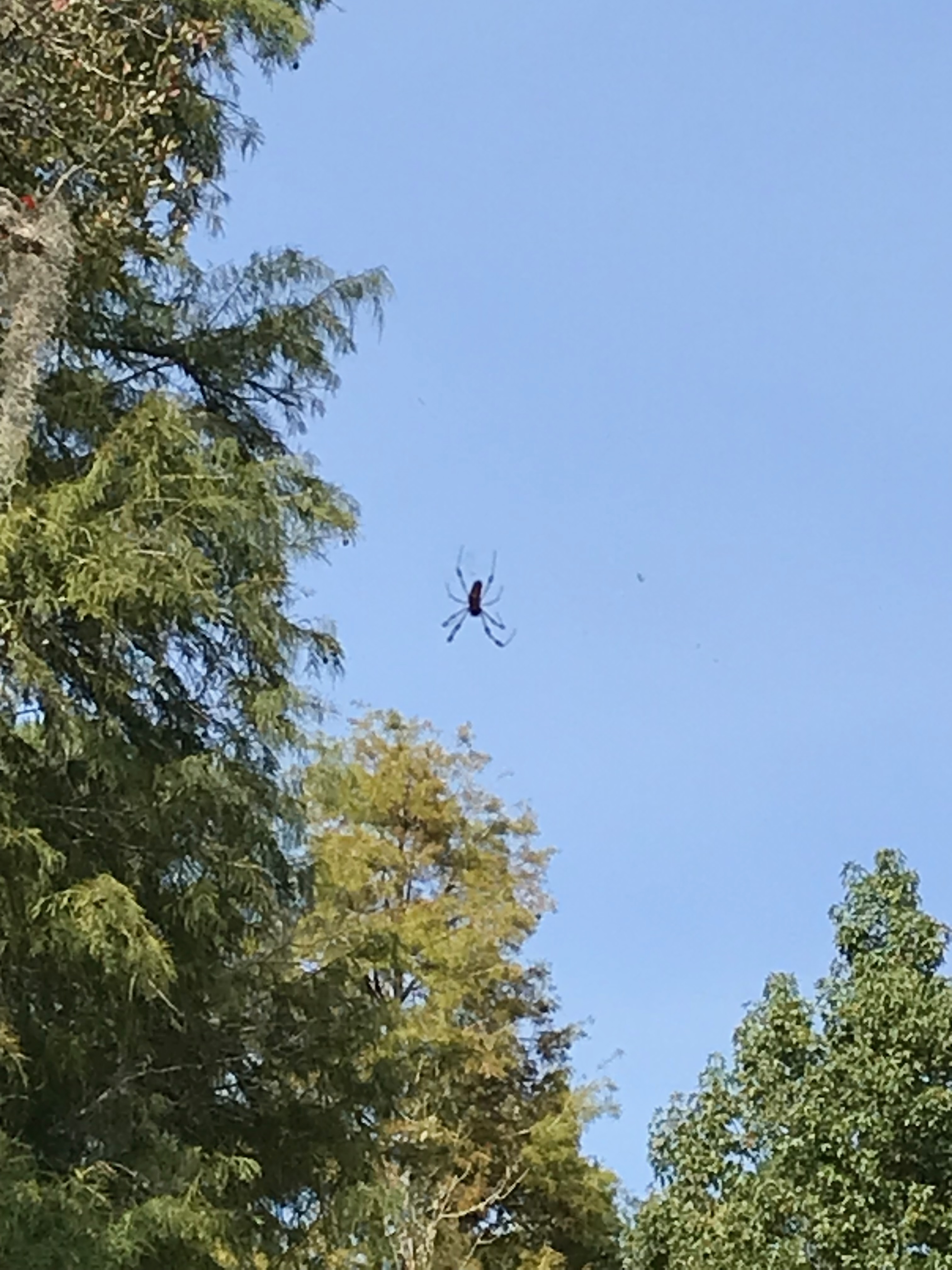
Spiders know.  Spiders are aware of when they’ve been seen.  I’ve been noticing this for some time now.  You can verify this yourself, but it may take some resolve, depending on your level of arachnophobia.  You walk into a room first thing in the morning and see a spider placidly hanging from its web.  If you intentionally look at it, it knows.  Leave the room for at least ten minutes and then come back.  The spider will be gone.  When you first stare at it, it won’t move.  Nature’s flight, fight, or freeze response has a clear winner here.  Spiders play it cool.  This happened recently on a weekend.  I had my wife verify this for me.  I pointed out the spider (I’d already stared at it) and told her I was doing an experiment.  She’s been married to me for thirty-five years, and such things no longer come as a surprise.

I told her my thesis and suggested we both just get breakfast ready as normal.  The spider didn’t move, even with clatter of bowls and spoons.  When my wife went to take her bowl to the sink several minutes later, the spider had vanished.   (This doesn’t seem to apply to spiders actively descending on a web in front of your face, I’ve noticed.  They’re too busy with their spider thoughts.)  Animals are smarter than we give them credit for being.  Who ranks spiders on their list of smart critters?  But they are.  And I wonder what they think of me.  If a spider crawls on me, I run away.  Like a spider I won’t return to the same place where it happened, at least not for some time.  All of this brings Rupert Sheldrake to mind.

Sheldrake has been summarily wiped off the table by other scientists, in part because he has explored the sense of being stared at.  Materialistic science tells us there can be no such thing since being seen is passive and we have no sense organs to detect it.  We have all, however, had the experience of turning around to find that someone has indeed been staring at us.  As so often happens with materialism, we’re told simply to discard it as fantasy.  But that’s not the way it feels.  So I look at my most recent spider—I know there will always be more—and know that s/he knows they’re being stared at.  When you’re small running may not get you away swiftly enough.  Freezing makes more sense.  Freezing and waiting.  The thing you fear (for a spider it’s me) will generally go away on its own, looking for something more material, I suspect.


Spider Planet

Misnomers aren’t uncommon when it comes to click-bait.  I’ve fallen victim more than a few times.  But such misdirection is probably as old as humanity, and is perhaps part of consciousness itself.  (Some birds are known to practice deception, as are some other primates.)  Earth Vs. the Spider is drive-in-bait as a title.  In the 1958 horror-sci fi movie (also titled The Spider), the danger isn’t really to the earth but to one small town.  There is, however, a giant spider and somehow it’s not as scary as the real thing can be, writ small.  Occasionally, such as when a spider comes out into the open in the house, I ponder why this is such a deep-seated human fear.  I know spiders are beneficial to the ecosystem and that they pose very little danger, at least in places where I’ve lived.  So why are they so scary?

Scientists, including those of the mind, have proposed looking to our primate cousins for an answer.  They too are afraid of spiders, and it’s posited that since primates climb trees to escape danger and that spiders also climb, the phobia is hardwired.  For me it’s only certain body-plans that are scary.  I don’t mind the cute little jumping spiders that get in around the windows.  They don’t seem out to hurt anybody.  It’s the kind with long, grasping legs that bother me.  As a child I used to try to identify spiders with a picture book identification guide, but soon the guide started to scare me and I had to put it down.  I wasn’t cut out to be an arachnidologist, I guess.  The movie could’ve used one, however.  They kept calling the spider an insect.

The unblinking advocacy of DDT was the scariest part of the film.  Got a problem?  Spray chemicals all over it!  It gives me the same fear as when I see all those pallets of RoundUp every time I go to Lowes.  That stuff is deadly to the environment, and I’m kind of attached to the environment.  Spring arrived around here late this year, but it was spider season by the time I watched Earth Vs. the Spider as part of my minor quest to see the “so bad they’re good” movies.  They’re also part of the history of horror.  Apart from Psycho in 1960, horror was kind of on vacation for the fifties and into the late sixties.  Of course, movies kept being made.  It’s just that they couldn’t be taken seriously.  And even though drive-ins seem to be extinct, I still fall for drive-in bait from time to time. Even when watching alone.


Scared Space

It was dark.  I often work in dim light since the computer screen backlights everything.  I’d strained my back the day before, and getting into a standing position took some time, with the first steps being necessarily ginger.  Out of the corner of my eye, I saw it in the shadows.  A wolf spider was on the arm of my chair, just inches away.  I could move neither fast nor fast enough.  By the time I’d hobbled to an empty peanut butter jar (we keep them for this purpose), it was gone.  But the fright remained.  It was several hours until I could think of sitting in that chair again, although the spider was last seen fleeing the site of the attack.  That got me to thinking about how spaces maintain the events that transpire in them.  It’s the early stage of haunting, I suppose.

Spiders were a childhood terror.  Just a week before the current spider incident, I was in the basement doing some repairs when a spricket jumped on my arm.  Sprickets, also known as camel crickets or cave crickets, live in damp places and they actually jump at their perceived enemies to frighten them away.  It works.  I was absolutely terrified by the thing.  It was large, and although it was on my arm only a second or two, I wanted to run screaming from the cellar and strip off my shirt and throw it in the washer.  I couldn’t go back into the basement the entire day.  It was the site of the fright, you see.  Spricket and spider were long gone, but their threat remained in the place I’d encountered them.

I often write about sacred space.  There is also such a thing as scared space.  I can see how this would’ve evolved from our primate ancestors.  Chimpanzees, for example, are frightened of large spiders.  They can climb trees right after you and they are impossibly fast.  I suspect in our encounter the spider was more frightened of me than I was of it.  I’m a giant in its multiple eyes and, were I not a believer in catch-and-release, could easily have killed it.  (Messy for the chair, but conceivable.)  Our ancient ancestors would likely remember—this is the place the spider bit Oog.  Must avoid.  So the idea remains, scarring the spaces we habitually sit.  Spiders outdoors, as long as I see them before they see me, are not such a source of fear.  But right now I think I’ll pick a new favorite chair, until my favorite becomes sacred again.


Insecticide

Although Halloween is more about spiders than insects, a real fear seems to be swirling around the latter.  For the second time in a year, a study has been published indicating a precipitous drop in the numbers of six-legged creatures worldwide.  This is alarming because everything’s connected.  Loss of insects means loss of vertebrates that feed on them and that leads to loss of species upon which we depend.  The problem with “humans first,” simply “America first” writ large, is that all species are interconnected.  The loss of one will lead to the loss of others—that’s the way connections work—until the entire picture changes.  And it won’t be prettier.  Even for lack of bugs.

Scientists aren’t sure of why this is happening, but the likely culprit seems to be global warming.  Temperatures are changing so rapidly that evolution can’t keep up.  And since those in political power don’t believe in evolution—America first!—they have difficulty seeing how global warming—a myth!—could possibly pose any threat.  Just ask the wooly mammoth.  The fact is that the very small frequently offer the answers long before it’s too late.  The problem is you have to pay attention.  And that attention must be not on America, or Trump, or Kavanaugh.  The Supreme Court is jobless if there are no people left.  We are part of an ecosystem, and the silence of that ecosystem is very loud indeed.   Decades ago Rachel Carson wrote Silent Spring to warn of the dangers of pesticides.  In our short-sighted way, we responded by banning the most dangerous of them and turning up the heat.

We like to focus on the negative aspects of religion these days, but one of the overlooked benefits of it has been religions’ ability to shift focus.  Christianity, for example, has been an advocate of thinking of others before thinking of oneself.  Now certain elected officials seem constitutionally unable to think of anyone but themselves, but the fact is none of us would be here if it weren’t for the insects.  They work to keep our planet neat and tidy, even if we regard them as a sign of uncleanness in our houses.  Maybe not the lowest, they are one of the essential building blocks of the world we know and recognize.  And they are disappearing.  As Carson recognized decades ago, the loss of insects leads to a silent spring because the birds that feed on them will disappear.  And what about pollination—whose job will that become?  I suppose we could assign it to migrant workers, but we’re sending them away too.  America first will be America the silent and hungry.  Unless we listen to what the insects tell us.