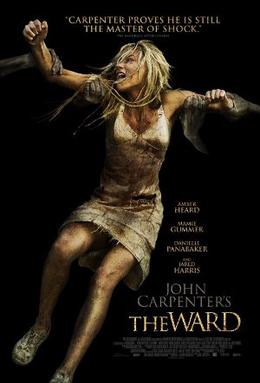
Carpenter Ward

Surveying my streaming service for something free, I found The Ward.  It advertises itself as “John Carpenter’s The Ward,” and Carpenter has proven his mettle more than once.  I found out afterwards that this 2010 film is his last, to date.  Although it has jump startles and scary sequences, it isn’t as frightening as his best work, such as Halloween and The Thing.  The eponymous ward is a psych ward.  A young woman with amnesia is brought to the facility in 1966.  She’s somewhat violent but begins to make friends with the other four girls in the ward.  It won’t be satisfying to discuss this without a major spoiler, but I’ll try to hold off for another paragraph before giving it.  Overall the movie is creepy and atmospheric, but not really a classic.  Movies about mental hospitals have built-in scary material, and The Ward meets expectations there.
Kristen, the girl with amnesia, is resourceful and nearly escapes a few times.  She’s worried because a ghost in the asylum is killing the other girls.  Nobody will believe her, of course, since she’s an inmate.  Now the reveal: the other girls are all projections of Kristen’s personality.  Actually, Kristen’s name is Alice, and she’s been at the asylum for some time, a patient with multiple personality disorder.  The other girls that are killed by the “ghost” are part of a new therapy her doctor uses to try to get Alice back.  The other girls, or personalities, had banded together and “killed” Alice and her “ghost” is now seeking them out and killing them.  In reality, only Alice is there.  While the viewer is rooting for the other girls, they are preventing Alice from being cured.

In some ways this is similar to Split, but that would come six years later.  The horror here is the loss of self-knowledge.  The little backstory that is given shows Alice suffering trauma as a child, forcing the dissociation that leads to her split personalities.  As a horror movie The Ward has the jump scares and eerie atmosphere that often work in the genre.  There are chase scenes and a monster.  The story, however, rides heavily on that final reveal.  It really doesn’t live up to Carpenter’s full potential.  It does, however, take the final girl trope seriously.  It’s not really a surprise that it failed at the box office.  Although Split came later, other such films had been produced earlier.  What this one lacks is Carpenter’s characteristic flair.  Still, there are many other films that deliver less when they stream for free.

Breakage

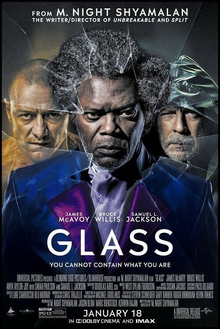
Glass makes me wonder; can any member of a trilogy really stand alone?  As someone who consumes fiction, the question always arises as to who really controls the meaning of individual units.  Scholars have given us reader-response theory that posits meaning rests with the reader (viewer, listener, etc.) rather than with the creator.  Being on an M. Night Shyamalan kick—I was brought in through his horror movies—I watched Unbreakable.  I vaguely knew it was a trilogy, but when I saw Split I was caught off guard.  Unbreakable was a super-hero movie.  Split was a horror film.  I knew Glass brought them together, but I wasn’t sure which way it would break.  It turns out the trilogy is a horror sandwich on super-hero bread.  It’s also surprisingly thoughtful.  And over two hours long.  There are horror elements, but it made me wonder since Split is horror, could it stand alone without the other two.

Having read about the development of this a little bit, Unbreakable could have stood alone.  It did for sixteen years.  Split could also, but for the reveal in the last few minutes.  And Glass manages to pull the whole thing off with a characteristic Shyamalan twist ending.  I’ve written about the other two movies in their own posts, but I really don’t want to give any spoilers for the last one.  I can say it ends with a message that is worthy of the Matrix.  It shows what movies can do.  Or at least it was taken that way by this viewer.

Given what movies are, and what they represent, I have to wonder if there’s not a good dose of racism in the criticism of Shyamalan’s work.  His movies are intriguing, without fail.  I haven’t seen all his films, but I have watched eleven of them now.  Some multiple times.  Here’s a guy with stories to tell.  I know, as a fiction writer who has trouble selling anyone on my vision, that a story can take over your life.  And you want to tell that story and see if it resonates with anyone else.  Those of us who make up tales generally recognize when something we write isn’t good.  My list of unfinished or unpursued stories dwarfs the stack of those I’ve had published, or tried to.  When you release a story out there in the world, you hope that others will get it.  I trust certain auteurs.  Even if not all of their films appeal to me, I like to think I see what they’re getting at.  This trilogy is well worth watching through to the end, even if it isn’t horror.


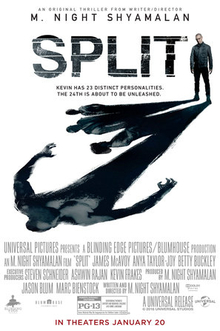
Split Decision

Sometimes advertising and packaging can make you ill-prepared for a movie.  I know that M. Night Shyamalan’s Unbreakable, Split, and Glass are considered a trilogy.  Without knowing the story, I saw the first film and discovered it was a superhero movie.  That’s fine, of course.  It’s not really horror much at all.  That’s maybe the reason Split caught me off guard.  It is brought into sequel territory right at the very end, but the story is tense and scary.  Kevin Crumb is a man with DID, dissociative identity disorder—what used to be called a split personality.  Quite apart from the inherently fascinating phenomenon (and the criticism the movie received for misrepresenting it), the idea that a person shifts and you don’t know who s/he is, is frightening.  A couple of those personalities have teamed up and become criminal.  Kevin abducts three teenage girls for a purpose that only becomes clear later.  Their efforts to escape create a great deal of the tension, and the quick shifting of identities that Kevin displays makes any kind of reasoning with him impossible.  

There are any number of avenues to discuss here.  One is that Kevin’s disorder stems from how his mother treated him as a child.  (Unintentionally I’ve been watching movies that trigger me that way lately.)  He developed personalities to protect himself from the pain and they continue to multiply.  Meanwhile, the kidnapped girls can’t figure out what’s going on but Casey (Anya Taylor-Joy—my first clue that this was horror instead of a superhero movie—)realizes that she has to treat the different identities in different ways.  Another avenue is to consider what “the beast” (one of the personalities) asserts: only those who’ve been broken are truly evolved.  Some children make it through difficult childhoods by becoming resilient while others don’t.  Casey, it turns out, also had an abusive relationship in her childhood.  Movies like this always make me reflect on how difficult being a good parent can be.

The person not in control of their own actions (ahem) is among the most frightening of human monsters.  Those with mental illness, however, seldom fall into this category.  I understand why mental health providers found this film problematic, but it showcases Shyamalan’s horror chops.  It was the scariest movie that I’ve seen in quite some time.  After I ejected the disc I felt bothered (and trapped) for quite a few minutes.  And I realized that if this is a trilogy then superhero and horror combined await in the third part.  We shall see.