Brain Dead

I’ve been thinking about brains (is there any more existential thing to do?). Reading a book this week about the mind (see Thursday’s post) probably has something to do with it. And also having finished a book on zombies maybe contributes as well. You see, I find it strange when scientists assume that we can figure out all the answers with our limited brains. Although we are endlessly fascinated by them, neuroscientists have long noted that they do have weaknesses—they (brains) are easily fooled, and, for those who find no room for the mysterious in the universe, we’ve made up gods to keep us company. We know that relative brain size—relative to body mass, that is—is a large factor in intelligence, but we seem not to imagine the possibility of larger brains than those we carry around. I suppose it’s not without reason that alien brains are disproportionately larger than our own, according to the standard image of the “grays.” We don’t like to think there’s something smarter than us hanging around. It’s a frightening thought.
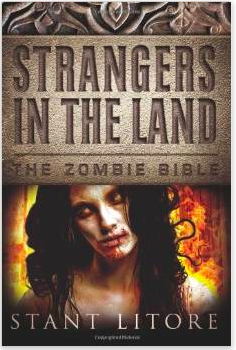
Screen Shot 2015-05-02 at 5.35.48 AMOn the more earthy side, brains have been the usual fare for zombies in one sub-division of the zombie movie neighborhood. George Romero gave us flesh eating as a paradigm, but eventually zombies settled on brains. This was on my mind as I finished the epic Strangers in the Land that Stant Litore kindly sent me in Kindle form. I’d read What Our Eyes Have Witnessed on my own, and the author wanted me to read more. Litore’s zombies are more in the canonical Romero sector—they eat flesh and their bite conveys zombiehood. Strangers in the Land takes its base story from the book of Judges. Only Deborah becomes a zombie slayer. Brains aren’t eaten here, but they must be destroyed for a zombie to—what? Redie? Full of colorfully drawn characters, the story rambles through the countryside of ancient Israel, plagued with zombies. It is the brain that keeps a zombie going.

While I have to stand by my recurring assessment that the zombie is a hard sell in novelistic form (here goes my mind again! Reading a book gives your brain too much time to focus on the utter impossibility of bodies missing organs or vital tissue to move, or “live,” even with a brain) Litore is onto an interesting idea here. Looking at it metaphorically (as surely he intends it) helps. Perhaps I just miss the lumbering revenants of Return of the Living Dead calling out “Brains! Brains!” The Bible, however, is endlessly open to reinterpretation. What Our Eyes Have Witnessed was post-biblical. This current installment moves us into the realm of reception history. I’ve been researching reception history and the undead for a few months now. I have some conclusions to share in an academic paper a few months down the road, but for the time being, I’m still trying to figure out brains. Or maybe I’m just out of my mind.

Underwater Zombies

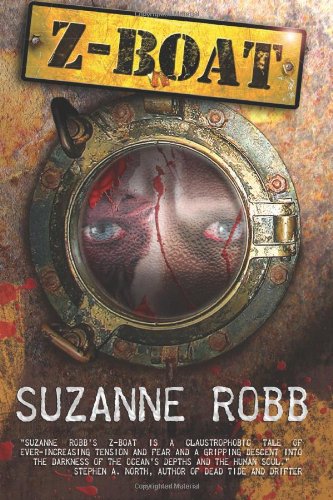
Z-BoatOne of the (many) benefits of blogging about zombies from time to time, is being sent books to read on the subject. Just as I cracked open The Zombie Bible volume What Our Eyes Have Witnessed, Permuted Press sent me an ebook of Suzanne Robb’s Z-Boat for comment. Z-Boat is an action novel with a strong female protagonist, that sets two naturally phobia-ridden subjects together: submarines and zombies. Since zombies, whether they acquire their undead status by vodou or by infection, are inherently a religious creation, they find their way onto this blog often. Unlike Stant Litore’s zombie universe, Robb’s is solidly secular, no mention of deities or demons anywhere. Set in a post-apocalyptic future (aren’t they all post-apocalyptic these days? We have difficulty envisioning anything much better), the crew of the submarine Betty Loo has to fight off a host of zombies intent on eating, and yes, converting, the living.

Zombies, whether conjured by spells and concoctions or by a contagious organism, while unthinking, always appreciate converts. The age-old human fear of being overwhelmed by swarms pertains just as well to the undead. We tend to avoid cemeteries at night, but death has a way of seeking us out in any case. I knew when my wife received a rather unsubtle flier in the mail advertising a local mausoleum that I too was likely on the list. Isn’t being a zombie all about the desire to survive, no matter what the cost? Still, it’s nice to know your custom is valued, right down to the end.

As I’ve mentioned before, zombie stories are difficult to take seriously in any rational world. Why a corpse with no stomach and no tongue would want to eat baffles the quasi-scientific mind I’ve installed. The Zombie Bible suggests that it’s hunger, and a metaphor is always appreciated in a room full of zombies. In Z-Boat the drive is more along the lines of the plot. You wouldn’t have a story without the undead. A potboiler, this is a page-turner, or, if you’re reading an ebook, a page-swiper. And although the function of a submarine is inherently like an ark—the preservation of breathing animals when overwhelmed by water—when the zombie organism eats its way into the crew, the only safety is found in escaping that ark. Robb’s tale is rollicking and rough, but her female Noah gives us all ground for hope.


Roman Undead

ZombieBibleLike most monster movie fans, I enjoy a zombie film now and then. I’ve even heard some very sophisticated people commenting positively on Shaun of the Dead. One of the standard features of the zombie is its forthright impossibility—reanimated dead are the stuff of humanity’s earliest nightmares, but in our rational minds we know that bodies missing vital organs, limbs, and blood, don’t just get up and try to eat the living. That doesn’t prevent me from watching zombie movies, and even considering participating in a zombie walk. Nevertheless, I’d not read any zombie books. That suddenly changed when I sat down with Stant Litore’s What Our Eyes Have Witnessed: The Zombie Bible. Literally the day I started reading it, a publisher sent me a copy of Suzanne Robb’s Z-Boat. I was surrounded by zombies.

I had decided to read What Our Eyes Have Witnessed because I was curious what a Zombie Bible might be. I quickly learned that it was an apologetic exercise where zombies are used as a vehicle for evangelization. It was difficult, however, to take the idea seriously. When a zombie breaks through the door of a Roman villa at the start of the book, I found the thought strangely funny. Many zombie movies go in that direction, acknowledging that they could never really happen, so they decide to give viewers a laugh or two along the way. Litore’s parsimony, however, became clear right away. This is a retelling of the martyrdom of Polycarp, but with zombies. It is a curious mix of Roman history, Christianity under persecution, torture porn, and the assurance of salvation. The premise is that Cain’s slaying of Abel resulted in zombies and their soulless souls must be put to rest. If they bite you, you become a zombie—you know the story. Meanwhile, the Roman authorities believe the Christians are to blame and decide to kill off the historical Polycarp.

The story dwells on the emotions of the Christians, in a kind of maudlin evangelicalism, as they try to avoid both flesh-eating zombies and Roman authorities. Zombies, it is said, are driven by their constant hunger and only Christianity has the true bread. This is a creative account of how the early Christian movement dealt with persecution. The zombies, however, feel somewhat superfluous in that situation, for the terror of imperial persecution was real enough. The zombies, however, aren’t after brains, and they don’t speak. They want to eat and the only thing they can digest, even if they have no stomachs, is other people. As an allegory it almost works, but zombies are a kind of fifth column in what was a very real struggle for early religious tolerance. Ironically, the undead and resurrection are never juxtaposed, although they are the most obvious way to connect the dots.