
President Dwight D. Eisenhower was, as everyone knows, a military man. With the role of Commander in Chief, United States Presidents control a military that eats up an enormous amount of tax dollars. To keep us safe, we’re told. Even though he was a military man, in his farewell address Eisenhower warned the American people of the Industrial Military Complex, a group of companies that not only eat national budgets for breakfast, but also control the most dangerous technology in the world. Secrecy, we’re told, is key. We don’t want any other nation on earth knowing what we’re up to. In fact, most Americans have no idea of and no control over what we’re up to. When people like Edward Snowden come out, their tales are so extreme that it is fairly easy to dismiss them. Would a good government ever do that? Nah. We’re the good guys, right? These were the thoughts going through my head after I watched Star Trek Into Darkness. I always run a couple years behind, it seems, on major movies. This one disturbed me in a way uncharacteristic of the Enterprise and its crew.
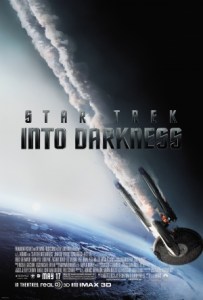
Since it’s been out a couple of years I don’t need to give spoiler alerts unless some readers are even further behind than me. Okay: here’s a spoiler alert.
As James T. Kirk gets busted down in rank for violating the prime directive to save Spock, he takes over the Enterprise when Admiral Pike is gunned down in a top-level Star Fleet meeting. Vowing revenge, he encounters Khan, the eponymous villain of the old series Wrath of Khan. As Admiral Marcus had made an alliance with Khan the parallels with the Bush family and Sadam Hussein became clear. And when Scotty finds a super starship on a moon of Jupiter, secretly developed by Star Fleet to go to war with the Klingons, more than a touch of the Black Ops came to mind. Here was a government that couldn’t be trusted and that didn’t trust its people to know its intentions. When Khan pilots this Black Ops starship into San Francisco, the shot of it falling out of the air so resembled classified military craft that I actually shuddered. The destruction was a parable of 9/11.
Throughout the movie there is a dialog of ethics. Is it right to kill a known criminal without trial? Is it permissible to start an unprovoked war? Does might make right? Khan, despite being evil, tells the truth. The movie disturbed me because I can’t remember the last time I could truly trust the government. I vote Democrat because they are the party that seem to do the least damage to the planet and actually care for the poor. I was born, however, after the Eisenhower administration. John F. Kennedy was assassinated after my first birthday. My reading since leaving college has convinced me that we will never get the full story. Star Trek, although set in the future, has always been a projection of the present day. Those few groaners of episodes from the late ‘60s that delved into popular culture proved that. As I watched the crew of the Enterprise battling an enemy under its own flag I realized little has changed in the final frontier.
 Steve A. Wiggins