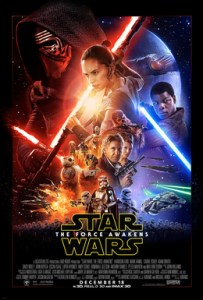
Awakening Forces

Star_Wars_The_Force_Awakens_Theatrical_Poster

Star Wars: The Force Awakens does not disappoint. Many of us who saw the original installment recognized the archetypal image right away. Good versus evil, light and darkness, the quest for the father, and a host of other tropes backed the story in ways that made us believe we were in a galaxy far, far away. As is well known, the mythographer Joseph Campbell was closely consulted on the movie, bringing his own Jungian understanding of myth to the story. We felt that we cared about the outcome of these characters’ lives. Prequels are, of course, a hard sell. Although technically proficient, the Sith episodes I-III dulled the eyes of many original fans. It wasn’t just because the action had to be all “shoot-‘em-up” western style either. There is a logic to mythology, and yes, whether we want to admit it or not, religious imagery. The Force Awakens returns to that religious, archetypal imagery and it shows not only in box office numbers, but in the reviews.

This is one of those movies that kept interrupting my subconscious the night after I saw it, even as a matinee. There was some powerful imagery going on there. Having seen the film only once, I’m sure much of it escaped me, but even based on the trailers people were wondering about the cruciform light saber wielded by Kylo Ren. Naturally, the force does awaken, carrying the mythology further. C-3PO, however, is the one who blurts out “Thank the Maker” when the resistance finally gets a break. What would a robot know of the force? Visions and prophets, the stuff of classical conflicts of good and evil, are fully present and accounted for. Even the marking of Finn’s helmet in the opening scene has elements of the Passover to it.

What stayed with me the most is a concept traditionally associated with the Quakers—the light within. Kylo Ren is struggling to defeat that light. Others are, in effect, praying for him to realize that it is still there. The force pervades every living thing, but humanoids have the light within. Movies that understand this kind of archetypal thinking quickly draw a fan base. Part of what we are seeing on the screen moves beyond entertainment to a kind of religious thinking. The original trilogy led to the growth of an actual religion called Jediism. The tenets are almost Manichean in their duality, and despite an ending that leaves you wondering, those who know the power of mythology have no doubts who, at the end, will be victorious. It is the way of the force.
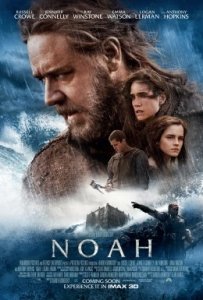

All Go Down Together

Noah2014PosterWhile the rest of the world was watching Star Wars: The Force Awakens, I was rewatching Noah, trying to find some profundity there. Like many curious people, I went to see the movie in the theater last spring expecting great things. While the story has some interesting elements, it just doesn’t live up to expectations. Noah is a hard character to like. In the biblical versions of the story, based as they are on older Mesopotamian prototypes, Noah (and his analogues) is a sympathetic character, at least in the reader’s mind. When we read we tend to identify with the main character, and since the builder of the ark is trying to preserve humanity from what seems to be an overly wrathful deity, we can sympathize at some level. What believer hasn’t felt put upon by the divine at some point or other? In the movie, Noah’s decision to end humanity after the flood is based on the silence of God. Indeed, that is one of the more profound aspects of the film—God never speaks to anyone so any action seems entirely human led. We’d expect someone who builds a floating zoo to be sympathetic to the human zookeepers at least.

Evolution, or something deriving from it, encourages species to protect their offspring. Some animals, of course, do this through over-compensation—producing more young than the world could bear if all survived to maturity. Mammals, however, care for and nurture their young. Noah’s ad hoc decision to end the human race, apart from being heavy-handed, is unreasonable and cruel. Who could look at their sons and say, “I’m going to let you age and die alone,” and yet feel that they are doing the will of the Almighty? Indeed, if humanity is made is God’s image, which Noah admits, isn’t this a form of deicide? Is Noah striking back at a silent God?

The movie does give the viewer much to ponder, but writing missteps plague the film throughout. Although wicked, Tubal-Cain is a more sympathetic character than the protagonist. He, at least, wants humanity to thrive. Noah, seeing how women are mistreated in Tubal-Cain’s kingdom, declares he will kill Ila’s children only if they are girls. There is a profound misogyny in the movie, it seems. Not that Darren Aronofsky intends for the story to be misogynic, but the implications speak loud and clear. To clear the world of violence, Noah proposes the most violent action of all. Like Noah, while everyone else was crowding into theaters with their fellow human beings to watch the force awaken, I was sequestered in my private ark waiting for a special message that refused to come. I wonder which is the more spiritual movie?