In Poor Taste

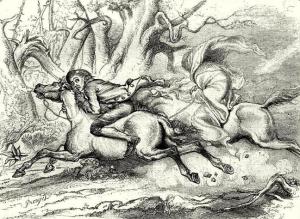
I remember seeing a television commercial once (not during the Super Bowl) where an older guy, a lawyer, complained at the camera, “It used to be that lawyers didn’t advertise.” He went on to say that he felt uncomfortable promoting himself since it was in poor taste, but since the legal profession had swung that way he was entering the game. I know how that guy felt. I grew up with the firm notion that self-promotion was in bad taste. If my career has taught me anything, it’s that unless you’re born well connected, if you don’t promote yourself nobody else will. Still, it rankles. With that hearty introduction, I would, in poor taste, point out that my latest article has been published. Those of you who keep an eye on this blog will know that I gave a paper about the Bible in Sleepy Hollow to a learned society a couple years back. That paper is now available in the Journal of Religion and Popular Culture.
ichabods_chase_crop

Doing research is difficult when you don’t have institutional support to carry it out, but doing such things as an independent scholar can be kind of liberating. I used to research, write, and get published an article a year, back in my teaching days. Nashotah House didn’t have the greatest library, but they did have interlibrary loan and, towards the end of my time there, internet access. More than that, life wasn’t measured in increments of nine-to-five. Living on campus, commuting could be measured in seconds rather than hours. Although publication didn’t bear the weight there that often pressures academics elsewhere, like that lawyer whose name I can’t remember, I wanted to be in the game. I guess I still do.

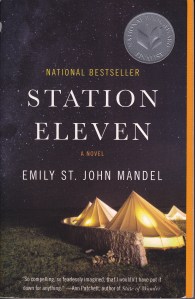
In these days of uneducated government, if you don’t do it yourself nobody’s going to do it for you. It’s what I once called “the educational imperative.” We are duty-bound, as conscious beings, to move knowledge forward. How many apocalyptic scenarios are there where, when the powers that be devolve into inanity, the monks in their cloisters have to keep knowledge alive? (The question’s rhetorical.) I’m reminded of Station Eleven by Emily St. John Mandel since there women do a good bit of keeping the culture alive when society collapses. Or, to put it another way, like Sleepy Hollow. When the forces of evil break into the world, it’s an African American woman who saves it. If your school has access to JSTOR, you’ll be able to find out more in my paper.

Stations, Everyone

Station11There has been a movement, of late, among some sci-fi authors, to envision a more optimistic future. I have always been a fan of dystopias, myself. Perhaps it’s the working-class mentality backed up by being raised in poverty speaking, but sometimes I feel that collapse is more fair than progress. What passes for progress, anyway. Maybe I’m thinking this way because I just finished Emily St. John Mandel’s Station Eleven. This book has been on my radar for some time since it is one of the more hopeful dystopias out there. The story of a group among the very few who survive banding into a traveling troop of musicians and thespians is about the most hopeful outcome I can imagine. Not a day passes when I don’t feel the effacement of humanity that has been slowly taking place since I first became aware of the world. Sure, I do appreciate the strides made in medicine. Of this internet, which is the only place anyone ever really sees me, I’m less sanguine. It has its benefits, but even Mandel mentions the cell-phone zombies that are all too real and as omnipresent as an omnipotent deity used to be.

Station Eleven has, as many dystopias do, a religious sect that emerges after society collapses. This element of bleak futures is actually very accurate, I anticipate. We’re constantly being told by the “intellectuals” of the public variety that religion is for weak-minded dreamers with milquetoast aspirations for fantasy. The fact is the vast majority of people in the world are religious. The numbers are nowhere even near close. If a pandemic were to wipe out all but one percent (and hopefully it wouldn’t be the one percenters that survive) those who remain would, without doubt, turn to religion. People are easily led in this area of life. Mandel gives us The Prophet. His vision of the world is not helpful, but he has no trouble gathering a following. He’s also somewhat messianic: child of a single parent, raised in Israel, he comes to bring a sword to a nation already prostrate in the dust. This is powerful stuff.

Societies that try to rebuild themselves after traumas quite often rely on religion. This is hardly surprising as civilization itself began as religions coalesced into temples and their priesthoods. What is surprising is that so many intelligent people today can’t see just how important religion is to our species. As I suggested before, part of this is that religion defies simple definition. It’s easy to belittle “magical” thinking when it’s assumed religion has to do only with the supernatural. Religion, however, reaches into whatever we believe. Some ideas in modern cosmology, derived from physicists and their mathematics, can look sort of religious when viewed from a certain angle. As those who write dystopias know, religion is complex. It may lead to massive destruction. Chances are, however, that if there are any human beings left to crawl out of whatever pit we dig, they will do so with religious ideas in their heads. As usual, the writers have foreseen it.