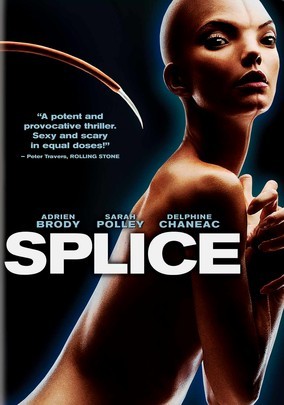
The Splice of Life

Splice Although not really scary, and although almost attainable with current technology, Dren is a curious monster. Many movies of the horror genre have explicit religious elements, but Splice may be a little too much science fiction for that. Or is it? The story is simple enough: a couple of geneticists have gene-spliced a couple of viable creatures that can be farmed for important chemicals and enzymes to solve diseases. So far, so good. But then the idea occurs to them: if the chemicals that can be used to help cure animal diseases had a human element, couldn’t they be used to cure our own diseases? And here is where the ethical quandaries begin. Adding human DNA to the mix, even when in small portions, suddenly throws open the moral dilemmas. Dren is the somewhat human result of these experiments, but the movie ends with the haunting, unanswered question—what is it to be human?

Although today the field of ethics is largely claimed by philosophers, morality is a measure of beliefs about right and wrong. In many cultures, including our own, religion has quite a lot to say about the issue. Once human DNA is mixed in the creature morphs from a bumpy slug into a creature that looks mostly human. The ethical dilemmas that surround human potential—abortion, stem cell research, cloning, and in past ages eugenics—all focus on the rights of the human person. Once a person is born, however, we almost immediately begin to curtail those rights until most of us become cogs in an unfeeling corporate machine. We are valuable, but for whose purpose? Who, sitting in their cubicle, or on their assembly line, or behind the wheel, says, “For this they defended my right to be born”?

Oddly, we privilege the potential of life without tirelessly working to improve the lot of those who’ve already been born. Perhaps, indeed, this is some form of evolutionary advantage—protect the future of the species at all costs. This idea becomes religious when it is deemed God’s will. In the movie, Dren’s creators ultimately deem her unhuman, a monster who must be destroyed. They, however, nurtured her humanness all along. While not the most profound movie ever filmed, Splice highlights the fact that ethics reflect the values of society. And society sometimes withdraws even humanity from those who’ve lost its favor.
Hope for the Flowers

Resurrection can become a tired trope, but it is the stuff of both religion and science. Last week it was reported that Russian scientists revivified a plant frozen on the tundra 30,000 years ago. Quite apart from proving that Siberia was already in place 24,000 years before God got around to creating the planet, this amazing feat teaches us lessons about life and its resilience, and also of the possibilities beyond the great pale. The scientists regrew the plant without the benefit of using seeds, making this a kind of virgin birth of the florid kind. Using plant versions of stem cells (the kind of science forbidden in the USA: “won’t somebody think of the seedlings!”), the dead plant was rejuvenated and is alive and healthy in a world vastly different than the mammoth-infested, frosty plains of northern Russia where it first saw daylight. Still, that environment was less hostile to science than the Religious Right. This resurrection shows that we don’t need miracles to bring inert matter back from the dead. No doubt there are covert Creationists trying to sneak into Russia with travel-sized bottles of Roundup in their carry-on bags.

Science has brought us to incredible places by its continued, self-critical process. Religion, preferring no critique, has given us characters like Rush Limbaugh, Glenn Beck, and Rick Santorum. And a really big book. Looking at the religious scene today it is difficult to believe that religions began as exercises in optimism—the world could be better if only we’d progress. Regress now characterizes the religion in the public eye—men (occasionally women) claiming that things were better when we were tilting with mammoths than they are now with people advocating equality for people of other genders, races, and sexual orientations. Science represents our progress, and the vocal theocrats claim we should be going backward. Back to when men were measured by the size of their spears.

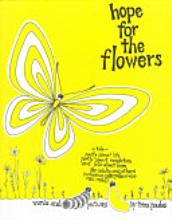
Back when I was a teenager I discovered the book Hope for the Flowers, by Trina Paulus. Not really a graphic novel, and not really a children’s book, it tells the story of two caterpillars with the courage to reject the constant, heartless climbing so often required by the world. In the end, of course, they become butterflies. The story has a religious subtext, naturally, but it was for a religion that believed butterflies should be valued rather than smashed between the pages of a heavy Bible. Butterflies bring the pollen that allows flowers to thrive. We live in a world where butterflies have become soft and defenseless while religion is aggressive and offensive. Science has shown us the way to bring flowers back from the grave, but old-time religion is waiting in the shadows with its rusty scythe.


Let’s Do the Time-Warp Again!

Yesterday MSNBC reported that the Vatican has again called for a conference involving serious scientists to discuss the implications of astrobiology — life in space. Despite the mocking sneers of the media, growing numbers of serious thinkers are doing the calculations and scratching their heads. When I was a child, I was assured that earth-like planets elsewhere in the universe were virtually impossible, statically. Now we know of several rocky orbs circling distant suns. Our own sudden advances in technology have started some to think that if we raced from heavier-than-air flight to the moon in only 66 years, and from landline to audio implant in about a century, maybe other intelligent life could do the same? What would the implications be for the geocentric world of Genesis and the Gospels?

The Catholic Church and Science are hardly best buddies; frequently they are not even on speaking terms. No, the tide did not change to a warm embrace with the (centuries late) apology to Galileo or the sudden realization under John Paul II that evolution is “more than just a theory.” All one has to do is think of the issue of stem-cell research and the eagerly offered hand is suddenly withdrawn. But on the issue of aliens, perhaps the church can race ahead of the projected God-of-the-gaps, do an end-run, and be ready to embrace E.T. when he finally makes himself known.

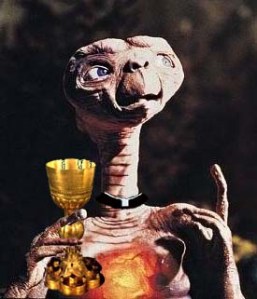
Don’t get me wrong, I am grateful that the Vatican has embraced evolution and thumbed its Roman nose to the creationists. (They deserve even more than that!) I am glad they are considering the possibilities of extra-terrestrial life. There is, however, a nagging doubt in my mind that they may be coming to the conclusion that the late Larry Norman once did that “if there’s life on other planets, then I’m sure that he must know, and he’s been there once already and has died to save their souls.” What good is advancement in science if mythology refuses to budge? What would an extra-terrestrial priest look like? What if they don’t have blood to fill their chalices? Do they have trumpet-horns on their saucers to announce the second coming? Yes, let’s explore our universe, but let’s not forget to update our credibility meters as well.

ETpriest

Our father which art in heaven?