Interiors

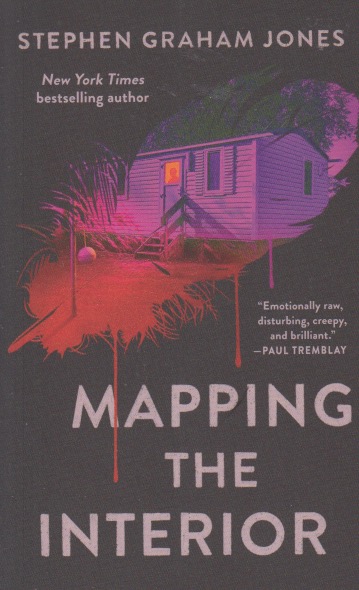
I first started reading Stephen Graham Jones after hearing him do a reading on YouTube.  I’ve always had a great deal of respect for Native Americans and his style was so sincere and down to earth that I was immediately drawn in.  Jones is now a well-established horror writer.  I’ve read a couple of his books and I have a couple more on my shelf, waiting.  Mapping the Interior is an early novella that has recently been repackaged and re-released.  You get the sense that even established authors have to prove themselves and then people will go back and read what they wrote before becoming somewhat famous.  In any case, it’s a haunting story about loss, growing up, and belonging.  At least that’s the way I read it.

Junior, the narrator, lives with his mother and younger brother in a modular house, off the reservation.  They are just barely getting by, Junior’s father having died and leaving them to live on one modest income.  But then Junior, who sleepwalks, sees his dead father in their house.  He becomes convinced that his father is victimizing his younger brother, Dino, who has a disability, in order to gain a body again.  Meanwhile, the kids at school all pick on Dino and the next door neighbor doesn’t like having Indians living so close.  He has mean dogs and an attitude.  Tension grows throughout the story as Junior has second thoughts about his father, whose death was never really explained to him.  There are some frightening scenes in this short book.  And a kind of matter-of-fact sadness.

Jones is a compelling writer.  He reminds us that American Indians know very well that they were wronged, but also have little or no recourse to justice.  The characters here keep on keeping on because that’s all you can do.  The end of the story does have a twist that is wrenching, especially after reading all that Junior has done to help his brother.  I read a fair amount about and by indigenous writers—the kinds of things many of those in power would like to ban and deny.  The experience of those whose heritage includes being colonized or/and enslaved is very important to know and to hear.  These are people who’ve been victimized and their stories need to be told.  I’m glad to have discovered this particular book, even as I’m awaiting the time to take on his longer, more recent work.  His is a voice worth listening to.

A Haunting Story

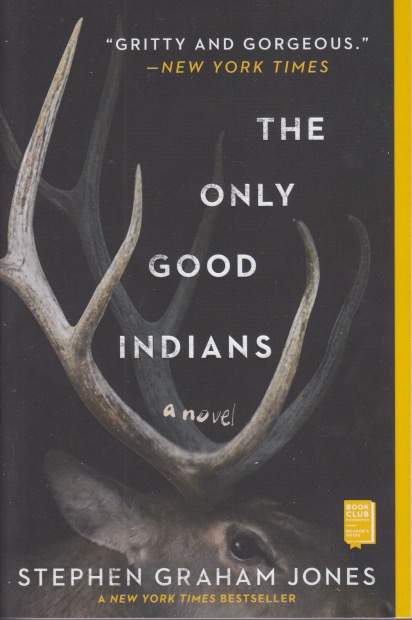
The last book I finished in 2021 didn’t quite make it under the wire for my year-end blog post.  It was the second Stephen Graham Jones novel I read in the year.  I guess I’ve been reading a lot of American Indian books lately.  The Only Good Indians is a horror story and more.  There’s reconciliation.  There’s tradition.  There’s hope.  As part of the privileged “white” class, I’m always a little afraid that writers from oppressed cultures will take it out on me.  It may’ve happened here, but if so it was done in a way that I didn’t feel the sting.  This is a story of friendship, mistakes made, and a monster who has a righteous cause.  There’s a lot going on here.

One of the persistent cultural fears of the unwoke, I suspect, is that there’ll be payback if all things were to become equal.  Perhaps on the scale of karma that’s true, but in reality the people that’ve been oppressed simply want the oppression to stop.  To be recognized and acknowledged as being human.  As if that decision is up to white folk to make.  This novel simply deals with American Indian life as it’s lived.  The characters all pretty much live in poverty but they lack the greed so many white protagonists have.  They’re happy if they have a few hundred dollars, or even a few twenties.  Life is more than playing the capitalist game.  It really all comes down to relationships.  And family.

Stephen Graham Jones writes with a deft hand.  He offers some humor amid scenes of violence and loss.  He speaks plainly and without pretense.  And there are parts of this novel that are genuinely scary.  Since I had no idea how it might end, I wasn’t even sure even while I was on the last page.  

The best monsters are those that teach us to be better human beings.  Quite often they teach us that the truly monstrous ones are those who look and act like people usually look and act.  We take the natural world, assuming it’s ours.  We think our small problems are those of the entire world.  Monsters help to fix our perceptions.  Without them we carry on as if it’s business as usual.  This is a good novel to read in the midst of a pandemic.  There’s hope here that we’ll come out of the crisis better than we went in.  Perhaps scarred and changed for good.  In every sense of the word.


Fear of the Other

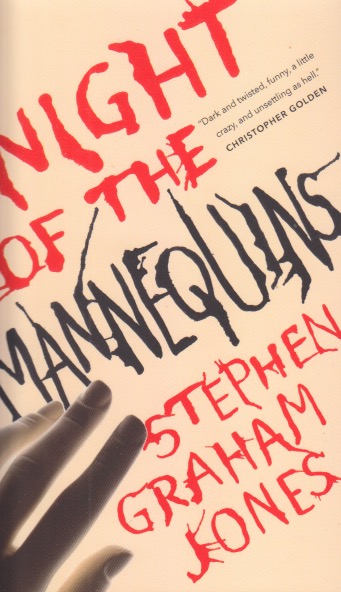
Two things: I’ve been reading about and materials by American Indians lately, and I learned about Stephen Graham Jones through a video of him reading one of his stories.  I was immediately hooked.  It seems to me that those of us who’ve gone through trauma—either personally or ethnically—are disproportionately represented among those who like horror.  I’m not suggesting a simple equation, but simply noticing a trend.  Jones has been winning awards as a horror writer and I was anxious to get started.  Night of the Mannequins didn’t disappoint.  Jones is a member of the Blackfeet nation and, according to the author bio, a real slasher fan.  This story isn’t really a slasher but it is an exploration of what happens when an idea takes over someone’s life.

More about growing up in Texas than being First Nations, it follows a group of teens who find an abandoned mannequin and a practical joke that goes terribly wrong.  It’s a story will a real feel for what it means to grow up beneath the middle class.  The realities for those who do are somehow quite different than from those who can take some measure of financial security for granted.  It also makes a good setting for horror stories as the protagonist tries to figure out what’s going on without the aid of authorities and adults.  It makes for a compelling read.  Jones’ no-nonsense style draws you in and it doesn’t let you go.

The book is fairly recent and I don’t want to give too much away.  I do often think about how a writer’s personal experience leads to the books s/he writes.  The horror genre is wide-ranging and can be deep and intelligent.  Despite its brief extent, there’s a lot of depth here.  The straightforward writing style gives the book verisimilitude.  You could see this actually happening.  Monsters, after all, are frequently in our minds.  That doesn’t make them any less real.  Mannequins tend to inhabit the uncanny valley—they’re human and yet, at the same time they’re not.  There are aspects of growing up in “white” culture that must suggest the same to those who’ve been and who continue to be, oppressed by that culture.  There is a real fear to being controlled by others whose intentions, it must be clear by now, are to make themselves rich.  The world is a richer place, however, for having books by Stephen Graham Jones in it.  I’ll be coming back for more.