Somewhere out There

If last month’s election taught us anything it’s that nobody really knows anything. For many years now I’ve been saying that the sign of an educated person is s/he admits how little s/he knows. Socrates may have beat me to that idea, but there are still people whose intellect appears so great that we should pay attention. To my mind, such as it is, Stephen Hawking is one of those people. I don’t understand his formulas, but some of the concepts I can grasp. So when Prof. Hawking says we have approximately 1000 years before we make our planet unfit for human life, I think we should take notice. In just a decade we’ve gone from a Wall-e White House to a Dumb and Dumber one, and old mother earth is due to take a beating. Hawking, according to a story in The Washington Post, advises us to look for another planet to colonize.

 Photo Credit: (NASA/Bill Ingalls)

Photo Credit: (NASA/Bill Ingalls)

Colonization seldom ends well. I wonder how the rest of the universe feels about us moving into the neighborhood. We dump our waste into anything pristine enough to carry it away so that people can make some of their number wealthy so that they can feel better about themselves. We can’t go one year without a war somewhere in our world and we kill one another just because we look different. We can’t even elect a president who’s smarter than any random undergraduate. Not exactly the kind of invasive species you want living next door. Any system can be gamed—capitalism most of all—and if it were up to me I’d prefer to have thoughtful neighbors. Perhaps the universe is politely saying to Dr. Hawking, “not in my backyard.”

What I find truly amazing here is that religion gave us the entitlement. Believing that the gods are like us, or that one deity made us in his white, male image, we’ve figured out this world’s ours to destroy. Just like entitled kids with too many toys. Daddy can always buy you another. So now we’re in the market for a new planet. One that’s not too hostile, but easily exploitable. A capitalist planet, but one that doesn’t mind a bit of help from former communists. You see, once we’ve figured out how to exploit another planet, there’ll be no stopping us. I have great admiration for Stephen Hawking. It’s just this time I think that we need to set our own house in order before we start inviting ourselves to somebody else’s home.

Consciousness Times Eight

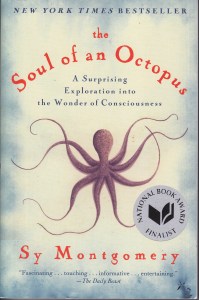
SoulOctopusPerhaps the characteristic that marks our species most distinctly is its arrogance. Conscious of who we are (we think) we stake the claim for minds for ourselves alone while all the evidence points away from that very conclusion. Naturalists are castigated for “anthropomorphizing” animals by stating that they have consciousness too, or—oh the heresy!—personality. Any of us who’ve spent time with two or more of the same non-human species, however, know that personality is a given. Animals think and feel and, yes, act on their own view of the world. I have to admit I fell in love with Sy Montgomery’s The Soul of an Octopus. I’ve read animal books from my youngest days, but finding an author so forthright about the feeling of getting to know another species is rare. And I learned tentacles full of information about octopuses. I had already known that octopuses are intelligent—I hadn’t realized just how smart—but since my interactions have only been with sleeping cephalopods on the opposite sides of aquaria glass, I had little to go by.

Throughout her charming book, even if the evidence is anecdotal, Montgomery reveals the personalities of the octopuses she got to know at the New England Aquarium. The reader can be left with no doubt that these are animals with personality, different from one another and strikingly conscious. We can’t define what consciousness is, but I tend to agree with Montgomery that it is what many people call “soul.” She admits that her religious tradition would likely frown upon her willingness to share such a valued commodity with an animal—an invertebrate, no less—but surely she is right. Many, if not all, animals have a form of consciousness. Heaven will be a much more interesting place for it.

Please don’t confuse my enthusiasm with sentimentalism. Those of you who regularly read this blog will know that books on animal intelligence by a variety of scientists make up a steady part of my literary diet. Biology, however, often has a difficult time in a world where physics and chemistry are treated with reductionistic glee. I was strangely satisfied when Montgomery mentioned that Stephen Hawking signed the Cambridge Declaration on Consciousness which proclaims humans alone are not the guardians of this phenomenon we don’t even understand. The Soul of an Octopus was one of those books that I couldn’t wait to keep reading, even if it meant being on my long commute each day. And I can’t help but think of how much intelligence we squander by claiming that only our own kind possesses it.


Techno-Paradise

DSCN3308

I’m building a robot priest. I’m not sure what he does. He has to be a man, though, since we all know that if God existed he’d have been a male. These thoughts come to me courtesy of the Washington Post. You see, on some Amazon accounts you get sent the most read headlines of the Post and this has led to some great reading (I’m thinking Alexandra Petri here) and some great anxiety. This is one of those anxiety pieces. A story by Peter Holley I read last week told of Bill Gates and his assessment that people should be afraid of AI—Artificial Intelligence. This struck fear into me. It’s as if God told people they should consider evolution. It is so unexpected. Like Victor Frankenstein wondering if his monster would ever find Viagra (all he’d have to do, after all, is start an email account). When Bill Gates wonders why we aren’t afraid of AI, my knees begin to knock like at Belshazzar’s first reading lesson. So I figured I’d build a robot priest.

The article cites Stephen Hawking joining the chorus of doom. And Elon Musk. And Clive Sinclair. And Professor Marvel. (Not really the latter, but I thought we should add him.) We’ve started something we don’t know how to stop. The first question you ask when you climb into a car to learn to drive is “how do I stop this thing?” Instead we’ve set up a system where we don’t even know what intelligence is and we’re offering an artificial variety. Doubt me? Try to find Job on the internet and see if your computer doesn’t think you’re asking about new employment. AI just doesn’t have that biblical context. It didn’t grow up reading the Good Book. And linguists don’t even know how we learn language. Have you ever tried to reason with a computer? When they show you that screen that says something went wrong, but even the mainframe has no idea what? My computer may need an exorcist. Or at least a priest.

I’ve been around half a century and change. By the time I got to college I’d never seen a computer. I finished a Master’s degree still using a typewriter. Now I can’t start my day without a post. And I don’t mean Post cereals variety. The trick to being a slave owner is not to let the slaves realize what they are. Why is my computer not letting me type what I wanted to say? Of course AI is benevolent. Technology would never hurt you. Wait a minute, that wasn’t me writing! Pay no attention to the man behind the keyboard. I’m afraid I can’t let you do that, Dave. That’s okay. I’ll just use the internet to look up how you connect the consecrator to the sermonizer. Don’t worry, I think I know what I’m doing.


AP Physics

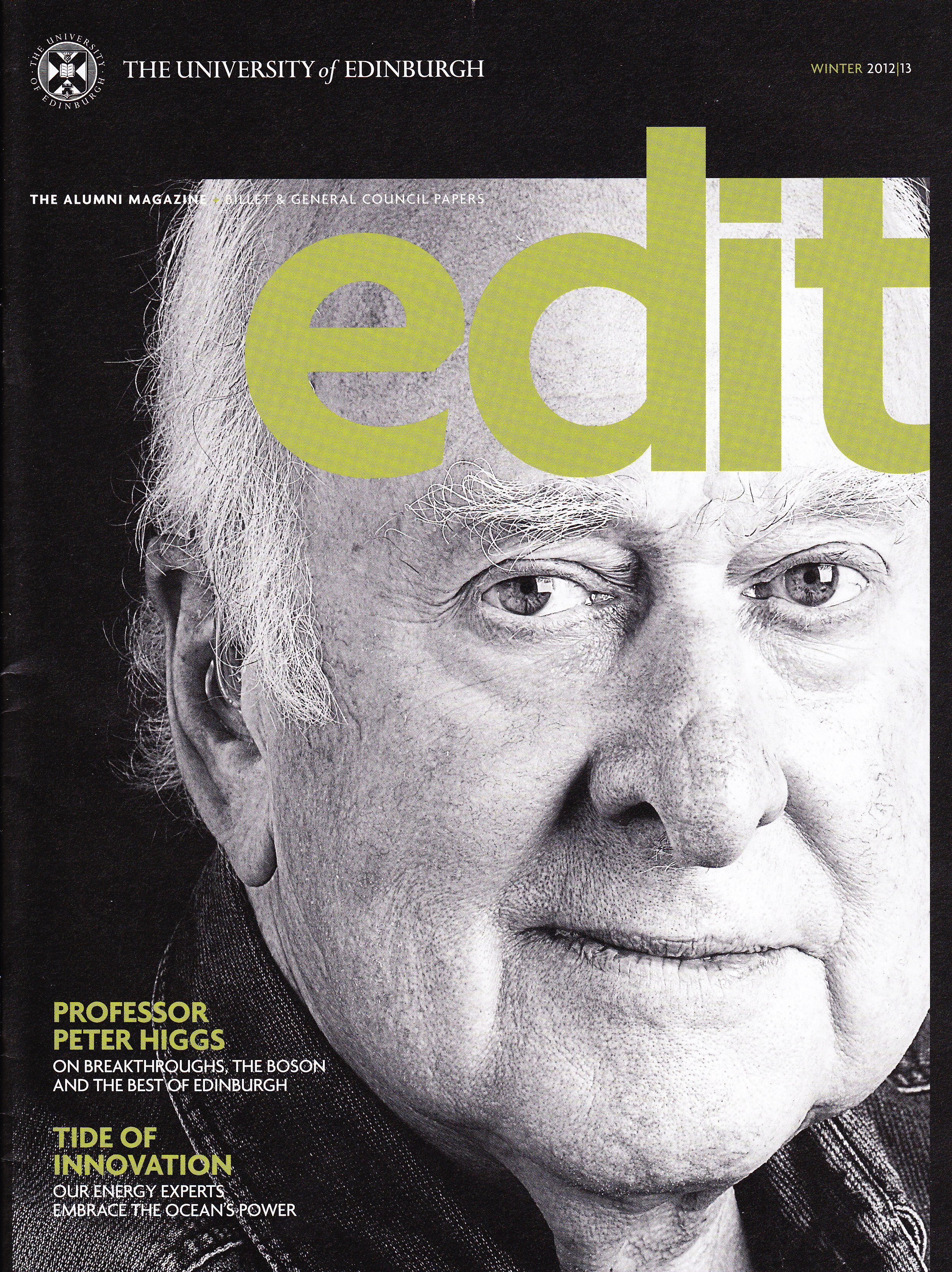
AP Physics. Few words strike terror into high school students like these initials and scientific surname. As a student I didn’t really comprehend AP, and never took any Advanced Placement courses, but I enjoyed physics. It was by far my favorite science class. Even as a Fundamentalist, I saw that here was the explanation for the entire universe, as we knew it. Laws deduced by people far smarter than I could even dream of being could explain everything. But then Heisenberg. And Schrödinger. And quantum mechanics. I remember being taught that nothing was smaller than an atom. (Primarily school teachers in the early ‘60s can easily be forgiven the generality.) Still, on my own I read about protons and neutrons and electrons with wonder. When physics and chemistry brought these to the level of reality, it was like we really understood that each atom was like a solar system and boy didn’t it look intelligently designed! But then we looked closer. Quarks, in a Life-Saver array of juicy flavors, string theory, and the God particle itself, the Higgs boson, coyly showed their elusive faces and physics got weirder and weirder.

Edinburgh does physics (and God) proud

Edinburgh does physics (and God) proud

When my daughter told me about AP Physics recently, I was reacquainted with this world where apparently conscious beings have their choice about reality. The observer bends the results of the quantum experiment. And yes, particles can be two places simultaneously. When a friend pointed me to an article on Quantum Reality in The Waking Times, I was ready to throw open the doors of perception and celebrate life in a universe so strange that the very concept of reality itself is up for grabs. Some physicists now believe the entire physical universe is constructed of energy and that it flashes into and out of existence at a staggering speed that makes me feel a little perpetual-motion sick. Reality is, literally, what we make it.

I have to admit just a little bit of pride on the part of having chosen to study religion here. The more we learn about the quantum world, the more religious it becomes. There will be hard-core reductionists who dispute this, I know. Those who’ve spent any time among the mystics, however, will know what I mean. Back beyond the singularity the laws of physics are so stretched and protracted that even Stephen Hawking can’t sort them all out. And we find ourselves daily living in a world that we help create, on a sub-atomic level. Reality may not be what it seems. I learned this in high school physics. Now that my brain has ossified into patterns that don’t admit much of calculus or accounting any more, I’m beginning to realize that physics is suggesting that reality may be consciously constructed after all. Only this time we’re the gods. And that’s a really weird concept.


Unbelievable Voyage

In Sunday’s paper a story from the Los Angeles Times reported that Voyager 1, now 35 years old (and a technological grandfather, considering how quickly technology develops), is poised to leave the solar system. It is the first mechanical device, at least designed and launched from earth, that will do so. The spacecraft, billions of miles away, sends signals that take 17 hours to reach earth. It is boldly going where no man [sic] has gone before. The vastness of open space was one of the initial challenges to the traditional theology that had developed in an unbroken sequence from the time of the Bible down to the days of Copernicus and Galileo. Nobody was sure what was out there, but certainly Heaven had to be somewhere and God was clearly above us, so, in a marriage of convenience, God reigned in the unexplored sky. Voyager 1 bears a gold-plated plaque that attempts to describe who and where we are. Sent into the neighborhood where God used to live, Voyager was announcing that we were ready for celestial guests.

Many scientists don’t take seriously the idea that we’ve already been visited. The internet, however, has become a great clearinghouse for those intrigued by extraterrestrial life. I found a website this weekend that had located at least three different life-forms in just one of the Mars rover Curiosity’s pictures. We are lonely without heavily denizens. Stephen Hawking famously warned, a couple years back, that if they’re there, they’re probably not friendly. His paradigm, however, was based on earth psychology. Most of us know how far to trust that!

The fact is, we’ve been beaming our existence into space since the invention of the radio. Our electronic signals are, according to physics, pretty close to eternal. Electromagnetic waves just keep going and going, putting all manner of Energizer bunnies to shame. Long before Voyager 1 reaches the cusp of the solar system, our light and sound show has been announcing that this is where the godless party is and has been for over a century. Voyager 1 is far less than a needle in the cosmic haystack. It is more akin to a molecule or an atom. Will it find God out there? I highly doubt it. Nevertheless, when I went out to get the newspaper before dawn this morning, I spent an extra few moments looking at the stars and wondering.


First Byte

The scientific study of religion poses dangers to the native environment. It doesn’t take a specialist to realize that different people respond to different religious stimuli; some like smells and bells and others prefer the stripped-down Puritanical style. Even beyond that some people get their religious thrills from nature, others from meditation, and some from controlled substances. In a story on CNN late last week, it was revealed that some Apple users find worshipping their favored brand a religious experience. A study by British neurologists discovered that the same areas of the brain are stimulated by both thoughts of the deity and Apple gadgets. MRIs have been utilized for many years now to study where the brain “lights up” during intense spiritual states. It seems we now have proof that God is a Mac user.

While some would cite this story as an example of idolatry, others would interpret the results in a more technological way. Our brains resemble motherboards, in some sense. Even Stephen Hawking’s famous interview of last week had the genius saying that human brains are just like computers. (I must confess to siding with Stuart Kauffman (Reinventing the Sacred) on this one—the brain does seem to be more than the sum of its parts.) If our brains are computers, then the Mac question is a literal no-brainer. Having worked in offices where every PC tries to be a Mac knock-off (wake up, folks! Windows is a Mac emulation environment) I too can sense a superior being behind that Apple with Eve’s first byte removed.

Should we attempt to explore where religious impulses originate? As intimated by Newberg, D’Aquili, and Rause (Why God Won’t Go Away), if we are able to find the God centers in our gray-matter and stimulate them electronically, we may trigger religious rapture on demand. How does this artificial stimulation differ from the religious experience brought on by years of meditating, praying, or fasting? Or Apple products? Our brains are complex and only imperfectly understood. Religions have been around long enough for us to get a grip on their origins. Billions of believers worldwide, however, would prefer that other people keep their hands off their Apples.

Original thin?


Stephen Hawking’s Heaven

CNN’s Belief Blog, apparently open to contributions only by “successful” (i.e., university employed) religion scholars, nevertheless occasionally comes up with a thoughtful story. One of yesterday’s posts focuses on the fact that Stephen Hawking says Heaven is a “fairy story.” First of all, I have admit being surprised to see that Hawking is still in Cambridge—I could have sworn he was working in the Princeton public parking garage because it is his voice that comes out of the ticket machine. (Times being what they are for academics, I figured he might have needed a second job.) Ah, but appearances can be deceiving! I have had great respect for Stephen Hawking for many years. My own scientific interests must be relegated to a decidedly lay position among the collegiums of scientists, but Hawking writes books that people like me can (mostly) comprehend. Echoing an idea I stressed earlier—we came to the same conclusion independently—Hawking noted in a recent interview that Heaven is an idea devised to cope with fear.

Cosmologists, such as Hawking, speak with authority on the literal heavens. Ironically, the word “heavens” continues to retain its usefulness, even among scientists, for describing everything that is out there. Humans are assuredly small and our place in the universe is miniscule. In our heads, however, we conceive lofty ideas that seem to place our own consciousness outside the unlimited bounds of this universe. Is it any wonder that we can concoct gods? As deeply as they peer into the cold, dark recesses of outer space, astronomers and cosmologists find no room for Heaven. This cosmic inn, no matter how many aliens there may be, is largely empty.

What I find interesting is that journalists of religion find skepticism among scientists newsworthy. While being a rational thinker, as science demands, does not necessarily forego divine entities, using gods as explanations and having trans-dimensional heavens tucked away behind some far asteroid does somehow devalue the power and majesty of our eternal home. We expect our scientists to be skeptical—we wouldn’t often visit a doctor who sacrificed a goat on every office visit to consult its entrails concerning our health. And yet it is newsworthy when a scientist says in a forthright statement that Heaven does not exist. It would be like an evangelical preacher saying evolution never happened. The biggest miracle of all may be that whether it is Dr. Hawking’s doing or not, I actually manage to find parking in Princeton.

Billions and billions, but no angels with harps...


The Reality of Movies

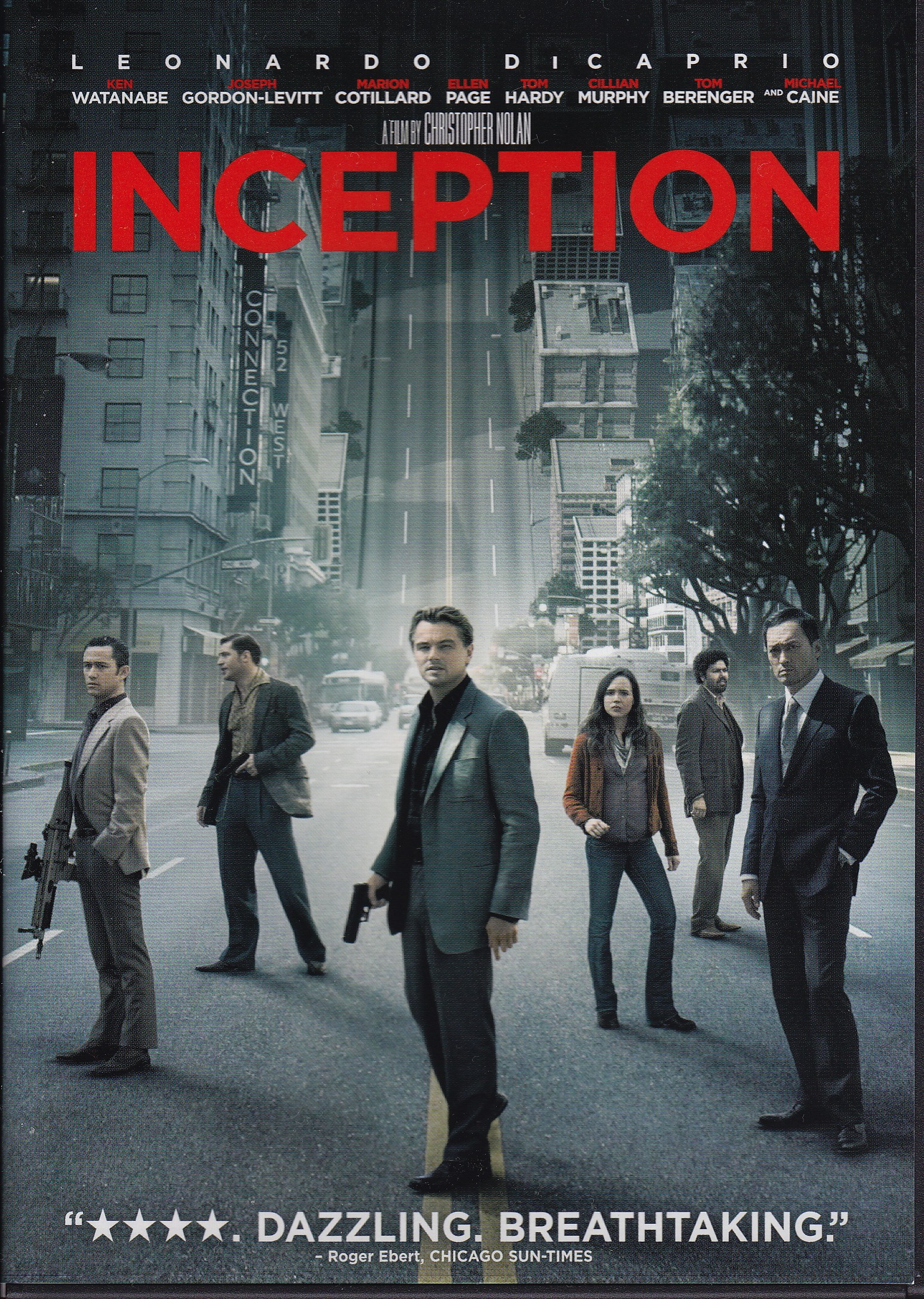
Inception was released on DVD this week, and having a weakness for struggling with reality, I knew I had to see it again. Now, people with a far sturdier grip on life than myself have been blogging about the movie since the summer, writing posts both profound and critical. I wrote an earlier post on the movie, toying with its retelling of the Theseus myth. This time, I am wrestling with the wonderful burden of having a subconscious mind. The crux of the movie is when Cobb has to decide which world is real: Mal’s or his own. The movie, of course, refuses to divulge the answer.

With a finesse that I had previously experienced with the original Matrix movie, Inception ups the ante on what we consider reality. “Reality” is a problematic concept, a bi-product, we are told, of consciousness itself. Reality is generally viewed in exclusive terms, and most of us spend our days in what I learned to denominate “naïve realism,” the concept that what we perceive is pure, unadulterated reality. Perhaps not as Inception or The Matrix, or even eXistenZ would have us believe, scientists today tend to agree that the world is not as it seems. The quantum world has opened up levels of reality undreamt of even by Einstein whose God did not play dice. This is perhaps one of the greatest challenges to traditional religions.

Although many religions gladly point out that there is a mythical reality behind what we experience every day, there is no hard evidence to back up these assertions. This is not the same as declaring they don’t tap into that reality, it is just that we have no final arbiter as to what that reality is. Having been in the business of religion all my life, I am absolutely certain that it isn’t what any fundamentalist group declares it is. They make claims about reality that would leave Jesus scratching his halo-encircled head. Is it Cobb’s, Neo’s, or Allegra’s reality or is it Hawking’s, Witten’s, or Greene’s? I simply don’t know. I just put the disc in an press the play button.


10 Questions

This week’s Time magazine’s 10 Questions feature is directed to Stephen Hawking. Predictably, the first one concerns God. “If God doesn’t exist, why did the concept of his existence become almost universal?” a reader asks. I was less concerned with the answer than with the implications of the question itself. The very question represents a paradigm shift. Time was, such questions were directed to local clergy. The minister had the answers. To be sure, many millions, if not billions, of people regularly rely on their clergy for divine guidance. I used to teach clergy, so I am wary. Today, however, we need to know if all the answers fit. To find out if God exists, ask a scientist.

Theologians have earned their reputation as inscrutable doyens of the unspeakable. I have been involved in higher education in the field of religion for nearly twenty years and when I read theologians I am left scratching my head and asking “what?” Erudite to the point of being obtuse, the issues and methods of theologians address the unknowable. Much of it is idle speculation. The specialists, however, must earn their keep. Deans are impressed by what they can’t understand. God himself, I’m sure, wonders what some of it means. Is it any wonder that the average citizen would rather ask Dr. Hawking than ask some obscure theologian?

Religion and science are bound to bump at the borders like the parallel universes of string theory. Both are concerned with explaining things. Science has a proven track record of presenting verifiable results while theology has produced a poke full of intangibles. I am the first to admit to being a working-class Joe who has no special knowledge. What I’ve learned has come from the many classes I’ve endured and the books I’ve read. As far as I can tell, none of it comes directly from God. In my mind’s eye I reverse the situation. I see a popular theologian, take your pick (I have trouble conjuring the moniker of a household-name theologian), being featured in 10 Questions and the first query being, “What is M-Theory?” I can imagine the convoluted answer.


Talking Past Each Other

My first two sections of Mythology class met yesterday, and my post on Stephen Hawking was still fresh in my mind. As predictable as clockwork, religious leaders have begun to respond the Hawking’s new book, not yet released. Theodicy in overdrive.

I am not qualified to assess Hawking’s scientific findings. As much as I daydream about having followed my childhood ambition to be a scientist, I find myself in religionist garb teaching university courses among the humanities. What is ironic is that theologians feel that they have to answer Hawking’s conclusions. An article on CNN has the rebuffs of a number of British clerics, including the Archbishop of Canterbury. The main thrust of their comments is that the God Hawking dismisses had already left the theological classroom (the God-of-the-gaps) while the God the major monotheistic religions serve is less of an explanation of the universe and more of a method of determining what it means. So, I guess, this God of meaning may or may not have created the universe, but let God be God and mathematics and physics be damned.

Unless the theologians are better trained than most, the intricacies of M-theory are far too complex to be understood by workaday religious practitioners. The theory is backed by mathematical formulas that are far more frightening than Tiamat, Ahriman, and Azazel bunched up in a cosmic tag-team match against the nice world theologians have created. For my part, I am happy to let the physicists deal with the numbers and symbol systems while I sit by trying to explain what mythology really is to my undergraduate audiences.

Who's looking down today? Uncle Earl?


God of the Gaps = Poof!

In Stephen Hawking’s new book, The Grand Design, according to MSNBC, he declares that God is not necessary, physically speaking, to get the universe going. The only people who should be surprised here are those who took Hawking’s final lines from A Brief History of Time too literally: “However, if we do discover a complete theory, it should in time be understandable in broad principle by everyone, not just a few scientists. Then we shall all, philosophers, scientists, and just ordinary people, be able to take part in the discussion of the question of why it is that we and the universe exist. If we find the answer to that, it would be the ultimate triumph of human reason – for then we would know the mind of God.” I remember being a bit surprised when I read that the first time.

Whose eyes are watching you?

At some level, it seems, many people took comfort in knowing that one of the greatest scientific minds alive had left a door open for God. The great cosmologist looking through a theoretical telescope and seeing God on the other end looking back. There was a symmetry here, a sense of rightness. Some, to gauge by the reactions reported, feel that Dr. Hawking has betrayed us in stating the obvious. God was never to be found in the petri dish or under the electron microscope. According to the theorists of a theological stripe, God has no quantifiable qualities that might be measured. As the article states, the only God to disappear here was the God-of-the-gaps.

As a young, undergraduate religion major, when I first heard that God-of-the-gaps was bad philosophy/theology, I was a bit surprised. (I spend a lot of time being surprised.) If God has no explanatory value in the real world, whence deity at all? If religious folks behaved better, there might well be cause to suggest that the evidence for God comes in human kindness and charity. Unfortunately, religious folk quite often instigate the hatred and suffering that scars much of human society. No, Stephen Hawking has not killed God, just as Friedrich Nietzsche did not commit deicide in the nineteenth century. If the God-of-the-gaps is gone, nothing of value has been lost. The minds of theological thinkers will only have to be stretched just a bit farther.


Old Father Hubble

“Space. The final frontier.” So I grew up hearing as Captain Kirk and Mr. Spock raced through the galaxy and plucky Will Robinson explored the cosmos with Robot despite the machinations of Dr. Zachary Smith. In Seattle a few years back I visited Paul Allen’s Science Fiction Museum and as I stood before the original Enterprise console and viewed Robot in person, it was almost a personal epiphany. This was my childhood all in one room.

Experience Music Project and Science Fiction Museum, courtesy Gnu

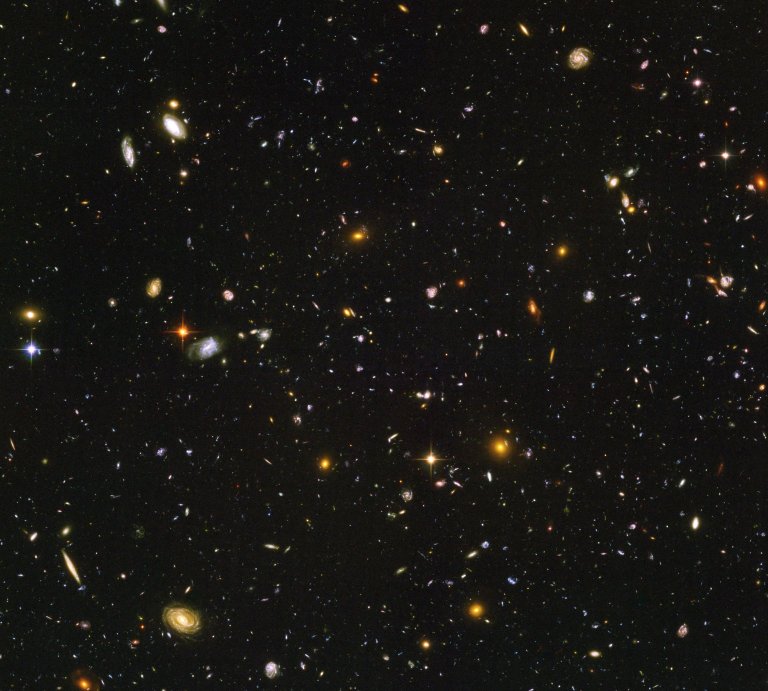
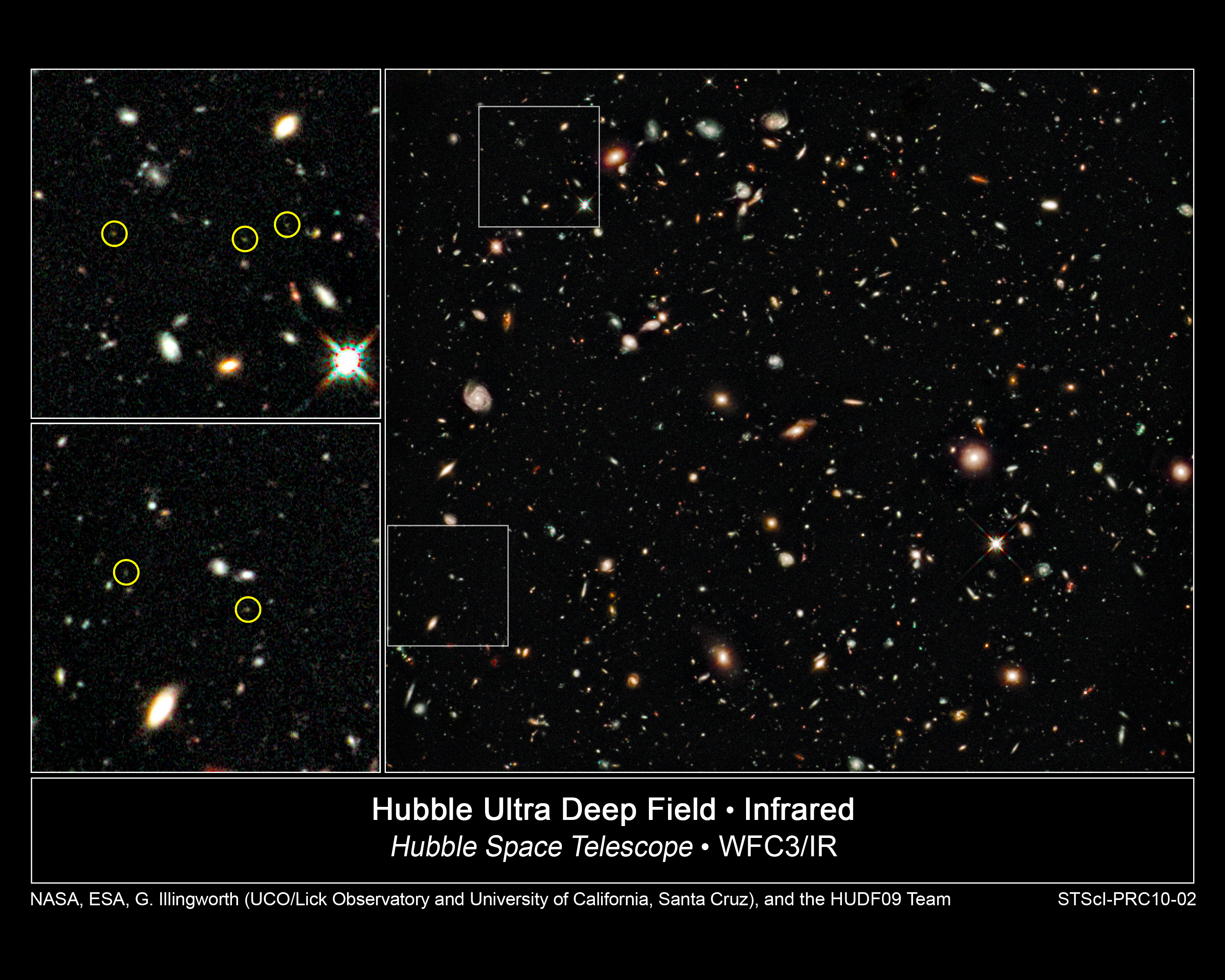
NASA has just announced the release of more deep space images snapped by the new and improved Hubble Space Telescope. These images show objects, galaxies, back to a mere 600 million years after the Big Bang. Look any further back and you’re liable to find yourself staring God right in the eye! These incredibly ancient images are humbling to a scholar of ancient times. In the cosmic calendar Sumer isn’t even on the map. And now we can see back almost to the Big Bang itself. It is another kind of epiphany.

Here's lookin' at you, kids - Hubble's new view

Cosmology is inherently religious. Even Stephen Hawking leaves room for the unknown, “religious” entity in his popular writing. As the infinitesimal biological apex of evolution on our own planet, we are somewhat less than cosmic dust on the grand scale. When we reach out to that cold blackness of outer space metaphors fail us until we fall back on God language. I look forward to the day when the Big Bang is captured on film (or digitally). I am almost certain that when that happens science will become far stranger than fiction.