On a Wager and a Prayer

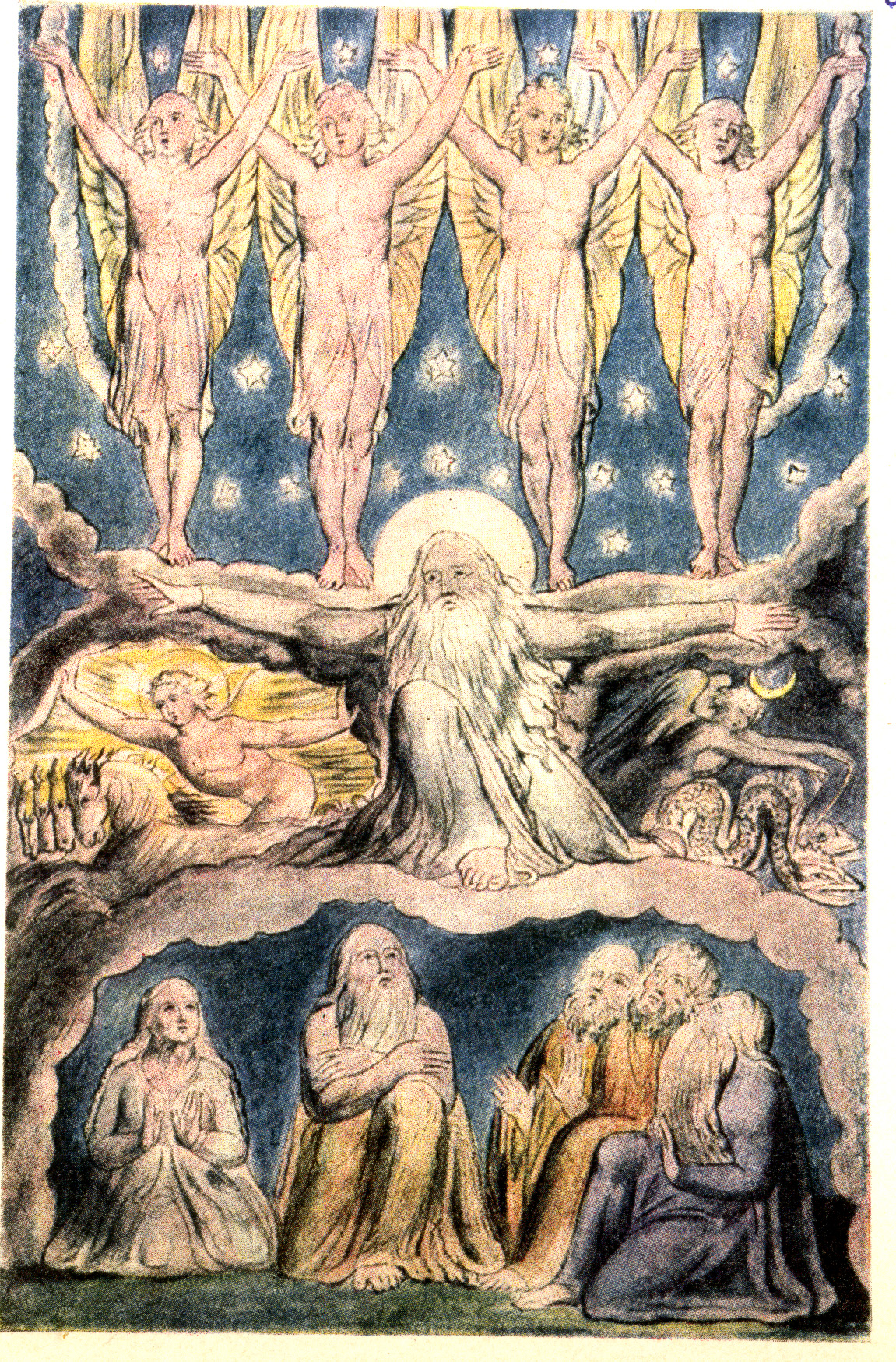
I’ve been thinking about Job a lot lately. Not my job, but the biblical book. Way back when I was preparing my initial classnotes on Job, I remember a commentator—I forget who—stating, as commentators are wont to do, that people have strong reactions to Job. Either they love it or they hate it. I have enough imagination to consider some people being somewhat ambivalent about it, but I have observed many people over the years revealing powerful reactions to this Wisdom book. One of the reasons, I suspect, is that God doesn’t come off looking particularly good in this story. This was recently reintroduced to my awareness in Steven Cahn’s God, Reason and Religion. The reader, unlike Job, knows the real reason for Job’s suffering. It was a divine wager, instigated by God, that Job would not curse him even if allowed GBH by the Satan. We know, however, and we are culpable for that knowledge. It puts a burden on the reader.
BlakesJob

When God does explain to Job why he shouldn’t question God’s acts, as Cahn points out, the answer rings hollow in the knowledge of the truth. God can’t admit to Job that he was playing fast and easy with his health and the death of his ten righteous children. A roll of the dice and Job is vulture-bait. The book of Job should make us squirm. We base our morality, we are often told, on the ideals of the Bible. If we were Job, who ends the book never knowing about the bet, we might be content. But the author, with a sly wink to those who face life squarely, points out that this is all a charade to justify God’s confidence in one of his many carroms. I suppose that might be small comfort to the pawns.

For Job there is no answer given to why he suffers. He doesn’t even really ask why—God’s right on that count, Job is very good. Yet the reader is not so lucky. How can we gain any comfort knowing that God sometimes lays us on that altar, not for any just cause, but as a wager against the divine prosecutor? No, the Satan in Job is not the Devil. He too is a divine character, an attorney borrowed from Zoroastrian mythology. He’s just doing his job. His Job. He is present to make us feel our guilt. And if Job, who the Bible itself says is perfect, can barely restrain his soul from cursing, how much of a chance do the rest of us have? There are many who hate the book of Job. I am not one of them. A more honest book I have a difficult time imagining. If it comes to justice in this world, however, I wouldn’t bet on it.

Rational Religion

GodReasonReligionGod, Reason and Religion, the title of Steven M. Cahn’s book, fit uneasily together. Or so it would seem. Cahn, a philosophy professor, collected together in this little book a set of sixteen short, provocative essays keyed to major topics of the philosophy of religion. I’m always skeptical when I see Reason and Religion together on a book cover. It seems like an unholy plotting is going on. Perhaps it’s because those of us who study religion are often classed together with those who use slipshod techniques to “study” a subject they’ve already made up their minds about. Any scientist who’s seriously tried to learn Akkadian might have to reevaluate that premise. Happily, Cahn is not trying to promote such an idea. He states in the introduction, “My conclusions may be surprising, for although I am not a traditional theist, I find much to admire in a religious life, so long as its beliefs and practices do not violate the methods and results of scientific inquiry.” For books with Reason and Religion on the cover, that can be quite a concession.

One of the biggest faults of religions is their lack of introspection. That is a gross generalization, I know, but there is truth in it. Most religions have been severely challenged by the empirical method. Reason, it turns out, can explain most of what required one—or a multitude of—god(s) to accomplish. At the same time, religion makes people feel secure and happy. My experience of science has often been enlightening, but decidedly prickly. I’m sure I’m not the only one. Nevertheless, Cahn takes the reader through a maze of ways to think about religions from different angles. What is the tie between religion and ethics? How do we tell a good deity from a bad one? What is faith and is it a safe bet? Do miracles happen? These kinds of questions, when viewed rationally, don’t always have the dreadful results so often feared. So maybe the laws of physics aren’t violated, but that doesn’t mean you have to stop praying. Did I mention that Cahn makes concessions?

We are the cultural children of our logical, Greek forebears. They taught us to trust our reason and we’ve developed that to a high skill. Yet reason has its limits. Consider the Republican Party, for instance. Or Snooki. In life not everything adds up. Facing their final moments, few have the fortitude to keep their thoughts purely on the rational. What lies beyond we just don’t know. Science has no way of answering. So Reason and Religion should get along. There may be more than one way of knowing, and some things in our world may bridge that deep gulf between Reason and Religion. That bridge may sometimes be difficult to find. If you decide to seek it out, however, I would recommend taking Cahn along for some good reading. Even the most serious search must offer some concessions.