Stinging Days

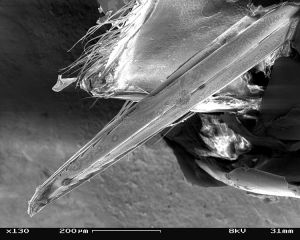
It doesn’t take much to encourage wasps.  Even after a few unseasonably cold weeks in autumn, one warm day will bring them back, poking along the siding looking for a nesting place.  My most recent stinging incident occurred in October.  It’s fitting, then, I suppose, that to try to keep awake late one October weekend afternoon that I watched The Wasp Woman.  These creature features were what I grew up with, and this was a Roger Corman brief film from 1959.  In fact, it was so brief that eleven minutes had to be added to make it a stand-alone television release.  It was originally part of a theatrical double feature.  Finding out about added time explained why Dr. Zinthrop’s accent changed from the first eleven minutes to the rest of the film.
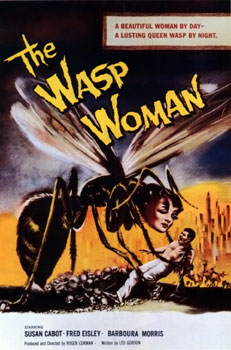
Women have the same right as men to be made into monsters, of course, but there’s a poignancy to this storyline.  Janice Starlin is the owner of a cosmetics company but profits have been declining since she’s showing signs of aging.  Her customers want a younger looking woman providing their beauty products.  As is to be expected for a movie from the fifties, it’s a pretty sexist storyline.  Still, through the plodding plot the viewer can’t help but to feel for Ms. Starlin.  So when Zinthrop shows up with an extract made from wasp royal jelly (a secretion that actually comes from honey bees) that reverses aging who can blame her for trying it?  Of course it turns her into a giant wasp woman.

These kinds of mad scientist movies with their inevitable results perhaps injected a sense of caution into those of us who grew up watching them.  They weren’t great works of art, but that doesn’t mean they didn’t have something to say.  What I heard, watching this one, was that women exploited for beauty products suffer from natural aging processes.  And any formula that reverses aging come with its own set of problems.  The only other scary part of the film was when employees have to get to the upper floors to prevent Starlin from killing people, they have to wait for the elevator.  Their sense of frustration, although funny, is nevertheless a reality of working in a high-rise.  These movies from the late fifties seem to me to be a cry for help.  The sexist, button-down, white shirt world isn’t all it’s advertised as being.  Mad scientists are needed to help us cope.  Or at least stay awake on a sleepy October weekend afternoon.


Insect Inside

It seems a shame we don’t have an accurate name to classify all of them.  Insects, arachnids, and arthropods, I mean.  Those creatures smaller than us that inspire fear.  I suspect I’m not alone in experiencing a profound ill-at-easiness for some time after a close encounter with various of these small creatures.  Some experiences can be sublime, such as the other day when praying mantis on the glass of our front door provided a wonderful opportunity to look at a marvel from a seldom seen angle.  More often, however, the response is one of terror at being outnumbered, out-gunned, or out-run.  Spiders can be speedy as well as scary and I often yield the floor to them.  If I’ve got an empty peanut butter jar handy I try to catch and release, but I’ll look with worry at the spot of the encounter for days.

Photo by Rosie Kerr on Unsplash

Or the flying, stinging things.  Mostly they’re good for the environment and I don’t like to kill anything.  The other day, however, while returning the recycling bin to the garage I failed to notice paper wasps had built a nest (in just a day, since I’d taken the bin out only the afternoon before) above the door.  They were offended that I’d invaded their space—their concept of time is completely off from that of creatures that tend to live decades and want to stay in the same location for years at a time—and decided to attack.  This was a new stinging experience for me.  One flew down and stung my face then quicker than lightning landed on my right hand and bit again.  Its poison burned, I can tell you.  I’ve had run-ins with lots of stinging things in my time, but the shock probably added to the hurt.  I couldn’t even get the garage door shut, as previously mentioned.  

The next morning I awoke unsettled.  Houses have cracks and crevices.  They settle over time and critters can find their way in.  I understand.  Everyone needs a home.  But opening a door and being unexpectedly attacked hardly seems fair to me.  I hadn’t even seen the nest.  It’s easy to forget, in this virtual world of pandemic proportions, that we share the planet with a wide variety of others.  The large predators are mostly gone.  The countless small ones are still here, however, and many of them enjoy the way we’ve warmed the place up for them.  I have a feeling that when we finally outlive our welcome on our home, the insects, arachnids, and arthropods will be glad to stick around.


Buzzy Headed

If you’re like me, and I sincerely hope you’re not, you spent your childhood worrying about killer bees.  You see, I was stung a lot as a child, having stepped on a yellow-jacket nest hidden in an old tree stump.  That event was one of the most formative of my life.  Oh, I act brave, shooing wasps and carpenter bees away, but that’s all a front.  I was repairing a piece of furniture out in the garage over the weekend and a big old bee got in and started buzzing around.  It drove me to distraction.  I once had a bee land on my back and sting me for no apparent reason.  Alone in the garage I had no one to watch my back.  I decided to do some repairs back in the house instead.  Let it have the garage.

During this pandemic, then, the last thing I needed to hear was that “murder hornets” have made it to the United States.  And Republicans are bad enough!  The murder hornet is responsible for double-digit deaths in its native land, and now my childhood nightmares of killer bees have reemerged.  We had a warming trend over the weekend.  There were so many wasps and bees around outside that I could even hear their buzzing with the windows safely closed.  Insects are the future, of course.  They adapt better and more quickly than we do, and there are many, many more of them.  The Bible often uses insects as vehicles of divine wrath.  No wonder horror movies often make use of them!

Image credit: SecretDisc, via Wikimedia Commons

More rational minds soothe us, saying that murder hornets seldom attack people or pets.  If provoked, however, they can do so fatally.  Perhaps it’s the anger of stinging insects that bothers me the most.  The yellow-jackets that attacked me certainly seemed angry.  My stepping on their home was an innocent accident.  It was also a learning experience.  I don’t step on old stumps any more.  I haven’t since the incident.  Such early traumas can stay with you all your life, and the buzzing co-inhabitants of the earth, I have to remind myself, have as much right to be here as we do.  In cases like killer bees, we invented them.  When we play Doctor Frankenstein nature responds in kind.  The monster was angry.  Bees, wasps, and hornets may be intelligent but they can’t reason out the motives of bumbling humans who accidentally disturb them.  And now a bigger variety has moved in.  It’s probably best to keep calm and not get anybody angry.