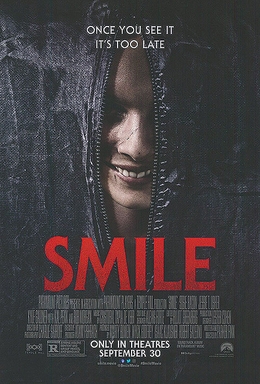
For the Camera

Smile 2 is getting some good critical notice and I hadn’t seen Smile (1) yet.  Psychological horror often bothers me, but I figured I’d grin and bear it.  I’m glad I did.  The ideas in the film, which participates in “the stigma trope,” are disturbing because it’s unclear if Rose (the protagonist) is mentally ill or not.  The stigma trope posits that something has infected someone either by having seen something they shouldn’t (as in Ringu) or by physical contagion (It Follows) and the victim can’t shake it.  Smile may trigger viewers with suicidal phobias since the premise is that an entity feeding on trauma passes from person to person by having the new victim witness the previous victim’s suicide.  Rose is a therapist who hasn’t gotten over the trauma of her mother’s death.  Rose witnesses a patient die by suicide, and who smiles just before she does it.

The patient told Rose that she’d watched one of her professors die by suicide.  Rose subsequently learns that the professor also witnessed a suicide and so on and so on.  Each prior victim had watched someone else die.  Now Rose has to figure out how to break the cycle, otherwise she’ll perpetuate it.  The idea of inadvertently obtaining a “sticky” entity is pretty scary, and a very human concern.  One of the more frightening aspects of possession movies is the belief that now that demons know that you know, they will target you.  Interestingly, what makes this film provocative is that the victim has to have suffered trauma before.  As such, it is a study of trauma and its lasting effects.  I suspect most people don’t intentionally traumatize others (world leaders excepted).  Trauma can be dealt with (or not) in very different ways.

Smile did quite well at the box office.  I suspect there are a lot of us traumatized people around.  Capitalism encourages traumatizing others through slow violence, if not the more obvious quick way.  People don’t easily walk away from events that scarred them, particularly if they happened at an early age.  Such people, if experience is anything to go by, find themselves in vulnerable positions in life and rather thoughtless people, often for religious reasons, end up traumatizing them even further.  I have to admit that there were triggers for me in Smile.  I still struggle with a few of my own traumas that were never resolved.  Like Rose, I sometimes don’t know who can really be trusted with such things.  This is a perceptive movie.  I guess now I can put on a happy face and see Smile 2.  But first I’d better talk to my therapist.


Religious Melancholy

DamnedNationI’d never come across the term “religious melancholics” before, but somehow it seemed to suit me. Perhaps that goes without saying as I’m reading Damned Nation, by Kathryn Gin Lum. While sitting on a bus. We’re sitting in traffic and the guy sitting next to me has obviously just finished a cigarette before climbing aboard. Having grown up as the victim of second-hand smoke for my first two decades in life, I’m thinking about Hell as well as reading about it. You see, Gin Lum’s descriptive subtitle is Hell in America from the Revolution to Reconstruction. The fact that Hell’s alive and well, despite some evangelicals’ attempts at annihilating it, suggests that it’s best to keep informed on the topic. This book’s mostly historical, however, reporting how Americans interpreted Hell in the eighteenth and nineteenth centuries.

As with most histories, I find the earliest material the most interesting. Gin Lum tends to focus, naturally, on preachers at this period since they are the ones most likely to talk about eternity. The thing that struck me the most was the number of people she describes who, after contemplating (a primarily Calvinist vision of) Hell, attempted suicide. I tend to think of suicide as a contemporary problem, but obviously it has been a steady human practice since our species first learned that you don’t have to wait for someone else to help you slough off this mortal coil. It is troubling, however, that it was a “doctrine” barely found in the Bible that led people—most of whom later became preachers—to try to kill themselves. It also seemed a touch odd that evangelicals in those earlier days of our nation didn’t find it troubling that those leading the flock had almost sent themselves to perdition. These early days of literal Hell believing were most interesting indeed.

The phrase “religious melancholics” comes from the resistance. There were those—generally skeptics, doctors, psychologists, and the like—who felt that the preaching of hellfire and brimstone took a toll on the healthy psyche, particularly of the young. As one of those who grew up attending revivals where Hell was a featured guest, I know that my life has been a prolonged attempt to avoid said eternal lake of fire. Even when I rationally learned that there is no three-tiered universe in which it still fit, and that the idea was cobbled together from a variety of religions into the ultimate scary place, Hell still manages to haunt me. Does it keep me moral? I don’t suppose that to be the case, since I have tended to believe people are basically good. Don’t bother trying to convince me logically that Hell doesn’t physically exist. I know that already. It’s the mental one that I’m trying to avoid. And that can be a full-time job for a religious melancholic brought up on a diet of overcooked theology.


De Profundis

IMG_1591In a grocery store last week a friend pointed out how many magazines had pictures of Robin Williams on the cover. Although his suicide two months ago was tragic, I wonder about the message we send to young people (and maybe some older ones as well) about this fixation. As we probe, attempting to understand the sad clown (and they generally all are), are we inadvertently telling our kids that suicide will make you an icon? We often hear accusations that extremist Muslims “brainwash” their youth into thinking that a righteous suicide will lead to glory. Perhaps the glory we perceive is somewhat different here in the post-Christian west than it is in the post-Christian east, yet I wonder what the essential difference really is. Why can’t we see that the cult of celebrity seldom ends well? The worship of the successful does not really grant them eternal life, as much as we may think otherwise.

Call me a curmudgeon—I probably deserve that—but when I overhear office mates in their cubicles or young people on campuses talking about stars I feel not a little like Rip van Winkle. Most of the names I do not recognize, and even showing me a picture doesn’t really help. Of course, I enjoy movies as much as the next dinosaur, but apart from the bargain bin and the occasional indulgence in Amazon Prime I really can’t much afford them anymore. I walk into a bookstore (where they can still be found) and the authors I want to read are not on the shelves. They are gone and all but forgotten. Many of them having left profound ideas in their wake. I guess I could pick up a magazine. Robin Williams looks happy on the cover.

I used to watch some late-night television before my job required waking between three and four a.m. One of the things I quickly noticed is that those stars our society worships had little of substance to say. That’s not to say all actors and media darlings are shallow, but I often wondered why their interviews always seemed to come down to the lowest common denominators. Have we lost our interest in probing beneath the surface? Isn’t there some profundity left to explore? Don’t get me wrong—I find Robin Williams’s death a tragedy. He may have been a deep and philosophical man. Who really knew him? Nevertheless, I wonder if perhaps, if we challenged ourselves a bit more, we might just consider the messages that our media broadcast. After all, they have to turn a profit. Do we really mean what our magazine covers seem to imply?


A Run-By Fruiting

Photo credit: Eva Rinaldi, Wikimedia Common

Photo credit: Eva Rinaldi, Wikimedia Common

I’ve never been enticed by the cult of celebrity. Becoming famous is frequently a matter of being in the right place at the right time to get noticed. Interviews with stars inevitably come across as lacking in substance. Some of the funniest people I’ve known have worked in camera shops, administrative offices, and IT departments. Still, the suicide of Robin Williams a week ago has impacted a wide swath of the nation. We hate to see a funny man die. It is such a truism as to be trite that those who are clowns often host inner demons. Laughter, Reader’s Digest proclaims monthly, is the best medicine. Who better to heal than those who know what it’s like to have been wounded? Yet we want the funny to keep on making us laugh until we move on to the next diversion.

For this past week I’ve been pondering how one man’s tragic death has jolted a nation into a reflective moment of silence. I can’t say I was Robin Williams’ biggest fan, but I’d seen a number of his movies, and I was devoted to Mork and Mindy growing up (aliens have a way of getting prime-time exposure that has never really been explained). I thought he was good at what he did. He was famous and had money, but it wasn’t enough to buy off the demons. Suicides hit me hard since I’ve known a few and have struggled with depression myself. There are times, truth be told, when no direction is up. It is at those times, however, that others tend to ignore you, lest you bring them down. People like to laugh.

There is something profoundly religious about the idea of a wounded healer. Anthropologists as well as theologians have noticed it. They need have only looked as far as the Bible to find examples. Yet the Christian tradition treats suicide as a great sin against God and the plan is that we all live to die either at the hands of nature or of someone else, so the guilt doesn’t cling to us. Death always leads to a remorse that entails such guilt. And yet it is inevitable. As a nation we are used to seeing comedians overdose or live reckless lives that end tragically. Deliberate action, however, feels the most horrendous of all. We’ll ask “why?” for a while, and we’ll make tributes and tearful speeches. And meanwhile some of the funniest people we can claim will be sweeping our floors or asking “would you like fries with that?”