
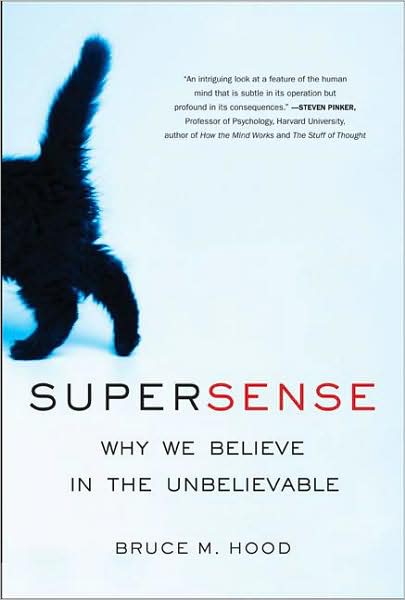
 As not infrequently happens, I take my reading cues from others. In general I am reading half a dozen books at any one time, so when I finish one I cast around for something of a similar genre. One book that I just finished I learned about from my cyber-friend Sabio Lantz’ Triangulations blog – Bruce M. Hood’s Supersense: Why We Believe in the Unbelievable. Hood is a respected psychology professor, and his writing style is engaging. The book itself, while fascinating in its ability to offer an overarching theory to explain why people believe in the supernatural, is deeply disturbing. I grew up in a family where the supernatural was taken for granted. Many of Hood’s explanations are cogent and logical, but that was not what I found to be distressing.
The overall premise of the book is that if science cannot measure a phenomenon, it is “super”-natural. If it exists in nature, science can define it. To me this seems far too limiting. It assumes that science has already probed the infinite aspects of an infinite universe. Yes, we understand (to a degree) matter. We have discovered the sub-atomic world with its quarks and other tiny bits. We understand a great deal about energy as well. Could there not be, however, an entirely natural aspect of either matter or (more likely) energy that science has not yet learned to measure? And could not this aspect be a piece of the larger universe that we inhabit? In other words, when all that is not defined by science is “supernatural” then we have already decided on the limits of our world.
From a psychological viewpoint, I find Hood’s analysis quite agreeable. The human psyche does have a need to find the supersense in the world. We do look for irrational causes. Not all unexplained phenomena are supernatural, however. It is a semantic trap. If we define “supernatural” as anything outside of current understanding, then his thesis stands. If, however, we define “supernatural” as that which violates physical laws not as they are currently understood but as they actually are, then who is to say whether there is anything supernatural at all? “Unexplained” and “supernatural” are not the same thing. Such a distinction would not be troubling were it not for the fact that Hood defines “reality” (another problematic concept) only in terms of “scientifically known.” If it has not been measured by science, a phenomenon is not real since our physical brains (measured by science) are the filters through which we experience the world. There is no room for what has not yet been found.
Far more distressing than that is his assertion that freedom is an illusion. One of the most distasteful theological travesties ever is the concept of predestination. The idea that a loving God would create most people to suffer eternal torment simply to fulfill his own arbitrary assignment of justice is something for which Presbyterianism can never be forgiven. It is about the most immoral God that can be imagined. The same goes for the psychological premise that we must react according to our biology. I found myself wondering why Hood wrote the book at all, if life is all predetermined. What if he had chosen not to write it, or to write it differently? You could argue that this too was predetermined, but does this not simply justify the income and fame of those who are “important people”? It runs a true danger of being terribly bourgeois, if not downright supportive of eugenics. Not that Hood would advocate such an action, but any time predetermination is raised, it presents the grandest of excuses for the most heinous of behaviors. Even the psychological observations that support it may have been misunderstood. Of course, if you disagree with me, don’t blame me; it was predestined that I should write this.
That having been said, I found Supersense overall to be a wonderfully fascinating book. At points Hood’s argument seems to consist of the post hoc, ergo propter hoc fallacy he rejects as unscientific, but if this can be irrationally forgiven, there is much useful material to be gleaned from this book.
 Steve A. Wiggins