
Sutton Courtenay lies sleepily outside the bustling business complex known as Milton Park. Over my work time at Routledge in the United Kingdom, I have been immersed in the frenetic world of academic publishing. Putting a book together and selling it may seem a simple prospect, but in reality it involves many people at multiple stages who specialize in everything from writing content to ensuring that the four-color print of the cover looks just right. Sometimes working in publishing one can get so close to the trees that the forest really does become invisible. So it was that a friend of mine took me to Sutton Courtenay over lunch one day. The hamlet was very quiet. Next to the clattering pub—the only real sign of life here in midday—stood the gateway to an abbey long decayed to dust. Iconic thatched roofs and brilliant grassy greens make this place seem very far indeed from the negotiations and dealing that take place just down the road in Milton Park.
In a silent cemetery dotted with yew trees just behind the twelfth-century Norman All Saints’ church, rest a couple of very influential people. Lord Asquith, sometime Prime Minister, holds the most prominent place. A few paces away in an unassuming grave are the remains of Eric Arthur Blair. Unless you knew his penname, you wouldn’t be aware that you were in the presence of George Orwell. Orwell never lived in Sutton Courtenay. When he died in 1950, requesting to be buried nearest where he died, there was no room in the interment grounds. Millions of people live in London and millions have died there. The image conjured in the mind is distinctly Orwellian. Sonia Brownell, his widow, with the help of David Astor, found a resting place in Sutton Courtenay.
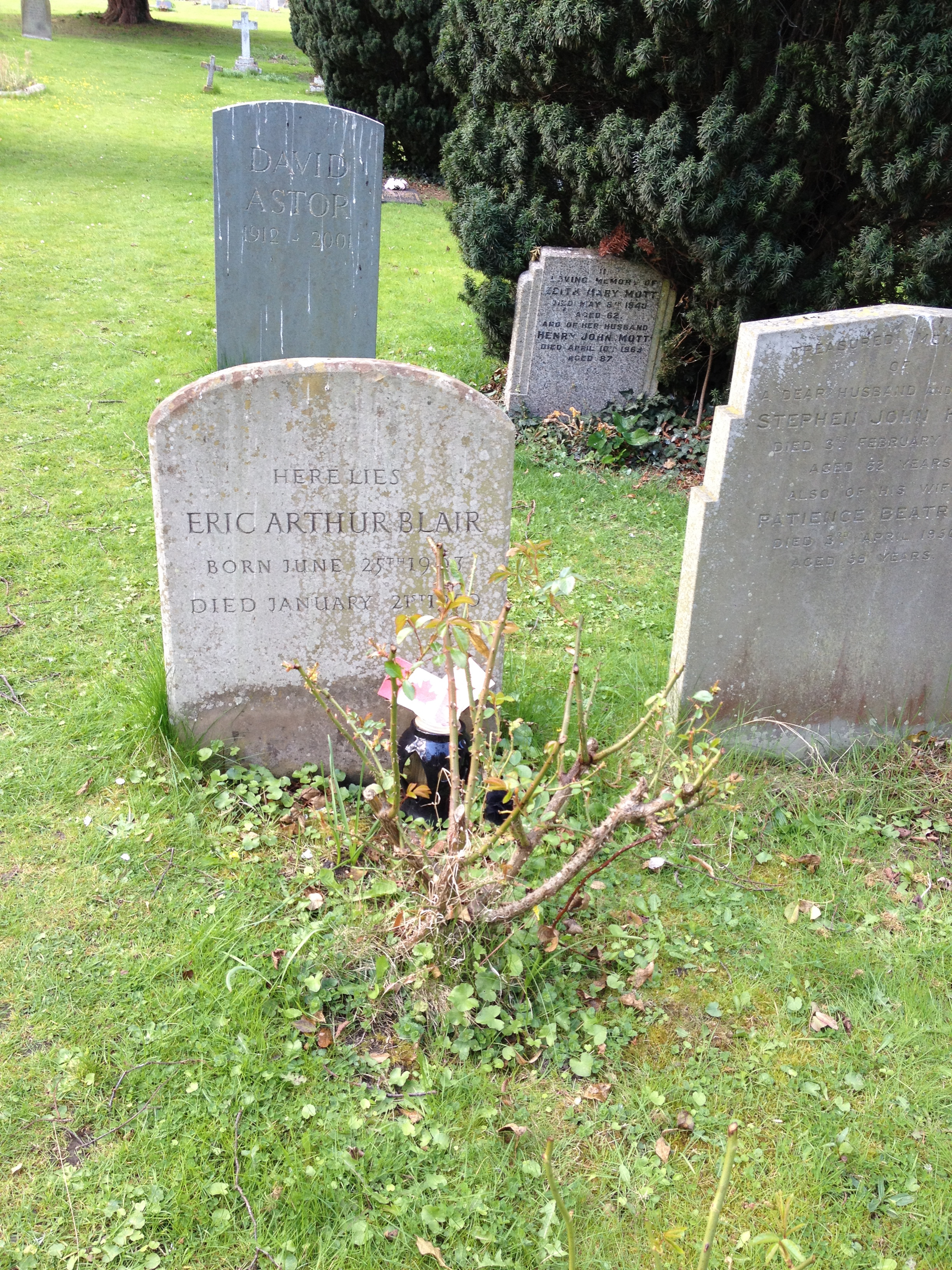
Today one would be hard-pressed to find a school child in Britain or the United States who has not been assigned to read one or both of Orwell’s prescient novels. Orwell’s anti-fascist views were often eerily prophetic. In 1949 1984 seemed a long way off. As the latter year came and went, some heaved a sigh of relief that Big Brother never arrived. Those who labor away in busy office parks, those who attempt to board a commercial airliner, those who live in cardboard boxes on busy city streets, and those who pay taxes so that the wealthy won’t have to, however, know that Big Brother is indeed alive. He has grown crafty with age and is well adapted to camouflage. He is known by many names: Free Market, Laissea Faire, Unrestrained Capitalism. One place he is not to be found is in a quiet churchyard in Sutton Courtenay contemplating a simple stone to a man named Eric Arthur Blair.
 Steve A. Wiggins