No Go Subjects

The problem with being eclectic is that you never catch up with everything.  Although I was once a professor of Hebrew Bible—not technically the field in which I’d studied—I read (both past and present tenses) widely.  Anyone who’s brave enough to follow this blog for any length of time must know that.  I tend to think the element that ties them all together is religion, or a curiosity about religion.  I have read material on science, art, psychology, history, geology, astronomy, literary theory, mythology, the paranormal, religious traditions, monster theory, to name just a few.  Because of my interests across standard disciplinary lines, I often wonder about “no go” subjects.  No go subjects are interests that will likely ruin your prospects of getting either a job or basic human respect.  Although the government is taking serious interest in the topic, one of those subjects is UFOs.

For historians of religion such as myself, the study of UFO religions is sometimes acceptable.  Indeed, there is a correlation between some evangelical sects and the UFO phenomenon.  I experienced that firsthand as a child when my mother drove us to a church meeting where a guest preacher was discussing UFOs and God.  I have only the vaguest recollections of that event in my then young mind, but it did leave me with the question of why respectable people aren’t allowed to look at certain subjects.  Why does taboo even exist in an academic setting?  I recently ran across David Halperin’s website.  I’d known of him because his recent book, Intimate Alien, had gotten a lot of press.  What I didn’t know was that he was formerly a professor of religious studies.

It seems to me that many of the interesting, outré topics fall into the baskets of religion scholars.  We touch the taboo objects that nobody else will.  Why?  Because there should be no “no go” categories.  Sex?  Religion scholars study it.  Politics?  We’ve got it covered.  Paranormal?  We go there too.  Perhaps it’s because religion scholars have so little to lose.  We’re not high on the prestige list.  I tend to think, however, it is because people who go into religious studies are innately curious.  (Not all, of course, but many.)  We’re drawn to that which doesn’t fit into the everyday, the ordinary.  Transcendence, seeking that outside of which we daily operate, haunts us.  Why do people scoff at what they don’t understand?  Doesn’t it make more sense to look at it and try to increase our comprehension?  To me it seems to be basic human nature, even if the interest is literally out of this world.


White Carrots

Acronyms are useful in a complex world, although they are frequently opaque to outsiders. Taking a new job you’re found constantly swimming in an alphabet soup of abbreviations that can drown you as easily as ABC. Each the church has them. As an undergrad religion major at a Presbyterian school I had to memorize TULIP (Total Depravity, Unconditional Election, Limited Atonement, Irresistible Grace, and Perseverance of the Saints), all of which but the last I had to reject on the grounds of sanity. As aids to memory they can serve as mnemonic devices, or they may simply be frustrating caricatures of reason. In any case, we all know them. In universities departments or divisions are known by acronyms, local businesses and landmarks may be as well. The internet has only speeded the process up, with countless abbreviations, some of which are definitely NSFW.

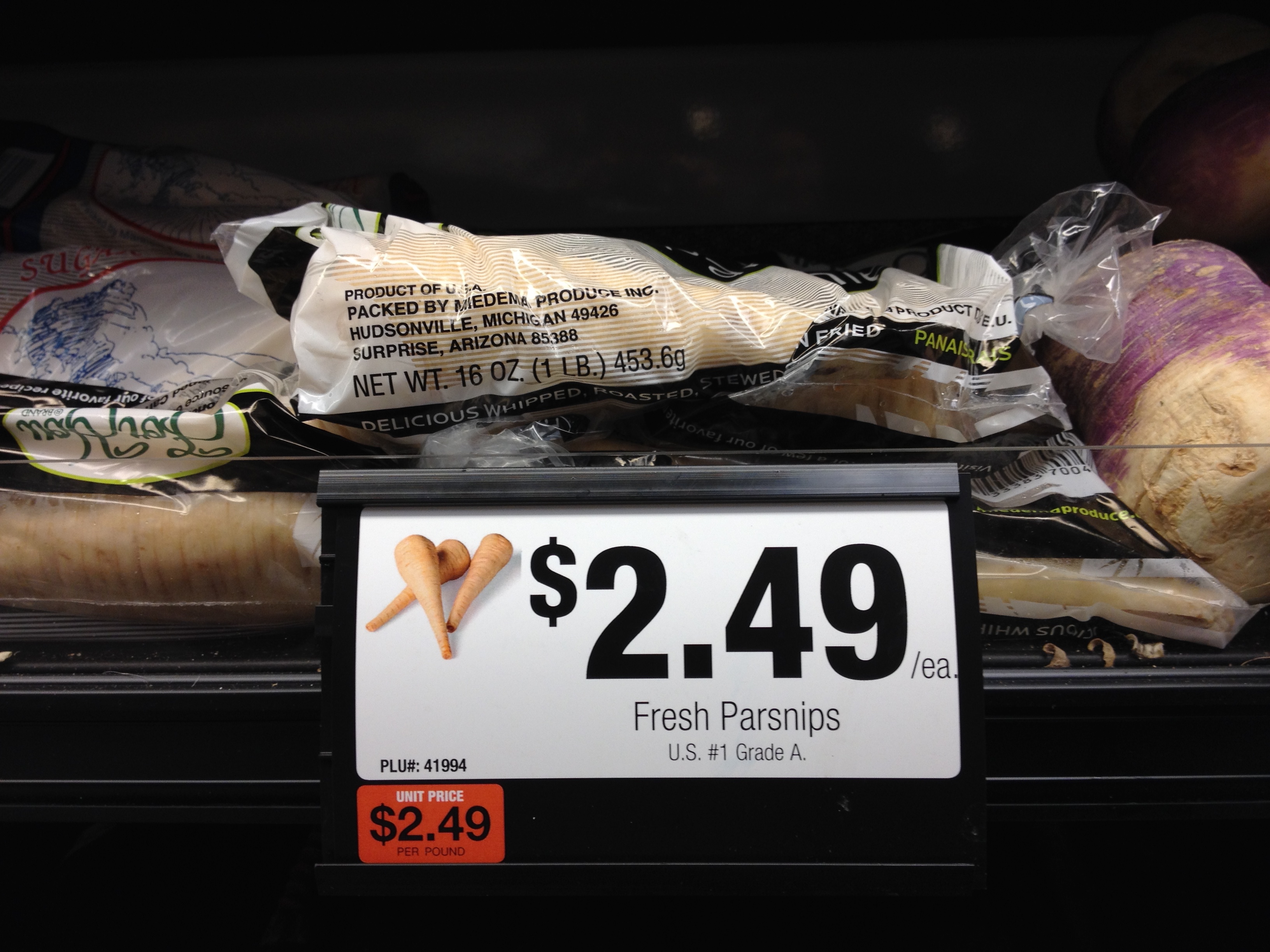
IMG_1889So it was that I learned an acronym that is current in the publishing industry. I always thought of the parsnip as a rather curious root vegetable, somewhat like a white carrot. As a child I severely disliked them, but I’ve come to appreciate them, roasted and glazed, as an adult. The word itself is somewhat fun to say: PARSNIP. It is also an acronym of things publishers, particularly those who publish textbooks in English as a second language, have to avoid. PARSNIP stands for, according to the popular explanation, Politics, Alcohol, Religion, Sex, Narcotics, Isms, and Pork. Interestingly to me, at least four of these things have their traditional taboo status because of religions. Clearly Religion is one of those, but restrictions on Alcohol, Sex, and Pork are also based on religious rules. One could argue that Narcotics also fits into that category as well. As I’ve mentioned many times on this blog, religion, substances, and sex are all deeply intertwined.

One of the curious things about this is that our post-Christian society has declared that religion is not worth discussing, or even learning about. We slash religion departments from universities and then wonder why we can’t discuss things like sex and alcohol, without which our society would apparently collapse, freely in other cultures. When I was a child, reading MAD magazine, I quickly learned two things that adults didn’t discuss were religion and politics. The list has grown since that time, but apart from the fact I have no idea which Isms are to be avoided, I see PARSNIP as the white carrot of religious taboos. And politics. In this secular world, we’ve become very politically correct, although we really shouldn’t mention politics in that phrase. Now I’m wondering if maybe I should reevaluate TULIP after all. At least the first part.


I Swear it’s True

Spoon-fed the belief from youngest years that certain words are categorically bad, I find myself as an adult who daily plays with words wondering how this curious idea began. The taboo. The “badness” of select words can have nothing to do with the combination of sounds; one language’s swear word is another language’s polite invitation to dinner. It is the context of those sounds that constitute a swear, a cuss, a curse. Forbidden words. The sanctions against such words generally come from religious specialists who know the hidden power of human utterances. Even magic words trace their ancestry back to religious elocutions. In a report sure to be condemned by many religious groups, the journal NeuroReport has announced this week, according to the Los Angeles Times, that cussing makes you feel better.

In a controlled experiment involving ice water (shudder), participants who swore in response to the pain were found to have higher tolerance to discomfort compared to those who suffered in saintly silence. Those writing the report theorize that flight-or-fight response may be triggered by angry expostulation, giving cussing a survival advantage when used judiciously. I had previously read reports that suggested swear words, different for each language, were societally determined and were intended to freeze action (without ice water) in a similar way to a lion’s roar. Indeed, apart from those who habitually cuss, thus cheapening the effect, an inappropriate word is often enough to get the attention of a room full of people (not that I would know).

No matter what their psychological origins, taboo words exist in every culture. Whether they are intended to hurt or help is a matter of theoretical perspective. There is no question that these words possess the power to give pause. I am reminded of a former student who had gone on a missionary trip to a part of the world where Indo-European languages were not the norm. Introduced to a young Christian woman who had a name that sounded to English-speaking ears like his host (a bishop) was suggesting he commit an immoral act with himself, said student turned red with indignation. Months later, safely back in North America, he remained scandalized by the experience. In their context those sounds meant nothing inappropriate – so swearing is in the ears of the beholder. Before you decide to use this curative, however, be aware that the study reveals the best results in pain control apply to those who generally do not swear. Many of those I have worked with through the years would perhaps find a non-swear word far more helpful in stopping pain than their everyday vociferations.