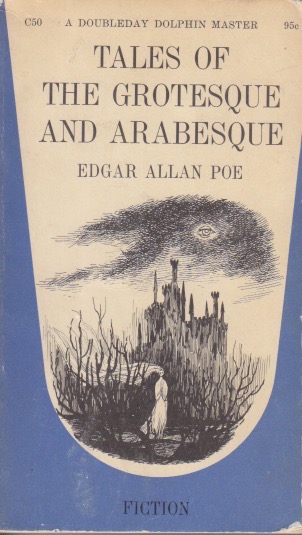
Grotesque and Arabesque

My last post about Edgar Allan Poe’s Tales of the Grotesque and Arabesque led a couple of readers pointing me to places where the missing tale (“The Visionary”) could be read online.  That fact is beside the point.  I have sitting next to me an omnibus edition that contains, in print form, all of Poe’s tales and poems.  Poe deserves to be read in print.  No, the point of that previous post was that I wanted to read a print version of Tales of the Grotesque and Arabesque through so that I could observe a couple of things: the stories Poe thought his best at the time, and to read several Poe stories I never had.  Also, it was an exercise of ratiocination.  So I found a used copy online that contains the full contents, unaltered, of the original printing.  Such a book may be still in print, but given the constraints mentioned in my previous post, it cannot easily be found.  So on to the stories.

A great number of the stories contained herein are funny.  Poe was quite capable of humorous writing.  Some of the stories verge on science fiction.  Others demonstrate his incredible breadth of reading.  He wrote smartly about ancient history—fictionalized, of course—and about astronomy.  He wrote a story about the end of the world, which adheres, in some measure, to the “biblical” account known even in his day.  The stories are erudite and often obscure.  They are seldom read, or at least discussed among Poe’s horror tales.  I’ve been pondering horror as a category quite a lot as of late.  It’s clear that during his lifetime Poe was not a “horror writer” as we know such authors today.  He was a brilliant, and imaginative interrogator of the world in which he lived.  Reading this book all the way through was an epiphany.

Poe’s writings are in the public domain.  There are websites, easily found, where all of his stories may be located for free.  There are some writers, however, that I believe have earned the honor of being read as they were published—on paper.  Until recently I had only a couple of editions of paperbacks of Poe’s stories.  They were mostly tales I had read multiple times, here and there.  I even break out the omnibus edition now and again when I want to read one of his stories that aren’t in the other collections.  Tales of the Grotesque and Arabesque has expanded my view, which often happens when I read Poe.  And that is a high compliment to any author, just like reading them in paper form.
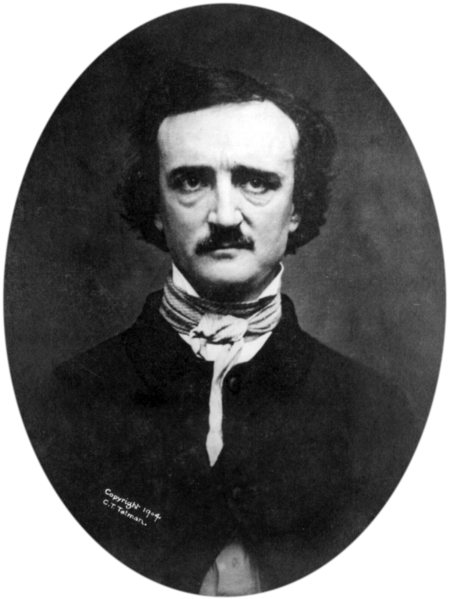

Finding Poe

A gift a friend gave me started me on an adventure.  The gift was a nice edition of Poe stories.  It’s divided up according to different collections, one being Tales of the Grotesque and Arabesque.  This was originally the title of a collection of 25 stories selected by Poe himself in 1840.  I realized that much of my exposure to Poe was through collections selected by others such as Tales of Mystery and Terror, never published by Poe in that form.  I was curious to see what Poe himself saw as belonging together.  I write short stories and I’ve sent collections off several times, but with no success at getting them published.  I know, however, what it feels like to compile my own work and the impact that I hope it might have (if it ever gets published).  Now finding a complete edition of  Tales of the Grotesque and Arabesque turned out to be more difficult than expected.

Amazon has copies, of course.  They are apparently all printed from a master PDF somewhere since they’re all missing one of the stories.  The second-to-last tale, “The Visionary,” is missing.  I searched many editions, using the “read sample” feature on Amazon.  They all default to the Kindle edition with the missing tale.  I even looked elsewhere (gasp!) and found that an edition published in 1980 contained all the stories.  I put its ISBN in Amazon’s system and the “read sample” button pulled up the same faulty PDF.  Considerable searching led me to a website that actually listed the full contents of the 1980 edition I’d searched out, and I discovered that, contrary to Amazon, the missing piece was there.  I tried to use ratiocination to figure it out.

I suspect that someone, back when ebooks became easy to make, hurried put together a copy of Tales of the Grotesque and Arabesque.  They missed a piece, never stopping to count because Poe’s preface says “25” tales are included, but there were only 24.  Other hawkers (anyone may print and sell material in the public domain, and even AI can do it) simply made copies of the original faulty file and sold their own editions.  Amazon, assuming that the same title by the same author will have the same contents, and wishing to drive everyone to ebooks (specifically Kindle), offers its own version of what it thinks is the full content of the book.  This is more than buyer beware.  This is a snapshot of what our future looks like when AI takes over.  I ordered a used print copy of the original edition with the missing story.  At least when the AI apocalypse takes place I’ll have something to read.