Sodom Returns

Somebody really ought to write a book.  It’s not me, but when new archaeological discoveries with large explanatory value emerge, they begin to paint an interesting picture.  Archaeologists have determined that Tall el-Hammam, a city in Jordan of about 8,000 residents, was wiped out by a cosmic airburst, or meteorite.  If you missed it in the headlines it may be because this happened in 1650 BCE.  Barring volcanoes and other melting phenomena, since they don’t get hot enough, the cosmic airburst is the best theory.  Given that Tall el-Hammam is not far from the Dead Sea, it has been posited that the sudden destruction of this city led to the biblical story of Sodom and Gomorrah.  This makes sense to me.  Just like the theory that the flooding of the Black Sea by the Mediterranean led to stories of the flood.

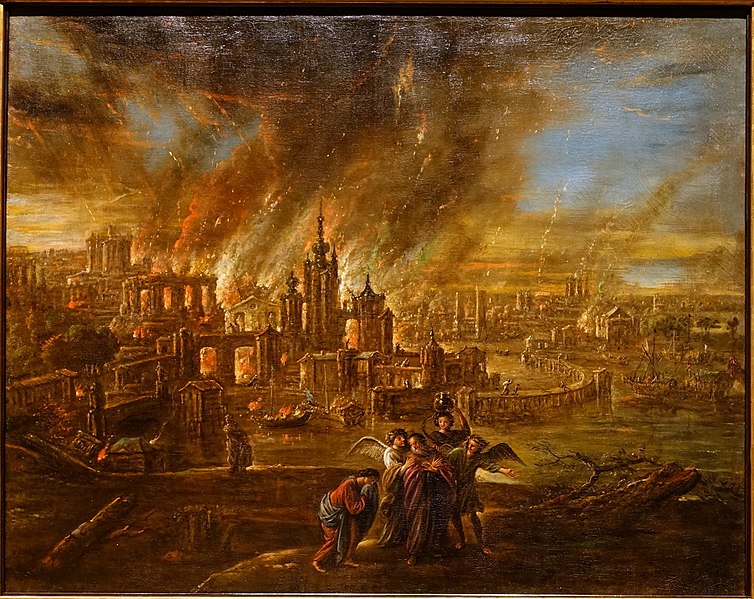
Sodom and Gomorrah afire, by Jacob Jacobsz. de Wet; image credit: Daderot, public domain via Wikimedia Commons

People who had no other ways to explain such things would naturally consider them forms of divine punishment.  Deep-seated guilt seems to be a universal of human psyches, sometimes for good reasons.  In any case, an entire city wiped out by a meteorite looks like the finger of God just as much as lightning does.  Biblical scholars have long supposed that the story of Sodom and Gomorrah was an etiology, or origin story, of the formation of the Dead Sea.  This is partially based on the famous salt pillars, more than one of which bears the name “Lot’s wife” or the equivalent.  And the Dead Sea is unlike any other body of water on the planet.  

I suspect that over time other biblical stories may find logical explanations in ancient catastrophes.  I haven’t found convincing those that try to explain the “plagues of Egypt” based on a scientific daisy-chain of events, although they are interesting.  There’s no doubt that between the expulsion from Eden and the arrival of Moses there were dramatic events narrated by Genesis.  If these were ghosts of memories of ancient tragedies that makes sense to me.  They’re moralized, of course.  Aesop’s Fables also ended with the moral of the story.  We still like to know what a story means, and a good movie or novel will have some kind of message to convey.  There’s no way to prove that Tall el-Hammam’s destruction led to the biblical account, or that memories of a catastrophic flooding of the Black Sea led to tales of arks.  But still, somebody ought to write a book.  I’d read it.

Sodom

Look!  Up in the sky!  It’s a bird!  It’s a plane!  It’s an asteroid coming to wipe out a city!  One of the cottage industries outside biblical studies is the interest in finding historical events to explain Bible stories.  A few years ago it was proposed, with some degree of probability, that the flooding of the Black Sea by the Mediterranean, validated by archaeology, led to the story of Noah’s flood.  I recently saw a story suggesting that the destruction of Tall el-Hammam by an asteroid about 3,600 years ago might’ve been the basis of the story of the destruction of the cities of the plain, Sodom and Gomorrah  most prominent among them.  The piece by Christopher R. Moore in The Conversation describes the moments of horror—mercifully brief—as the space rock exploded above ground and wiped the city from the face of the earth.

Since this happened near the location of Jericho, the destructive shock waves knocked its walls down, leading to another biblical tale.  I often wonder about these “theories.”  They show just how deeply biblical our society is.  The frame of reference is already there.  People know about Sodom and Gomorrah.  They know about the flood.  They know of naked Adam and Eve and a snake wrapped around a tree.  When a disaster happens in the right region, and before the biblical story was written, it is suggested as the etiology of the tale.  Many have tried to explain the plagues of Egypt using similar methods.  Our culture seems to long for some skyhook on which to hang our biblical hat.  Some indication of why people put such strange stories in the Good Book.

Biblical scholars look too, but with a different perspective.  Etiologies are stories of origins.  Traditionally the Genesis account of the cities of the plain is understood as an etiology of the Dead Sea.  A unique geological feature of this planet, it is, in a word, weird.  The story of Abraham’s nephew Lot seems to explain it.  The article makes a compelling case for a heavenly fireball at about the right time that wiped out a settlement of about 8,000 people.  Genesis wasn’t written yet at 1600 BCE, the time of the event.  Since the impact site wasn’t far from the Dead Sea it seems to fit  the bill for a valid etiology.  None of these events proves biblical stories true, but they do show possible avenues of transmission.  This one definitely has me wondering.

Image credit: Daderot via Wikimedia Commons