Life Course

Curriculum vita.  The course of a life.  I see quite a few CVs, although I’m not on any search committees.  As I was examining one the other day I recollected how, when I first tried to put one together, I was told to leave high school and its achievements out of it.  Nobody’s really interested in that anymore.  Presumably college is an indication of choice whereas high school is a matter of where your parents live.  Or how much money they have.  College says something indicative about you.  Although many parents—not mine, to be clear—help bankroll college and may have a say in where you go, college is “your choice.”  Unbounded by geography, young people mostly old enough to take care of themselves, are given a really tremendous responsibility here.  And it was certainly influenced by high school.

Some choices are economic, and that also says something about a person.  Some are faith-based, which definitely says something about you.  Some are terribly ambitious, and those tend to get you the biggest head start on your life course.  Of course, some of us did not realize that.  Some of us, not sure if college would work or not, chose somewhere close to home.  Somewhere where escape, if needed, was possible.  And of course, your college shows up ever after on your CV.  I often wonder if things would’ve worked out differently if I’d gone somewhere else for college.  I needed somewhere understanding to shake me out of the false narrative I’d been told.  Had I gone somewhere more strident I might’ve retrenched in my pre-decided ideas.  Of course, those pre-decided ideas are what made me decide to go to college in the first place.

How can we possibly measure the course of a life?  From big event to big event?  So many of the meaningful bits occur in small spaces wedged in-between the large markers of who we are.  We can’t possibly know all the consequences of our choices, even as we attempt to select the right option at each step of the way.  And there’s no guarantee regarding the outcome.  Were it a feasible option I’d go back to college again—I would start at a different place this time—to test the results of my first decade of higher education.  For, I know, although a CV can reveal more than it might intend, it leaves much more unsaid than it can possibly say.

Conference Voice

“Conference voice” is a phenomenon that began with my career malfunction.  While teaching I attended the AAR/SBL annual meeting every year but one.  Even the year that Nashotah House fired me I attended, through the generosity of a seminary colleague who’d left for a parish and who used discretionary funds to help me afford it.  (Churches can actually help people from time to time.)  In any case,  I always met many colleagues at the meeting itself, and had many conversations.  Besides, I taught a full docket of courses every year.  Then the malfunction.  I was eventually hired by Gorgias Press but I had to do adjunct teaching to make ends meet.  I taught up to about ten courses per year at Rutgers, all in the evening.  Then I was hired by Routledge.  The commute to NYC precluded any adjunct work, so I settled into the quiet world of editing.

I also began attending AAR/SBL again.  I came home with “conference voice.”  After going for days, or even weeks, with no substantial conversation, I’d lost my lecturing vocal stamina.  At the conference I had five days of back-to-back meetings, often in a crowded and noisy exhibit hall.  I’m a soft-spoken individual (I can project when teaching) and my larynx was stressed by the concentrated five days of constant conversation.  My voice had dropped in pitch by the time I got home and it took a few days to get better.  I would lapse into cenobic silence for another year.  After the conference I’d return every year with aching vocal cords.  My family sympathized, but I really just don’t talk that much.  Especially at work.

Recently I met a friend for lunch.  I hadn’t seen him to chat for a few years so we spent over two-and-a-half hours talking.  Part of it in a restaurant where I needed to raise my voice.   I awoke the next morning with conference voice.  This bothered me because I’d been invited to do a podcast episode about a horror movie and I faced an existential crisis: what does my real voice sound like?  In my mind, my profession is teaching.  The voice I had at Nashotah House, University of Wisconsin Oshkosh, Rutgers University and Montclair State, was my real sound, such as it was.  Life has landed me in a situation where I seldom speak, and almost never to groups where I need to project.  Conference voice is a reminder of what I was meant to do and what I, of necessity, must do.


Thinking Teaching

I am a teacher.  Although no longer employed as one, my entire mindset is geared toward the profession.  Those hiring in higher education have no clue about this sort of thing.  Apparently nobody else does either.  I’ve worked in business now for over a decade and a half.  During that time only one employer has shown any inkling of understanding the importance of clear teaching.  Instead, most promote busy people trying to explain things in sound bites that lead to confusion, compounded daily (sometimes hourly).  The immense waste of resources this entails is staggering.  It is the most inefficient system I can imagine: in the rush to convey sometimes important information, necessary pieces are left scattered on the floor like seeds under a bird feeder in migration season.  In our rush to do our jobs, we settle for half-baked rather than paying a baker to make proper bread.

This is a constant frustration for someone who has the soul (and mind) of a teacher.  Our society undervalues educators of all stripes.  And, yes, many people go into teaching without the requisite gifts or motivation.  I’m certain I’m not alone in having had a high school or college course where the teacher was completely disengaged or perhaps in out of their depth.  Students shut down, hate school, and then spend their lives making uninformed decisions on everything from politics to profession.  Teachers—good teachers—are the future of any nation.  I know our young are our future, but if they’re inadequately taught, take a look at the headlines and see what happens.  Why is it so difficult to see that if children aren’t taught well, institutions will perpetuate that model until everything is a barely contained pandemonium?

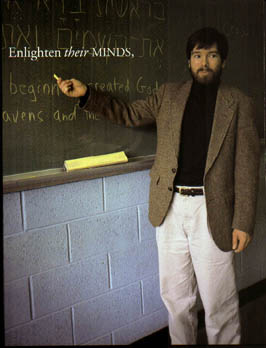
We see this happening in history.  A people or culture gets to a point where they just begin to implode.  Too many things that just don’t make sense have been built on top of other things that just don’t make sense.  The whole thing begins to collapse.  I see this happening all the time—the hurried email that simply doesn’t explain anything, sent in haste before moving on to the next sophomoric task just to get the job done.  When businesses take a look at budgets and feel a little scared, some of the first positions to go are those of trainers.  “People will figure it out,” they seem to say.  And we see the results.  Evolution has made teachers of some of us.  Many of us, of necessity, are doing something else for a living.  If only all jobs came with a blackboard.


Street Teaching

When I’m out on the street—not so often these days—I’m sometimes accosted with strange questions.  This has happened to me quite a few times over the years.  Recently, when I was taking the recycling out for my daughter on a weekend visit, I saw a couple guys in a car right by the receptacle.  I was wearing a mask, due to, you know,  Covid, so I wanted to keep social distance.  The one in the driver’s seat asked if I was going to dump the recycling and when I said I was his partner said “I’ll take care of that for you.”  They had a plastic bag full of cans and were loading glass bottles in their trunk.  I thanked them for their help and turned to go.  As I was walking away one of them called out.

“Hey!  Are you a teacher?”  I get asked that a lot.  Only the academy refuses to recognize it.  I acknowledged that I used to be.  “What level?” they asked.  I allowed as I used to be a college professor.  “Where?” I told them most recently at Rutgers.  “What’d you teach?”  This is where it always gets interesting and I start to sweat a little.  I told them religious studies.  I also said that’s why I couldn’t find a teaching job.  “The best information we ever had on religion came from a six-year old.  You know what the F in faith stands for?”  I shook my head.  “Forgiveness.  Without that the rest of religion means nothing.”  I told them I could accept that.

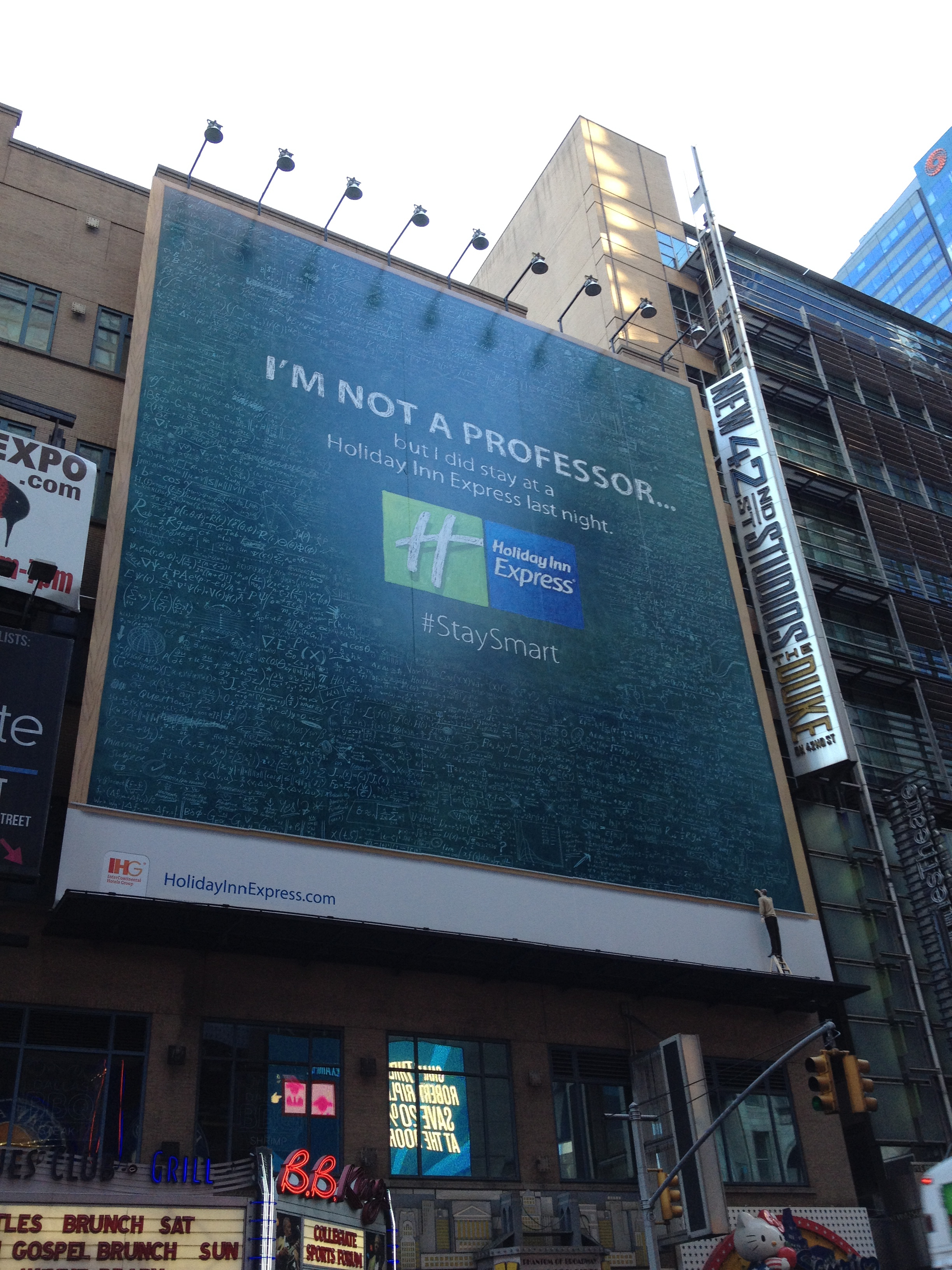
Then as I was turning to go they called out, “You know the acronym for Love?  Living our values every day.”  I told them they were now the teachers and I was the student.  They responded by telling me that they’d just sold a song they co-wrote for a million and a half dollars.  I expressed surprise at that.  They told me the title and said it was recording in Nashville this week.  I congratulated them and finally was able to be on my way.  This made me reflect on the several such strange conversations I’ve had on the street.  They often begin with “Are you” and not infrequently end with “a professor.”  This is usually followed up with some kind of intelligent question.  People, it seems to me, are eager to learn.  Maybe not in the classroom, but in what is referred to as the “university of life.”  Perhaps that’s all the schooling we ever really need.


Teaching Peace

Teachers, preferably unarmed, are some of my favorite people. While the travesty of a government muddles along in the District of Columbia I think back on my own education and wonder what went wrong. I’m sure you knew kids who hated school; I certainly knew plenty. For whatever reason they didn’t want to be enclosed in a classroom with everyone else, learning stuff for which they could see no practical application. Reading doesn’t appeal to everyone. Memories of advanced math still send shudders down my spine. And what was the point of gym class if it wasn’t to make those of us who liked reading feel bad at that awkward stage of life when you discover your body isn’t as well-made as that of others your age? Education isn’t perfect, but it’s what we now need more than ever.

There’s no way that everyone will learn to enjoy reading. We aren’t cookie-cutter people. Thinking, as my own mathematical experiences demonstrated, can be very hard work. No one person knows everything. That’s why, at least in my day, after you reached sixth grade you started to have teachers who specialized in subjects. What I didn’t realize as a kid is how hard these modern-day saints have it. Pay scales are low. Hours are long for those dedicated to being good teachers—the brevity of the school day beliefs the amount of work done after hours. Increasingly our educators have to hold down a second job to be able to survive. The least we can do is learn in gratitude.

School shootings are so tragic because many of the victims are those who haven’t had a chance at life yet. We elect uneducated presidents and wonder what could possibly go wrong. Education, if done right, becomes a lifelong journey. The day that passes without learning something new is the day I come home and go to bed depressed. More than simple evolving, life is learning. Teachers are those who set us off on that track. The young, it is true, have more flexibility in learning. There are more options open to you before your thinking gets set in its way. I ran into seminarians who, no matter how much you’d offer, had already made up their minds. No education required. Perhaps what we need to teach at the youngest possible age is that school never ends. The formal classroom experience may cease at grade twelve, the baccalaureate, masters, or doctoral degree, but the learning goes on. And it’s a good thing, not some bizarre punishment. For that teachers, unarmed, are those to whom we should be grateful. If only we’d be willing to invest in them.


Fresh Thinking

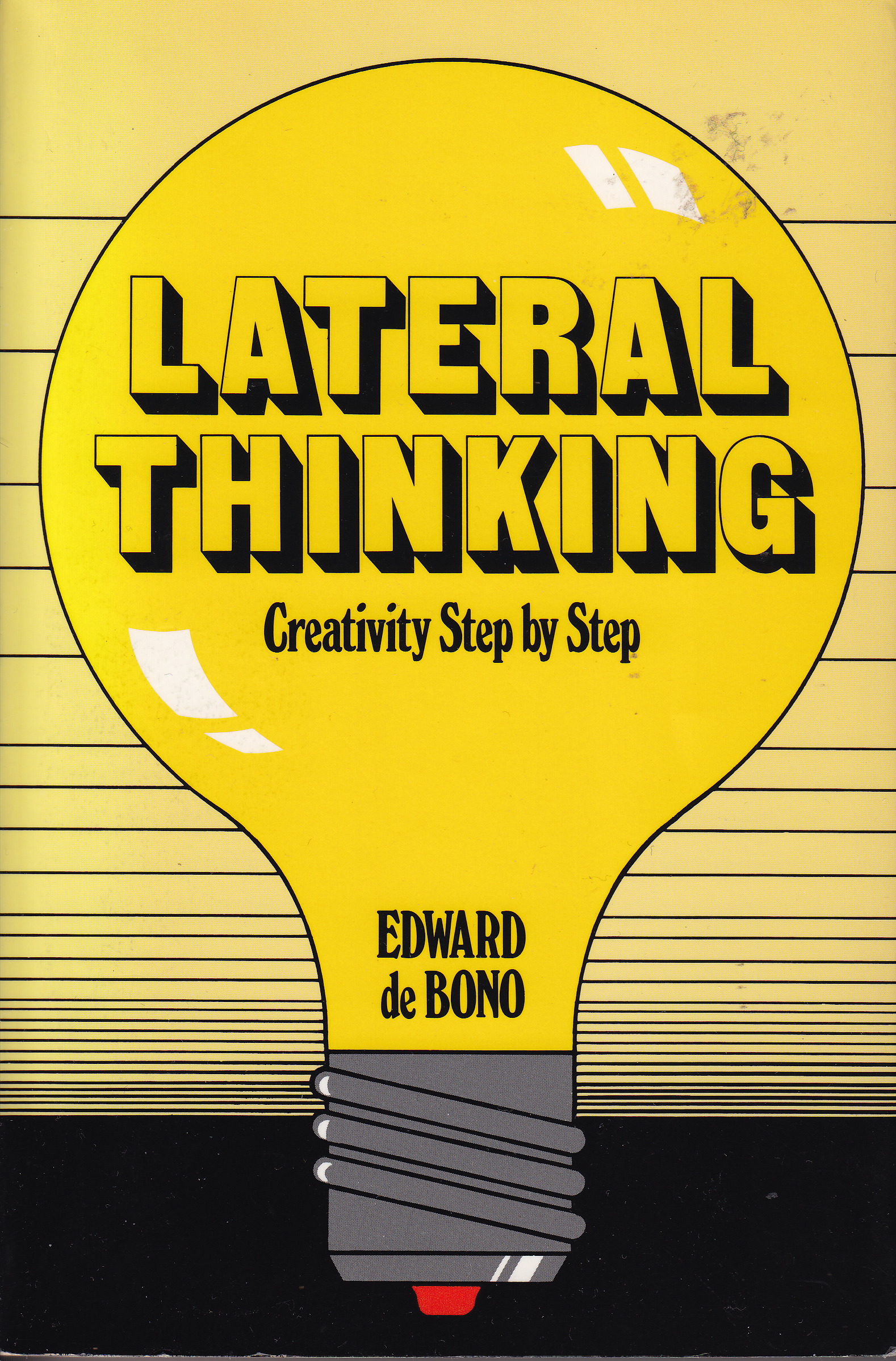
Lateral Thinking_0001Creativity receives an immense amount of lip service. Too bad that doesn’t correlate to actual appreciation. I’ve been working since I was 14. In all the jobs I’ve had, the first was the one that used my creativity most fully. I was a teenage assistant-janitor, doing manual labor. Laborers have great incentive to be creative since it can reduce the amount of work you have to do. Of course, at other times it can create more work. While I was teaching (the second-most creative job I’ve held), I picked up Edward de Bono’s classic, Lateral Thinking: Creativity Step by Step. Shortly after purchasing it I lost my teaching job with a change of administration and I’ve been involved in the least creative phase of my career ever since—publishing. I hope that I’m still a lateral thinker, and I read de Bono wishing to verify that I might be.

Lateral thinking, simply put, is the ability to see things differently. Logical thinking, with which we’re all familiar, is linear, or what de Bono calls “vertical.” Each step is based on the previous step and each step has to be right all the time. My mind, however, finds avenues out to wander among the daisies during the whole process. My interior dialogue is often a long stream of “what ifs” and questioning why things are done the way they are. I guess it’s no wonder that the church was leery of me. Lateral thinking, de Bono notes, does not sit well with dogmatism, nor with the arrogance of presuming you’re already right. If you’ve already got the answers, you need not ask any more questions. You go to seminary to learn to shore up the party line. Individual thinking is unwanted, and what’s more, it’s even dangerous.

So I have moved into the realm of business which, it would seem, stands to gain the most from creativity. Instead, standard business practices hamper, if not actively discourage, creativity. Having people sit in cubicles and maintaining rigid, often long, hours, and performing tasks that a lemur could be trained to handle. This is hardly the breeding ground of new ideas. I’ve attended “brainstorming” sessions in the industry where the leader shoots down immediately any idea that doesn’t lock-step with where s/he believes the company should be going. That’s not brainstorming, it’s brainwashing. Creativity may indeed lead to a temporary loss of profits. The truly creative business mogul will know, however, that it will lead to great leaps ahead further down the road. If you want to find the truly creative among the company, I suggest one place to go. Ask the janitors. Their ideas are likely the most creative of all.