
Gobeklitepe, or more properly, Göbekli Tepe, stunned the archaeological world a few years back. This site in what is now Turkey contained what is apparently a sanctuary—purposefully buried—and advanced architecture for its age. It was that age that was so shocking. Gobeklitepe dated from around 11,000 years ago. Now, in case ancient history’s not your thing—this will be painless—agriculture began, according to the standard chronology, about 10,000 years ago. This led to surplus production that in turn led to the first cities, indeed, what we recognize as civilization itself. While Gobeklitepe wasn’t permanently occupied, it was an example of a temple before agriculture, and according to the standard thinking, this should not be. Consequently not too much has been published on the site because nobody likes a smart aleck, even if said aleck is an archaeological site.
Just within the last weeks, Anadolu Agency announced that an even older site was found in Turkey, near the city of Mardin. Reports coming out of Boncuklu Tarla suggest that it is a millennium yet again older, dating from 12,000 years ago. The article doesn’t include many photos, but suggests the site is similar to Gobeklitepe. If this holds up, a new paradigm for human history will need to unfold. What drew people together at first was not tilling the soil and reaping a surplus, but religion. Even in the still standard paradigm, kings could only emerge with the backing of gods, so early cities had impressive temples. What the evidence now suggests is that the temples came first and ancient people came together at sacred sites before they had a surplus to bring. You can’t pick a sacrificial animal without having a heard or flock from which to take said victim.
We live in a technological era in which intelligent people are scratching their heads with their smart devices because religion just won’t go away. I have suggested before that the reason it won’t is that it is deeply engrained in our biology. We can try to reason the gods away, or abstract them to the point that we can call them laws or principles, but we can’t escape the fact that we’re held down by forces beyond our control. Ancient people in Turkey, hunter-gatherers in our current paradigm, were gathering together and putting massive energy into building what look like temples before they had a secure and steady source of food. Before, indeed, they had smart phones or even dial-up. Millennia later we would rediscover them and wonder about things even as religion would be the deciding factor in elections in the most technically advanced cultures on the planet.
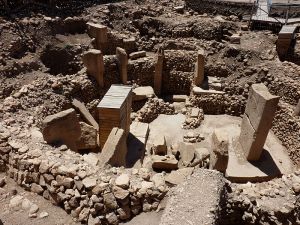
Photo credit Zhengan, via Wikimedia Commons.

 Steve A. Wiggins