Scientific Seminary

Old Testament. New Testament. Church History. Pastoral Theology. Systematic Theology. Homiletics/Liturgics. This was a typical kind of seminary curriculum about a quarter-century ago. Obviously there were variations, but the basic topics were Bible and its application. When I attended seminary science was already in the ascendent (seriously, it wasn’t that long ago!). Nobody much worried about how it might impact religion. People in the United States still attended church in large numbers but no one I knew really considered science a threat to belief. They were essentially different realms of inquiry and although some on each side asserted the superiority of their enterprise, the debate seemed to be good-spirited and without excessive rancor.
IMG_1656The situation has, of course, shifted radically since then. We’ve become a society guided by business principles and technology, and religion has all the appearances of being quaint at best, likely just useless, and, at worst, dangerous and deadly. Civilization, however, was built on the premises of a religion that permeated every aspect of life. That influence has been slowly replaced by that of a materialistic reductionism that suggests all things, this blog included, are but the random results of dry atoms bumping about a cold universe. Naturally there has been a reaction. The most vocal of believers, the Fundamentalists of all stripes, have directly challenged science in the arena of veracity. As we all know, however, Fundamentalists aren’t really equipped to convince the masses. The Bible, the underlying strength of the literalist, has come under scrutiny and has been demonstrated to be more inclined to myth than history. What more does a scientific worldview need to weld shut its superior outlook? And yet, reasoning, non-reactive religion still exists. Still has a place in this mechanistic universe where miracles are disallowed.

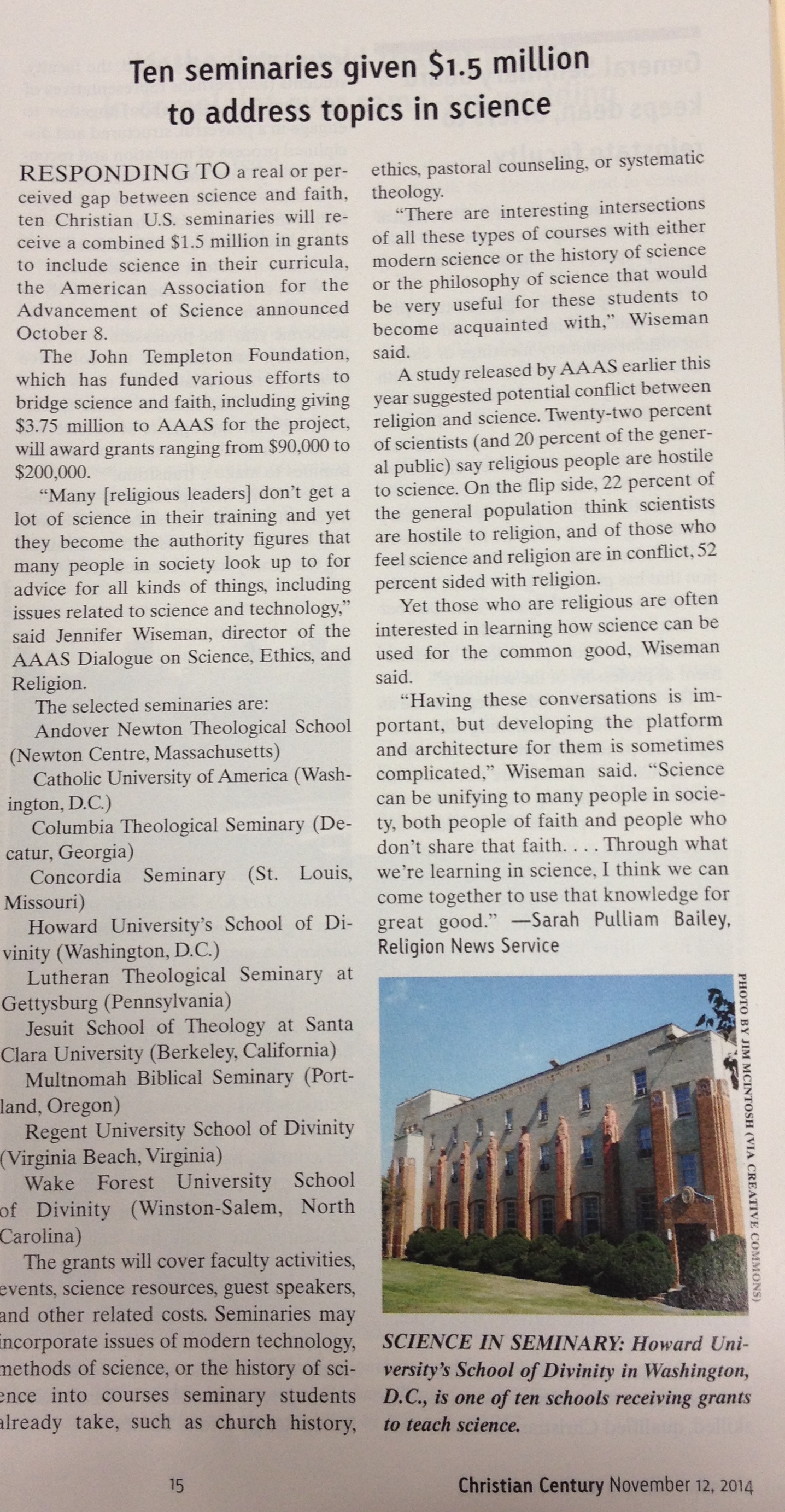
I recently read about a Templeton Foundation initiative that is funding programs on religion and science at seminaries. Some scientists excoriate the Templeton Foundation for trying to keep religion in the picture, but my humble opinion is that Templeton and its money have nothing to do with it. Religion is a very human response to a universe it can’t fully understand. Empirical method seems to work, and the results are so complex that few can even hope to comprehend. All but the most hopeless, on the other hand, can understand “love thy neighbor.” Religion continues to guide countless lives—most of them for the good, and not for the incendiary responses of a challenged literalism. The time has come for seminary curricula to adjust to the world as we know it. That world is run by inhuman forces that may help or harm humanity in equal measure. Religion, however, need not battle with science. It must, however, add it to the curriculum.
The Science of G-d

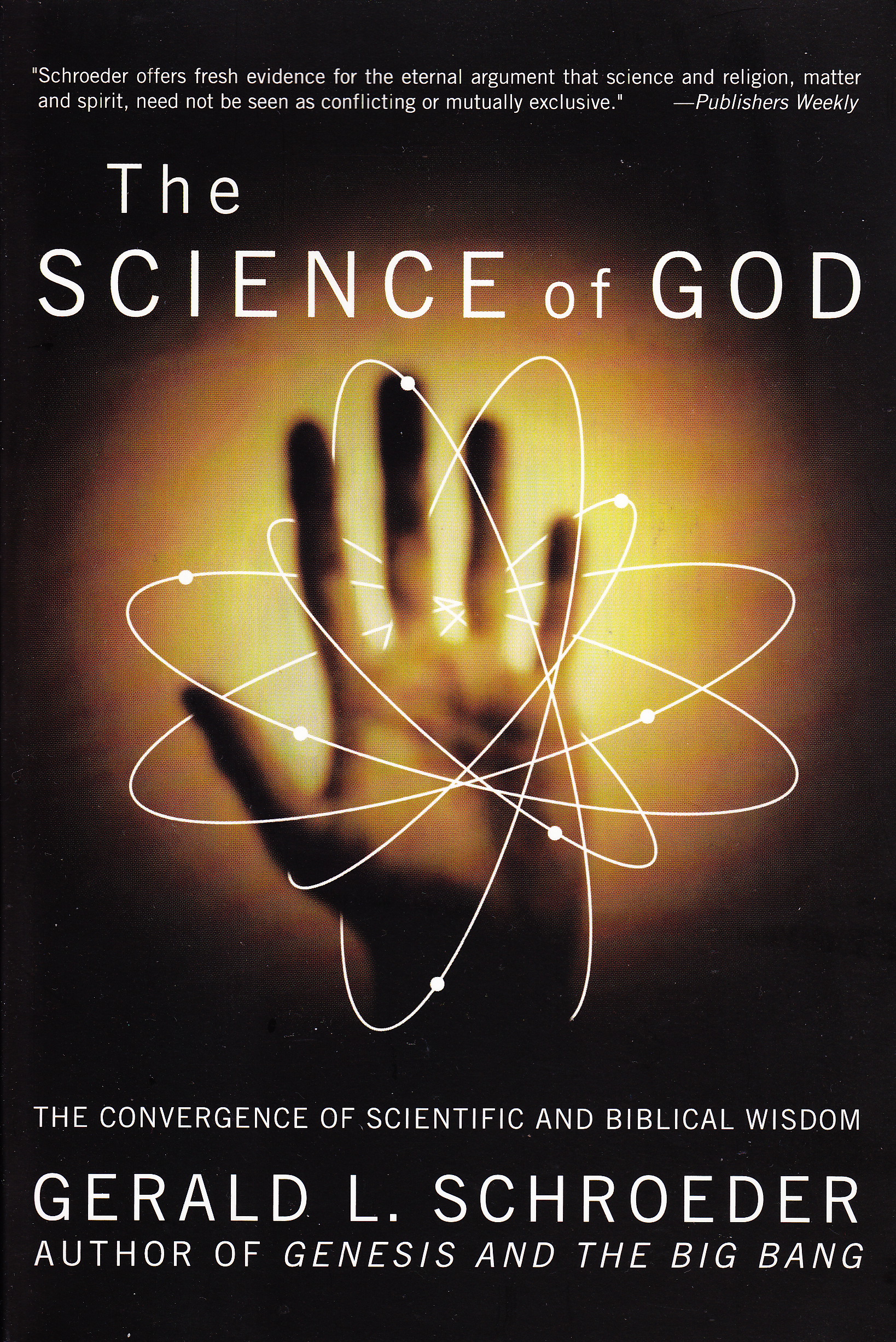
ScienceGodWhere, exactly, do science and religion come together? Since both are human mental enterprises, they must at some point at least glance off one another. Both religion and science attempt to make sense of human experience in the world, and, given the limitations of human time, being a true expert in both may be impossible. The John Templeton Foundation, as any religion scholar knows, supports research and awards handsomely those perceived to have succeeded, at least somewhat, in bringing the two together. A single lifetime, however, is not long enough for either, let alone both. Gerald L. Schroeder’s The Science of God illustrates this point. Subtitled The Convergence of Scientific and Biblical Wisdom, and produced by a major publishing house, the pitfalls of applying the Bible to a scientific worldview become apparent almost from page one.

Somewhat unusual in the field, Schroeder is an Orthodox Jew addressing the questions that the Bible raises for science. He is also a credentialed physicist. Most attempts to force religion and science into bed together come from Christian researchers—secular scientists usually have a headache—and a hidden agenda is often not too difficult to discern. I read The Science of God knowing nothing of Schroeder’s religious sensibilities. By narrowing the focus from science and religion to science and Bible, however, I knew the enterprise was doomed without even opening the cover. The Bible is one of the least scientific of all human writings. That’s not to say it has no value, but it is an honest observation by a lifelong reader of the Bible who believes science has a proven track record for making some sense of the world. Schroeder begins with that most specious of arguments, the anthropic principle. Few ideas raise such ire in my limited scientific understanding. The suggestion that the universe is fine-tuned for life is a moot point in principio. Who are we to say that life wouldn’t have emerged if the Big Bang were one degree cooler or hotter? It might have been life with different parameters, but the anthropic principle seems to point to nothing more than the tenacity of life.

While Schroeder does raise some valid points, it is clear from his challenging of the fossil record that the Bible will only ever sleep uneasily with science. For a physicist, Schroeder spends an awfully long time using God-of-the-gaps reasoning to fill in biology. In a disguised day-age “hypothesis” he gives us the creation order of Genesis 1, while skirting around Genesis 2 where humans are created before animals. And, I’m sorry, but the Bible does not mention dinosaurs anywhere. It’s a pity really. Schroeder’s book addresses some important issues, but using the Bible as a measure of scientific credibility fails every time. The science of God, it seems, is more a concluding unscientific postscript, but without the philosophical sublimity.


God, Particle, Reduce

Reductionism is beguiling because of the exalted status it gives to the human intellect. It is presumed that rational thought can explain everything. Still, reason sometimes leads to paradoxes—we’ve all heard the (admittedly theistic) one asking if God can create a rock so heavy s/he can’t lift it. Given the premise, two strands of logic conflict. A similar sort of phenomenon, it appears, accompanies quantum physics. In a story from last year on Big Questions Online (a website supported by the Templeton Foundation), Stephen M. Barr submitted a piece entitled “Does Quantum Physics Make it Easier to Believe in God?” The article requires some concentration, but the basic premise is simple enough to explain: quantum physics does not sit well with reductionism. There seems to be will in nature. It may not be God in the machine; it may not even be a machine at all.

I have always been fascinated by science, and I am not one to castigate it. Its string of successes stretches all the way from atoms and their explosive tendencies to the moon and Mars and beyond. At the same time, most of us have experienced something that “should work,” in which no fault can be discovered. Reductionism would declare the fault is indeed there, just undetected. If, however, at the sub-atomic level, particles sometimes act uncannily, don’t those effects climb the ladder into the visible world in some way? Logic would seem to demand it. The problem with putting will into the equation is that will can’t be quantified. There have been many documented cases of an instance of superhuman strength coursing through a person when they have to rescue a loved one. We raise our eyebrows, mumble about adrenaline and pretend that will hasn’t affected nature in this reductionistic, strictly material world.

Denigrating human brain power is not something I undertake lightly. Logic works most of the time. A thinking creature who has evolved to be a thinking creature, however, must realize that its own intellect is limited. Simply because we are limited doesn‘t mean we shouldn’t strive to improve, but it does mean that ex cathedra statements, whether from pontiffs or physicists, should be suspect. One would be hard-pressed to label Einstein a believer. Yet even he made the occasional remark that left the door open for, well, maybe not God, but maybe not reductionism either. I was once told, and I believe it to be true, that you can tell a truly educated person not by how much he or she claims to know, but rather by how much she or he claims not to know. It may not seem logical, but down there among the particles of the quantum world, I suspect those willful quarks agree.

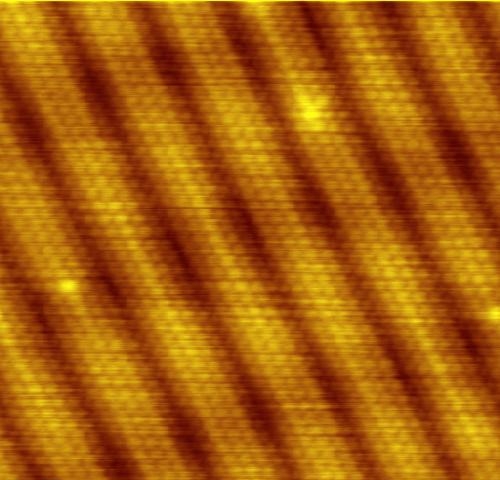
Erwinrossen's image of atoms, the sight eyes can't see

Erwinrossen’s image of atoms, the sight eyes can’t see