Who’s to Say?

Stereotypes are so easy to fall into. Having been “typecast” myself, early in my career as a “seminary professor” and a “conservative”—neither of which matched my mental outlook at all—I eventually had to abandon higher education as a career option. Why did I take a job that didn’t fit? If you’re asking that question, obviously you missed the 1990s. It was a brutal time to be looking for a job; there was this recession… wait a minute. What decade was I writing about again? In any case, many people will always remember me in the various roles I’ve played as I sought to actualize my ideal career. It is always interesting to see how others break out of their expected roles into new venues. Penn Jillette of Penn & Teller has established a reputation for speaking his mind. To those with limited experience, such as myself, he is stereotyped as a “magician,” more specifically, a “bad boy magician” who gives away the secrets of the guild. To find out that he is a writer was a kind of epiphany.
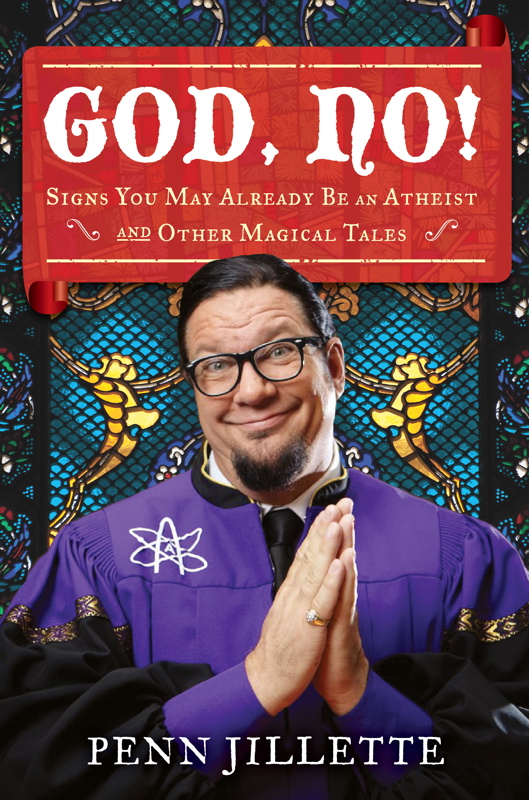
I read his new memoir/confession, God, No! this past week. I’ve always been cognizant of the strangeness of a world where someone may speak authoritatively on the basis of star status, but Americans love their performers. I’ve enjoyed the Penn & Teller acts I’ve seen on television, and after reading Penn’s book, I think I would like him in person. I can’t agree with him much of the time, but his honesty and good moral sense are very winning. I seriously cannot remember the last time I read a book that made me snort out loud with laughter or try to sink even lower on public transit so the polite person sitting next to me would not be able to see all the profanity on the pages before me. The book itself very loosely follows the Ten Commandments, which, surprisingly, the author largely agrees with in principle. The essays are all over the place, but the libertarian spirit is difficult not to admire. His appreciation of rational explanations for the world is admirable.

Probably the most difficult point of agreement for me, however, is his definition of an atheist as anyone who do not know if God exists. He does have a chapter lambasting agnostics, but as a stickler (as much as anyone in religious studies can be a stickler about anything) for definitions, it is useful to distinguish atheism and agnosticism. Saying one does not know is not the same as declaring one is certain. Since the existence of God can be neither proven nor disproven, those who say God does not exist believe that assertion. Those who say God exists also believe their assertion. Objective knowledge, in our current state, is not possible. I had to agree, in the final chapter, that faith causes most of the problems we find associated with religion, but I’m afraid faith is a huge part of the human condition. God, No! is not for everyone. Those who read it will, nevertheless, find an author as convinced as any evangelist that he’s right. And if they are honest, they will have to admit to having laughed along the way.



West Texas Dead

A small item from the Star-Ledger wire services proclaims, “Former priest accused of trying to hire hit man.” Since the story was bylined Texas I started to wonder if the accused was someone I knew. Nashotah House boasted more Texans than any other statehood citizenship when I was there, so it was natural enough of a gut-level reaction. Fortunately, it was wrong. A former Catholic priest named John Fiala stands accused of trying to hire a neighbor to assassinate a teenager who’d accused him of sexual abuse. In a travesty of at least three of the ten commandments, a man of the cloth allegedly attempted to bare false witness (the error is intentional).

We hold clergy to a high standard in our society. The mystique of being “called” by God, secreted away in a provocatively named “seminary,” and emerging ontologically superior to other humans has a touch of whimsy that is difficult to dismiss. Having twice been a victim of seminary, once as a student and for even longer as a faculty member, I learned some important truths about those trained for ministry. They are merely human. In fact, my best students were those who recognized and embraced this fact. When I was informed that an ultra-pious candidate was about to “shed the shackles of the laity” and would return from his weekend ordination “ontologically transformed,” I rolled my non-ordained eyes. I had seen the test scores and intense faculty evaluations. Ontological change? We should be so lucky.

So, a man barred from any sexual outlet seeks a silent victim. We should not wonder. Attempting to get a neighbor to become an assassin is a bit over the top, even for most Texans. It does, however, illustrate my point that the laying on of Episcopal hands does nothing to change the essence of a person. Clergy are just as human as anyone they serve. It is when they think otherwise that problems arise. Secular students in the halls of Montclair State University are talking about the Vatican’s changing collective mind on condoms. Discussion and exegesis of the issue cover the front page of the New Advent website. Too bad the decision hadn’t been made a few months earlier. This situation might not have emerged at all. As the paper states, “the Sacred Heart of Mary Parish in the West Texas community of Rocksprings [is] a rural enclave known for sheep and goat herding.”

Don't let it get your goat


Biblical Science Fiction

1950s science fiction films are perhaps the most parsimonious celluloid genre. Standard Saturday afternoon fare in my childhood, I still have a soft spot for the unapologetic self-confidence of these movies with their painted backdrops and hokey effects. The messages are frequently self righteous and often biblical. So yesterday as I treated myself to a viewing of The Mole People, I went on instant alert as the biblical references began right away for an audience that would have known the Bible well enough to take it all in. Set in “Asia,” the archaeologists are digging for Sumerian artifacts when then discover a stone tablet “below the great flood level.” That makes it at least 5,000 years old, the assembled academics declare. A diffident Dr. Roger Bentley tells his fellow excavators, “in archaeology all things are possible!” When a young boy of the indigenous population discovers an oil lamp shaped like a boat, the archaeologists note, “the flood’s been proven to be a historical fact.” The boat is a model of Noah’s ark, the Sumerian version. The scene of the expedition climbing Mount Kuitara includes footage from the 1955 Fernand Navarra trek up Mount Ararat during which a wooden beam was found, reputedly from Noah’s ark.

If you can stomach the bogus Sumerian you’ll learn that ancient Mesopotamians also survived the flood, a kind of “children of Cain” motif. These Ishtar-worshiping pagans are practitioners of a kind of social Darwinism, killing off their own kind when resources in their underground world become strained. Their great underground civilization parallels that of ancient heathenism while more advanced civilization on the surface of the globe has the benefit of an enlightened Christian worldview. Even the Sumerians whipping the actual mole-men is reminiscent of the Egyptians whipping the Hebrews in the Ten Commandments (released the same year).

Fast forward fifty years. We now live in a technologically advanced civilization where the myths of ancient people have little place. Science provides logical explanations for most of what we encounter in the world around us. Yet there are still otherwise intelligent people seeking Noah’s ark on Mount Ararat. The past is impossible to escape. The Sumerians in the film (whose walls are inexplicably decorated by Egyptian artwork and hieroglyphics) represent those who hold onto a confused religion that has become a form of terrorism in the eyes of the more advanced archaeologists. Perhaps the paradigm has shifted, and those who use religion today to gain political power and personal gain have become the self-righteous Sumerians of The Mole People.


Of Cats and Goddesses

During one of my periodic forays into current Asherah lore on the web, I discovered a new breed of cat. Well, actually, I didn’t discover it, I just became aware of it. Because of a misspelling on a website I learned that the Ashera (trademarked name!) is the most expensive cat in the world, retailing for $22,000. A blend of three species (the mind boggles), the African Serval, Asian Leopard, and domestic cat, this feline comes in at least three varieties, including the especially appropriate Royal Ashera. If you’ve come into an inheritance and want to waste a few grand, take a look at Lifestyle Pets to see the wonder.

According to Kirta she has a temper!

According to Kirta she has a temper!

Curious, I searched to find if anyone would tip a hand as to where the name of the cat was derived. Choosing the name of the queen of the Ugaritic divine world seemed a little too much coincidence for me, but then again, homophones happen. When the Prince of Egypt, Dreamworks’ answer to The Ten Commandments, was released, I had several people ask me why the Israelites were singing about “Asherah” after they crossed the Red Sea. I had to watch the movie very closely, but I figured out that they were singing “I will sing,” which, in Hebrew, sounds suspiciously like “Asherah.” I never did discover Ashera’s origins.

Cats, however often maligned as associated with witches and vampires and other creatures of the night, are certainly among the most divine of domesticated pets. If I were free to purchase an animal companion the Ashera would be in the ranking (after I’d won the lottery, of course). Whether intentional or not, who would not want to own a cat named after the only goddess to be mentioned in connubial relations both to El and perhaps even to Yahweh? (The latter association, like the naming of the cat, is entirely open to question!)