Hello, I’m Not In

I recently received two “out of office” replies to my own “out of office” message. Being a fan of futility in all forms, this struck me as a great paradigm for the modern age. Email has made vacation superfluous, of course. I was actually out of town moving my daughter back to college, so email was not high on my list of priorities. When I’ve tried to leave work without putting on a message explaining that I’m not there (I tend to respond to emails quickly for an editor, so I’m told) I’ve been politely informed that it is rude not to let people know you’re away. Or computers. My non-message prompted a non-messages from other vacationers’ email accounts, and when I returned, I had to read them as well as the original email that had received my impersonal reply. Both had sent their replies, despite their out of office messages. This is indeed a brave new world.

It is a world where human interaction is optional, at best. Our industry grinds away making devices and services that people will buy with electronic money sent over a network that no one really controls. And we think nothing of it. Business has blinded us to how meaningless humanity has become. Business runs for business’s sake. Even so, we’re asked to check our email when we’re on vacation, in case something important comes up. I used to think vacation was important. It is the sop we’re thrown for working jobs that lack the visceral appeal of growing our own food and relying upon ourselves. Thoreau on the web.

Benjamin_D._Maxham_-_Henry_David_Thoreau_-_Restored

Science fiction is the great predictor of where we might go. Most of it is completely fiction, or course, but some manages to catch glimpses of the truth. Skynet, or even the Matrix or Hal, have sent messages to us. Machines that think are devices we don’t understand. We haven’t even defined consciousness to a level that satisfies anyone. We know it because we feel it. Oh, I’m not really an alarmist about all that. I do wonder, however, where we are headed when technology races ahead while the humanities are disparaged. All those who emulate Spock seem to have forgotten that his appeal is that he’s half human. We build our aliens to specification. And they now pass polite greetings when they speed past each other on the cyber-highway with no laws.
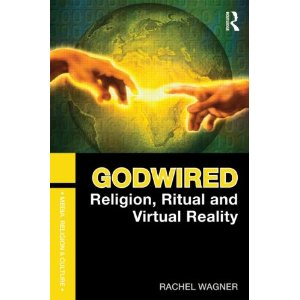

Wired for God

I am not now, nor have I ever been, a techie. When my fascination with the newest technological marvel borders on the rhapsodic, I suddenly realize it’s all electrons and immediately the fascination dissipates. It feels like an illusion. I am a guy who likes the sensation of a paper book in his hands and prefers conversation accompanied by all the subtle biological clues of being in the same room with somebody. Maybe it is lack of imagination on my part, but I will often get bored on the Internet and pick up a book instead. One book I recently picked up, and one that challenged my perception of reality, was Rachel Wagner’s Godwired: Religion, Ritual and Virtual Reality (Routledge, 2011). Wagner is one of that generation of younger scholars who is asking what the implications of electronic culture are for religion. If concepts such as online prayer walls, chat-bot salvation, and storing sacred texts on the same device as secular ones intrigue you, do yourself a favor and read this book.

As Wagner ably points out, religious individuals are tapping into the vast communications’ potential of the Internet to spread their faith abroad. There are apps to help you pray online, there are electronic games to prepare you for the fictitious rapture, and there are virtual churches. We have indeed sealed God in an Xbox, and we have beamed the divine across wireless networks and learned to confess our sins in cyberspace. And physicists are starting to confirm that, at our most basic level, we are energy rather than matter after all. Maybe we are tapping into ultimate reality here. Wagner explores how the level of engagement with virtual worlds constructed by software engineers (the new gods) becomes so intense as to provide an alternate reality. It all depends on how you define what is real. And it is clear that for many people, life without the Internet is now unimaginable. Those of us born before the supercomputer scratch our physical heads with amazement. How did Nebuchadrezzar or Alexander ever conquer the known world without GPS technology? Does my iPhone have a secret life about which I know nothing?

Within our culture live many older people who have never touched a computer. They exist alongside grandchildren practically born with some iDevice in their grasp (may be a choking hazard for children under three). I have lived long enough already to have witnessed keyboarding being replaced by thumbing, and research having shifted from long treks to the library in the snow to a few taps on a glass screen that can feel the electricity from my chilly fingers. From the comfort of my lonely room sings my soul, how great thou art! Perhaps Terminator didn’t go far enough, perhaps Skynet really is god. Maybe this matrix of blood, muscle, bone, fat, and spit is really just an illusion and the Internet is true revelation. Wagner pries open some very important questions in her book. And none of us should be surprised if, when we approach the pearly gates, we find a touchpad next to the electronic lock inscribed with this legend: “Welcome to Heaven. Please enter username and password. Type in the letters you see in the box below.”


Silent Might

Iowa is a state for reflection. For many years Christmas in Iowa was a family tradition, but living on the east coast makes such pilgrimages rare. On Christmas Eve in Ames, we drove past a Nazarene Church decked out for the holiday with a sign reading, “Jesus Came for You.” Perhaps I watch too many movies, but the images that came to mind were of Rambo and The Terminator—menacing figures who’ve sought out their victims for revenge. Coming for you was a threat rather than a promise. Who can forget Arnold’s “I’ll be back”? Was the child who came sent with a mission of punishment or of peace? To hear presidential candidates and other evangelicals tell the Christmas story, it is clearly the former—the Rambo of God who blows away the sins of the world—that we should expect. The Prince of Pieces.

That version of Christianity that likes to present itself as the default, the natural form of what the church has taught all these years, has a strong current of threat running through it. God never shows up unless there is a problem—an absentee father only too swift to remove his ample belt to begin a sound thrashing. Religion often thrives in the context of menace. Teaching that people are evil by nature and only good when under promise of Hell, such believers understand the coming of Jesus to be cause for fear and alarm. According to Luke, the angels began their message with “Fear not.”

How Christmas is understood reflects on the view of Christianity that believers choose. For the advent and arrival of an emissary can be cause for celebration or of fear. In some mangers the infant conceals a cudgel and woe to those who suggest equal treatment of all or a non-literal reading of favorite prooftexts. This time of year stands as an excellent test of what this child will grow up to be in the minds of his latter-day cohort. What arrival should we anticipate? If it is the Jesus of the politicians and evangelicals, we only have to look at the headlines to discover the answer.

What child is this?


What Hath AI Wrought?

Earlier this week an op-ed piece in the New York Times afforded the laity a rare glimpse into The First Church of Robotics, that is, Silicon Valley’s incredible and slightly disturbing vision of the future of technology. The writer of the piece, Jaron Lanier, an insider, expresses a concern that his area of specialization, a kind of artificial intelligence, is blurring the hard line between human and machine. Perhaps it is time we all watch Terminator again. Quoth Lanier, “It should go without saying that we can’t count on the appearance of a soul-detecting sensor that will verify a person’s consciousness has been virtualized and immortalized. There is certainly no such sensor with us today to confirm metaphysical ideas about people, or even to recognize the contents of the human brain. All thoughts about consciousness, souls and the like are bound up equally in faith, which suggests something remarkable: What we are seeing is a new religion, expressed through an engineering culture.” To put this in context, Lanier had been discussing the current concept that it might be possible to digitize human beings to incorporate all people in a Matrix-like universal brain.

I am woefully undereducated on the technology side of this issue to discuss whether or not such high-end digitization is possible. What interests me is the suggestion that this is a new religion. We haven’t even figured out the old ones yet. Defining what a religion is presents a nearly insurmountable barrier even to specialists in the field of religious studies, and some disgruntled conservatives claim that atheism and “sciencism” are religions. No matter how fast or how far you run, someone will always be able to label you as the adherent of one religion or another. Religion is an all-consuming category, a mental conundrum that cannot be contained by mere academic classification and circumscription. It is the universal solvent.

Meanwhile, universities and other learned bodies are reluctant to support the study of religion. In a world where the vast majority of individuals, university professors included, are motivated by religious guidelines and parameters, it is the elephant in the room we’d rather not discuss. From the sidelines I have watched reputable school after reputable school disembowel religion departments since they “don’t bring in money” and add nothing new to our understanding of the human condition. The sad truth is, religion indoctrinates much of the world. Deans and university presidents could learn a lot by reading op-ed pieces in the New York Times. Or at least have their avatars read them and store them away for future recall.