Holiday Fervor

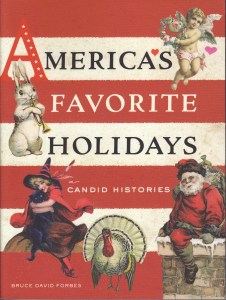
AmericaFavHoliTime comes in different varieties. In temperate regions where the changing seasons keep the time of year for us, we tend to have seasonal holidays. Christmas and other December holidays mark the shortest days of the year with the hope that light will soon become more abundant. Spring rituals, near the time of the vernal equinox, encourage the return of fertility to the earth. Autumnal holidays mark the approach of darkness once again as the world twirls endlessly on. Summer, bright and warm, doesn’t really lend itself to so many holidays. These thoughts came back to me as I read Bruce David Forbes’s America’s Favorite Holidays: Candid Histories. Forbes doesn’t cover all the special days, but focuses on Christmas, Valentine’s Day, Easter, Halloween, and Thanksgiving. These are five holidays marked, in some sense, by spending. They are often, although Forbes doesn’t really spend too much time on it, the focal point of cultural wars where various Christian groups wish to reclaim a certain day for its “rightful heritage.”

One of the real values of books like America’s Favorite Holidays is that it is clear that these claims of “keeping Christ in Christmas” and its kin are samples of collective amnesia. Many “Christmas” traditions predated Christianity. Others developed concurrent with it, but in “pagan” contexts. Christmas trees, for example, didn’t originate in the latitudes of Bethlehem. The same may be said for just about any holiday. Valentine’s Day and Thanksgiving, of the five explored, are the lone exceptions. These are fairly recent holidays and neither one marks a solstice or equinox. They celebrate aspects of life we value, making them sacred time. Don’t expect to get Valentine’s Day off of work, however. Capitalism never makes room for love.

Christmas, of course, is the holiday most under dispute. All holidays may be commercialized, but for Christmas spending is central. Forbes insightfully shows that Christmas is, and may always have been, both a cultural holiday and a religious holiday. The cultural aspect of the season is the one that most people celebrate. The birth of Jesus—which we are fairly certain was not in December—was a latter add-on. A baptism, if you will, of a pre-existing holiday. The winter solstice holiday is a staple of cultures in climes where the difference in available light and warmth is appreciable. It marks the point of the year when things start getting better. Yes, the real cold of winter has not yet set in, and there will be months of snow and ice. Still, once the solstice is passed, there is more light to help us cope. Celebrating sacred time, whether secular or not, is the natural reaction of people who crave light over darkness.


To Whom? For What?

Thanksgiving remains one of the few relatively uncommercialized holidays. Not tied to a specific religion, but with a general sense that gratitude is important, there’s nothing really to sell. Grocery stores may see a bump in profits, but we need to eat every day, so this is only a matter of degree. The icons of Halloween quickly transform to those of Christmas and even Thanksgiving begins to pale next to Black Friday as companies give employees the only four-day weekend of the entire year. Without money changing hands what can there possibly be to celebrate?

The strident question of to whom one is thankful is graciously subsumed under that of for what. History has demonstrated that the relative abundance that we enjoy in matters of gustatory gifts is indeed not to be taken for granted. Droughts are realities. Dustbowls and depressions occur. In many parts of the world starvation is stark reality. Having enough—even too much—to eat is less a sign of blessing for good behavior than it is an obligation to help others. Want is a specter that no one can debunk. The homeless here in a land of plenty remind us that holidays are truly opportunities to be thankful. Thankful simply for being able to get by. Not for what we buy.

IMG_2601

Holidays have their origins in religion. They may wander far from their foundations, but we have religions to thank for every day there’s a break in the routine of trooping into the office for yet another stint of work. Days when staying home is acceptable and spending is purely optional. The stretch from Labor Day to Thanksgiving is long. This goal can only be reached by a frame of mind rather than a state of one’s bank account. Having a day when money falls from focus is cause for thankfulness indeed.


Thank You

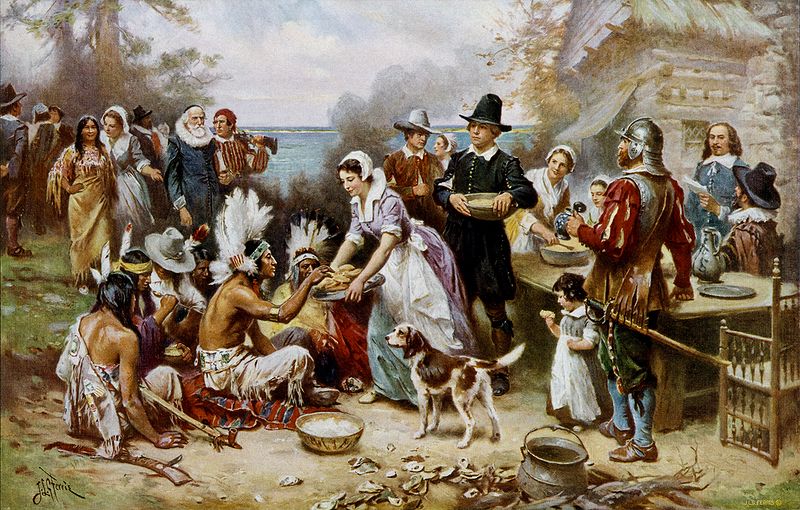
Comments being rare on this blog, I do read them when they come along. Recently I had a reader comment, in the form of a question (as sometimes happens): “Do Native American Indians do ‘Thanksgiving’?” Although I’m fairly certain this was intended as a rhetorical question, I was raised a literalist and couldn’t help trying to formulate an answer. Although I can make no claims to know Native American culture well (I wish I did) it led me to ponder the concept of Thanksgiving. No doubt the idea had at least informal religious beginnings. Even with the early European settlers, a religious diversity was already appearing. Still, although the Native Americans lost pretty much everything, they were still involved, at least according to the early accounts. The great spirit they thanked was not likely conceived of in the way that the god of the pilgrims was, and yet, thankfulness is a natural human response. Writers, often fully aware that their work deserves publication, frequently thank an editor for accepting it. It’s a deeply rooted biological response.

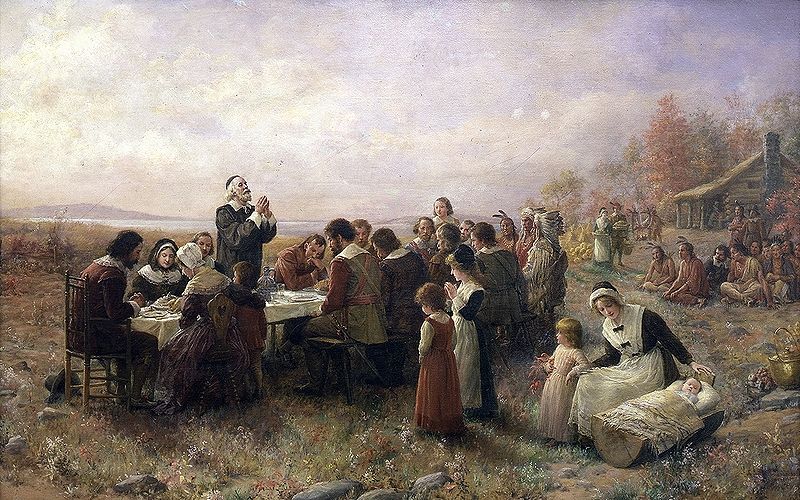
800px-The_First_Thanksgiving_cph.3g04961

For some of us, Thanksgiving is more about having time to recuperate after non-stop work for about ten months. The standard business calendar gives the occasional long weekend, but after New Year’s the only built-in four-day weekend is Thanksgiving. It is that oasis we see in the distance as we crawl through the desert sand. Time to be together with those we love rather than those we’re paid to spend time with. To rest and be thankful.

Among the highlands of Argyll, in western Scotland, is the picturesque Glen Croe. Years ago, driving with friends through the rugged scenery of boulders and heather, the little car struggled with its burden of four passengers. We stopped at a viewpoint known as “Rest and Be Thankful.” The name derives from an inscription left by soldiers building the Drover’s road in 1753, at the highest point in the climb. The Jacobite movement and the Killing Time had instilled considerable religious angst to the Scotland of the previous century and led to the calamity of Culloden less than a decade before the road was laid. These religious differences led to excessive bloodshed throughout a realm supposedly unified by the monarchy. Even though no natives protested displacement, religion led to hatred and mistrust, as it often does. Is not Rest and Be Thankful, however, for everyone, no matter their faith or ethnicity? And in case anyone is wondering, yes, this rhetorical question contains a metaphor to contemplate. Rest and be thankful.


Bleak Friday

Among the high holy days of capitalism, Black Friday stands as a beacon for those in the service of Mammon. It seems that we’ve taken the basic process of fair trade and constructed from it an über-religion based on getting more for less. Certainly in my little world of academic publishing I’ve encountered those who believe marketing a book is far more important than what it actually says. Ironically, my last two publishing jobs were located through LinkedIn. LinkedIn allows you to put your professional life online and those who shop for souls are free to “find” you, read about your accomplishments, and even occasionally contact you with employment options. It may not work for everyone, but it has for me. LinkedIn will also email you with opportunities, and this Black Friday as I opened my email I discovered that the top article they’d selected for me was entitled, “How Neuroscience Is Key to Successful Marketing Strategies.” Welcome to the temple of Mammon.

Screen Shot 2013-11-29 at 4.25.20 AM

Neuroscience has been as fascinating to me as it can be to a layperson. Since we all encounter the world through the gateway of our brains, we stand to learn a lot through its study. Of course, my mind always goes to the deeper questions: what can we learn about religious belief through neuroscience? What can the study of the brain reveal to us about reality? Will this science eventually reveal to us that more than brains are involved in the pure, raw experience of the ultimate? Of course, you can also use this study to figure out how to make a buck. We are so eager to make money that we’ll open stores on the prototypical family holiday itself, before the turkey is even digested. Try to corral the stampedes in a day early, and the great god Mammon smiles. We consume, therefore we are.

If you want to shop, someone has to be on duty. The worker might be enticed from her or his family by the prospect of “time and a half” pay. It might sound tempting, but I ask what the baseline cost really is. We’ve known since at least the days of the Charlie Brown Christmas and the original Grinch that happiness does not accompany owning more stuff. As a society we’ve promoted materialism so heavily that we are left feeling empty without the urge to buy making us feel like we’re accomplishing something important. I still find learning new things more satisfying than buying new things. Ironically, just below the neuroscience article, LinkedIn suggests I read “The End of the Public University?” It seems to me that Black Friday might have more than a single connotation. Of course, I’ll have to check in with Mammon on that; the smart money’s on the most demanding god.


Thanksgivukkah

A moveable feast is hard to hit. Or something like that. Religious festivals are frequently tied to celestial events—the ancient Jewish holidays are based on a lunar calendar which, we all know, is out of synch with the solar one. This is the reason that for Christians Easter migrates around the spring calendar, even if different branches of Christianity peg the resurrection on various dates. Curiously, no one has suggested going back to c. 33 C.E., fixing the date of Passover that year, and giving a calendrical date for Easter. It sure would make planning a lot easier. In any case, a week or so ago there was a flurry of lighthearted commentary on “Thanksgivukkah,” the fact that Hanukkah and Thanksgiving occur at the same time this year. Both are moving feasts, and they just happened to bump into each other this year.

Thanksgiving is a modern holiday, emerging with the Protestant penchant for giving thanks for surviving in a harsh, new world. The United States government (which was not shut down at the time) finally regularized the date of the holiday to the fourth Thursday in November, giving the commercial world it’s only regular 4-day weekend. Christmas, not a moveable feast, cycles around the days of the week, giving employers a great sense of glee when it falls on a weekend so that employees may be given only a token Friday or Monday off. The day after Thanksgiving, however, is thankspending, as American a holiday as one can conceive. Hanukkah is also a roving feast. Celebrating the cleansing of the temple in Jerusalem after being defiled by the Seleucids, it has taken on many of the trappings of Christmas over the years, but it can come as early as late November, as Thanksgivukkah demonstrates.

800px-Thanksgiving-Brownscombe

Holidays, in this secular world, have come to represent something for which the Sabbath originally stood. The idea was that people needed a break from work. Despite all the studies that show more breaks make people more productive, our culture glorifies the over-worker. The reason, clearly, is not productivity, but control. I recall a lawyer once drawing a large circle on a newsprint pad and telling me, “this represents what your employer can do to you.” He drew a tiny circle in the middle of the large one and said, “and this is what your employer can do to you that is considered illegal.” Yes, we are a society that has never really gotten over the idea of indentured servitude. Little things like holidays overlapping keep us amused, while still at our desks. Hanukkah lasts for eight days. Christmas for twelve. But don’t try to take all that off—you might like coming back to work refreshed a little too much. Instead, why don’t you try making those bricks by finding your own straw? Everyone will benefit from this pyramid scheme.


Holy Gobblers

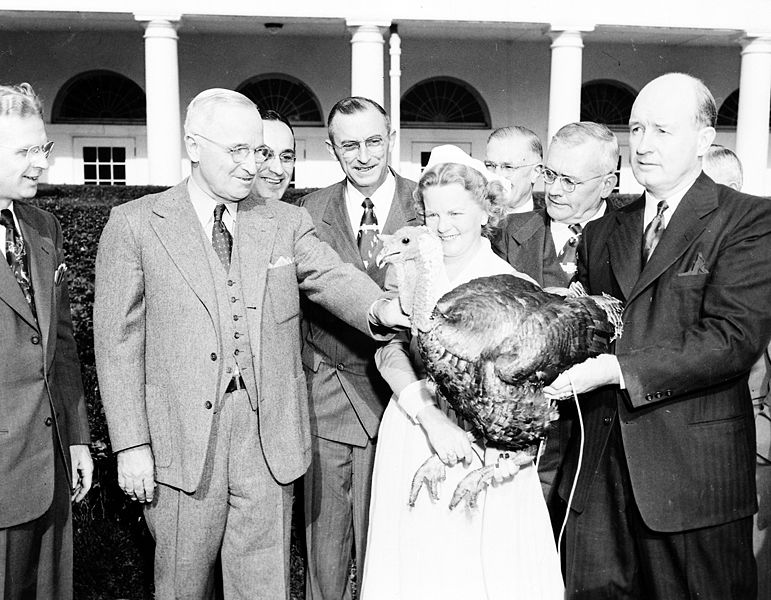
I wonder if this is how religions get started. Yesterday President Obama continued the lighthearted tradition of pardoning two turkeys prior to Thanksgiving. There has been a gifting of turkeys to the United States president at least as far back as the Harry S. Truman years, but the pardoning began, as did many myths, in the Reagan years. Ronald Reagan took considerable heat for pardoning Oliver North after his crimes in the Iran-Contra Affair. Handling criticism with a joke (again, of which there was no shortage in those days), he offhandedly mentioned pardoning the turkey. Reagan had already decided not to eat the bird and had it sent to a petting zoo. The first recorded official pardoning came in 1989 with George H. W. Bush. This seems so close to the origins of the concept of salvation that I have to pause and baste in the implications. Pardon is only effective when there is guilt involved, so presumably turkeys sin. The only sin that suggests itself is gluttony, but I’ve seen more than my share of wild turkeys and they seem to have any natural weight problems under control.

Ironically, the guilt in this case seems to rest with those who do the pardoning. Turkeys grow fat because they are raised to do so. They are, like most eating animals, sacrificial victims—sinless and slaughtered. Again, there is another beautiful religious trope here, but we seldom sing the praises of the noble turkey that takes away the hunger of the (first) world. So, as crimes are committed in real time, we can shift the focus to the turkey. The analogy with sheep in the first century is apt. Like the turkey, the sheep was known as a creature of rather simple mental capacity. The lamb was sacrificed for sins it did not commit. Yet we don’t sing hymns to the noble turkey. In fact, Thanksgiving, being a non-commercial holiday, has largely been eclipsed by Black Friday.

I see a future religion in which the turkey plays a supporting role. All we, like turkeys, have gone a-peckin’. Turkeys have no shepherds, but they are kept in tiny cages, and the pardoned pair are the great Moses and Aaron of the turkey world. They are released to live out the rest of their short, obese lives in relative comfort, having been messianically chosen from before hatching to be spared the fate of being consumed by the ultimate consumer. This is the very stuff (stuffing?) around which Bibles are written. The theology here is as thick as gravy. As a vegetarian, however, my sympathies are with the birds. Heaven help us all when the pardoned pair come back and declare, “Let my turkeys go!”


Dreaming of a Black Xmas

By my best reckoning, Thanksgiving has not yet taken place this year. Since Halloween, such as it was, is now over, we must still be in November. As I was exiting my office building last Wednesday, I noticed that the holiday tree was already going up in the lobby. A few blocks away and I heard the first Salvation Army bells of the season and shouts of holiday cheer. The great tree in Rockefeller Center was being erected. (I picture burly guys with a super-sized tree stand swearing in the cold air—”Left, nudge it to the left!”) Maybe it’s just a storm-weary city glad to be rid of Sandy, but it does seem to be a bit early to me. Holidays, in any modern sense of the word are about opening wallets and injecting cash into the system. The very corpuscles of capitalism. I enjoy holiday cheer as much as the next guy or gal, but I don’t mind waiting for it to arrive. Antici-

Holiday seasons are as old as holy days themselves. In our work-obsessed culture, however, convincing bosses of the regenerative utility of granting more than a single day off at a time is an uphill battle. Productivity is what we’re all about. And so we lengthen our public show of holidays instead. Thanksgiving’s not much of a banker except for grocers, and although turkeys may make great primary school decorations, they don’t really match the productivity and professionalism that corporate offices like to promote. The December holidays, however, give us Black Friday. Listening to the news over the last few days, it is clear that many people are biding their time, already ready to get those distant family members out the door, and let’s get those bargains! pation.

Holidays reflect what we hold sacred. I’m not one of those purists grinches who see gift-giving as some inherent evil—in fact, giving things away is one of the under-utilized tenets of most major religions—but I do wonder how much of it is an appeal to the ego. I feel good when I make someone else happy. Yet at some level, I’ve indebted them to me. I’ve made a business deal. The holy days have been infected with capitalism. Warm memories of not having to go to school for nearly two whole weeks, being with my family—the place I was unquestioningly accepted—and getting presents as well? What could be more sacred than that? But I’m getting ahead of myself. It is still mid-November. After all, Black Friday (and what’s that day before that called?) hasn’t even started yet.

A waif in a manger?


Solstice Now!

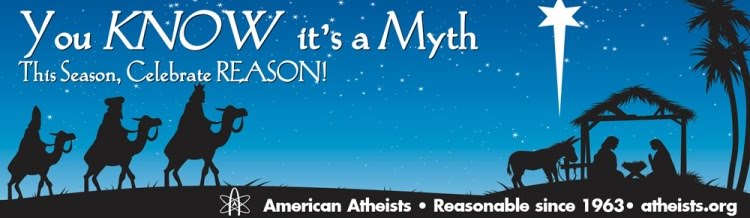
Who owns the solstice? Whoever it is, I wish we could just get it over with. The darkness falls before I step into my 5 p.m. class. It is dark when I drive home. The next morning, leaving for my 8:30 a.m. class, I drive to school in the dark. Back at Nashotah House a colleague once said his wife became “almost pagan” in her yearning to pass the winter solstice and head toward the time of year when light prevails over darkness. My wife pointed out a CNN story concerning a New Jersey billboard sponsored by American Atheists. The billboard, just on the Jersey side of the Lincoln Tunnel into New York, shows the star of Bethlehem, the manger and the wise men. The inscription reads: “You KNOW it’s a myth. This season celebrate REASON.” Naturally, motorists are up in arms. Who owns the solstice?

Before the Thanksgiving leftovers even hit the fridge, Christmas season has begun. Santa always ends the Macy’s Thanksgiving Day Parade, making it official. Since we are capitalists, we do what the red-suited captain of industry says: shop. As long ago as A Charlie Brown Christmas complaints of the commercialization of Christmas have reverberated through the media. Personal properties and billboards enjoin us to “keep Christ in Christmas” and remember “the reason for the season.” Economists tell us to spend more to assist the sluggish economy. Meanwhile the light continues to fade; the days grow darker. Why confuse the issue with religiosity? Why not just spend some money on others, feel the release of endorphins, and be thankful?

Nobody knows when Jesus was born. The church selected December to celebrate the event because the shortest day of the year, for those north of the equator, had long been a time of fervent wishes for the return of light. The first-century Christian rivals, the Gnostics, believed in the continual, literal struggle between light and darkness. When sidelined by Orthodox Christianity, the torch was taken up by those who celebrated Saturnalia, Lupercalia, Hogmanay, Yule, Sol Invictus or any number of other winter festivals. Christmas was a relative late-comer to the celebrations that welcome the resurrection of the sun. So drivers from New Jersey should take it easy. The solstice is everybody’s holiday. I just wish that whoever’s in charge would give us all a little more light.


Thanksgiving Day

This post is an excerpt from my unpublished book for young readers giving the history of American holidays:

When you think of Thanksgiving you may see visions of a big turkey dinner and a four-day weekend. If you’re like me (I hope not!) you probably think that ever since the first Thanksgiving dinner in 1621, Americans have had a big November feast every year since. This popular cozy image may be heartwarming, but it is wrong. Thanksgiving in history is a custom that goes back to the Puritan settlers. Puritans came to America so that they could practice their religion freely. They were religious people (not a great sense of humor); things had been pretty tough for them – crossing the stormy Atlantic in small ships, not knowing what to expect when they arrived, lots of people dying on the way – not an easy thing to do! Once they got here, there were no grocery stores and they hadn’t planted crops earlier in the year, they didn’t even know what would grow here. Many didn’t survive, they weren’t America-tolerant you might say.

What we think of as the first Thanksgiving involved English colonists (Pilgrims) in the Massachusetts Bay Colony and the Wampanoag tribe of Native Americans. One of the Wampanoag, Squanto, served as an interpreter – pretty big of him, considering he’d learned English from being a slave. He taught the settlers how to grow corn, which was unknown in Europe. (What the English called “corn” is what we call “wheat.” The more correct word for what we call “corn” is “maize.”) Squanto also taught the Pilgrims how to catch eels to eat – maybe he found a way to pay them back after all! The first Thanksgiving meal in 1621 followed the Pilgrims’ first successful harvest. They ate deer and some wild birds – enter the turkey! – along with their crops.

You see, both the Wampanoag and the English had traditional harvest festivals – many peoples do. “Thanksgiving,” however, has to do with, well, giving thanks. Did I mention that the Pilgrims were religious? They believed that God had successfully brought them here, so they thanked God. Not every early harvest was so great. In a bad year they had a day of mourning rather than a Thanksgiving feast. Some historians place the first “Thanksgiving” in 1923. The Pilgrims had experienced a drought. Frantically they prayed for rain, and, Flanders-like, it came. So they held a Thanksgiving. These Massachusetts Puritans held Thanksgivings in church rather than around a banquet table. For them, these irregular days of giving thanks marked the survival of difficult times, not fancy food. So they held occasional Thanksgivings, not watching football after a big meal, but praying in church. By the middle of the 1600s settlers began to have a harvest-day Thanksgiving pretty much every year, but not always on the same day. They had not set a specific date to give thanks and feast.

Puritans, you must realize, gave thanks at the proverbial drop of a buckled hat. They prayed before meals as a regular practice – something many families continue to do. To set aside a day for special prayers, like Thanksgiving, was as natural for them as women wearing bonnets. The practice of having an annual (yearly) day of giving thanks got underway in Massachusetts around 1630. Other colonies joined in, but not always at the same time. Remember, harvests come at different times in different places.

[See Full Essays for the rest of the story.]


Highway Homiletics

“Over the river and through the woods to grandmother’s house we go,” is an assertion to be taken literally in my case. Crossing the Delaware River and trekking through the forests of Pennsylvania are the only means to reach my childhood home from New Jersey. Each time I make the trip I am amazed at how strident the highway preaching along the way has become. Signs on both the interstates and the backroads announce the truths of a certain vociferous brand of Christianity that maintains that everyone must think that way or spend an eternity in hell. Having experienced this kind of fear-driven faith firsthand, I can’t protest too much without being labeled a hypocrite, but some of what I observed over the river and through the woods leapt out at me anew this Thanksgiving.

Firstly it seems that Jesus saves big rocks. Several large, obtrusive boulders worthy of the land time forgot bear the message that Jesus Saves. Locally this form of homiletics can be as persistent as the Trust Jesus notes spray-painted on just about every interstate overpass between here and Illinois. A religiously aware lumber company in rural Pennsylvania hosts a sign declaring, “Read, Heed, Live & Obey the Bible!” When I think of lumber, I think of 2-by-4s and of their standard use of knocking sense into others who look at things differently. This sign said more than its owner might have intended. A few miles down the road I read, “Why not try Jesus? If you don’t like Him the Devil will always take you back.” The assumption, naturally, is that anyone reading the sign is already devil’s food.

One of the great things about freedom of religion and freedom of expression is that such messages declare their writers’ fervent beliefs, but they hold no force beyond the rhetorical. Having met many sincere believers in other faiths over the years, I do wonder what kind of good news such non-negotiable advertisements really send. Some of the writers, I believe, are railing against the godless world they see around them (although the number of churches along these backroads would seem to testify to religion a-plenty) while others can’t accept any form of any religion that differs from their own, even if it be a different flavor of Christianity. Perhaps it is time I put up a sign advocating a vegetarian version of Thanksgiving — no turkey need die for anyone’s sins. In some religions such a message is considered trustworthy indeed.