
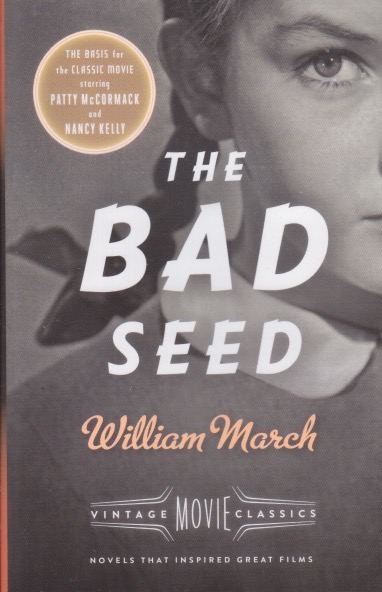
Not too long ago I watched The Bad Seed. In the 1950s it probably wasn’t considered horror, but it is quite a scary movie. I’d classify it as horror—not all fifties horror was guys in rubbery suits. When reading about the movie afterwards, I learned the novel had a darker ending (the movie was pretty dark as it was). So I decided to read the book by William March. The movie’s fairly faithful, up to the ending. As usual, the novel adds more detail and reveals some things rather differently. For example, Christine Penmark, the mother of Rhoda, can’t ask her father if she’s adopted. She “learns” this through inference. Indeed, the book leaves you wondering if she’s actually mentally unstable. The proof that she’s the daughter of a serial killer is strong but not definitive. And her father is already dead when the story opens.
The school outing, where Rhoda claims her second victim, is where the movie opens. Rhoda is expelled from the school because the women who run it can’t abide Rhoda’s dishonesty. The character of Leroy is very well portrayed in the movie, but he too seems to have some kind of mental illness. Monica Breedlove is accurately presented as a busybody, but she too spends a lot of time analyzing people, including herself. Rhoda is, of course, a literal sociopath. It’s fair to say the novel is an extended exploration of mental illness of various sorts. I remember from growing up in the sixties that many conditions that are now regularly diagnosed simply weren’t recognized. Kids were blamed for bad behaviors that were, in all likelihood, caused by being somewhere on the spectrum.
Much water has passed under the bridge since the fifties. This book was a bestseller then, but I only learned about it last year. Indeed, it’s been adapted to film three times and was a Broadway play before all that. There was a sequel released a couple years back. Rhoda Penmark is herself a trope of the narcissist who lacks empathy. Hmm, where else do we see that? It’s still analyzed as primarily a “nature verses nurture” novel, but I suspect there’s something more going on. We’ve moved beyond Freud and this novel probes what goes on in the minds of those who spend too much time alone, as well as who happen to be the mothers of pathological child murderers. And the ending is different, but the movie’s is equally as bleak. The Bad Seed a good book for this particular January.

 Steve A. Wiggins