The Grammar of Evil

I stepped into a devil of a situation. Elevators are strange spaces. Given the choice, I’ll take the stairs any time. At work, however, as one of the many quirks of Manhattan, our elevators only stop on certain floors and we’re not able to use the stairs unless it’s an emergency. After a meeting on a floor where the only option was to elevate out, I stepped into a crowded elevator where a conversation was going. “You always capitalize Satan,” someone was saying. The usual questions among non-religion editorial staff ensued. Why is that? What about “devil”? “It’s never capitalized,” came the reply. My profile at work is about the same as it is on the streets of New York. Not many people know who I am or what I do. Although I’ve struggled with this very issue before, on a professional level, I kept silence and waited for my floor.

So, was the elevator authority right? “Satan” has become a name, rather along the lines of “Christ.” Both started out as titles. In the Hebrew Bible “satan” is “the satan.” The accuser, or the prosecuting attorney—something like that. As one of the council of gods, the satan’s job was to make sure the guilty were charged of their crimes. Diabolical work, but not evil. By the time of early Christianity, however, Satan had evolved into a name. It is therefore capitalized. It was specifically the name of another title, “the Devil.” Or is it “the devil?” Do we capitalize titles?
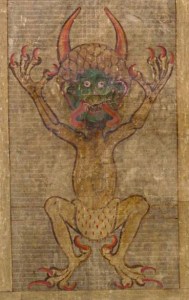
The Devil wears underpants.

The Devil wears underpants.

In seminary and college the received wisdom among those of my specialization was that there is only one Devil and the title should be capitalized. My elevator colleagues were discussing the number of devils when I stepped out. Traditional theology says there’s only one. Not that the Bible has much to say about the Devil—he’s surprisingly spare in sacred writ. Demons, however, are plentiful. Some people call demons devils, just as many believe that when good people die they become angels. The mythology behind demons seems to be pretty well developed in the biblical world, but again the Bible says little. Demons can be fallen angels or they can be malign spirits who cause illness. Either way they’re on the Devil’s side. But should we capitalize his title? The Oxford English Dictionary doesn’t help, giving examples of both minuscule and uncial. I suppose that’s the thing about the Devil; you never really know where you stand.

School Bible

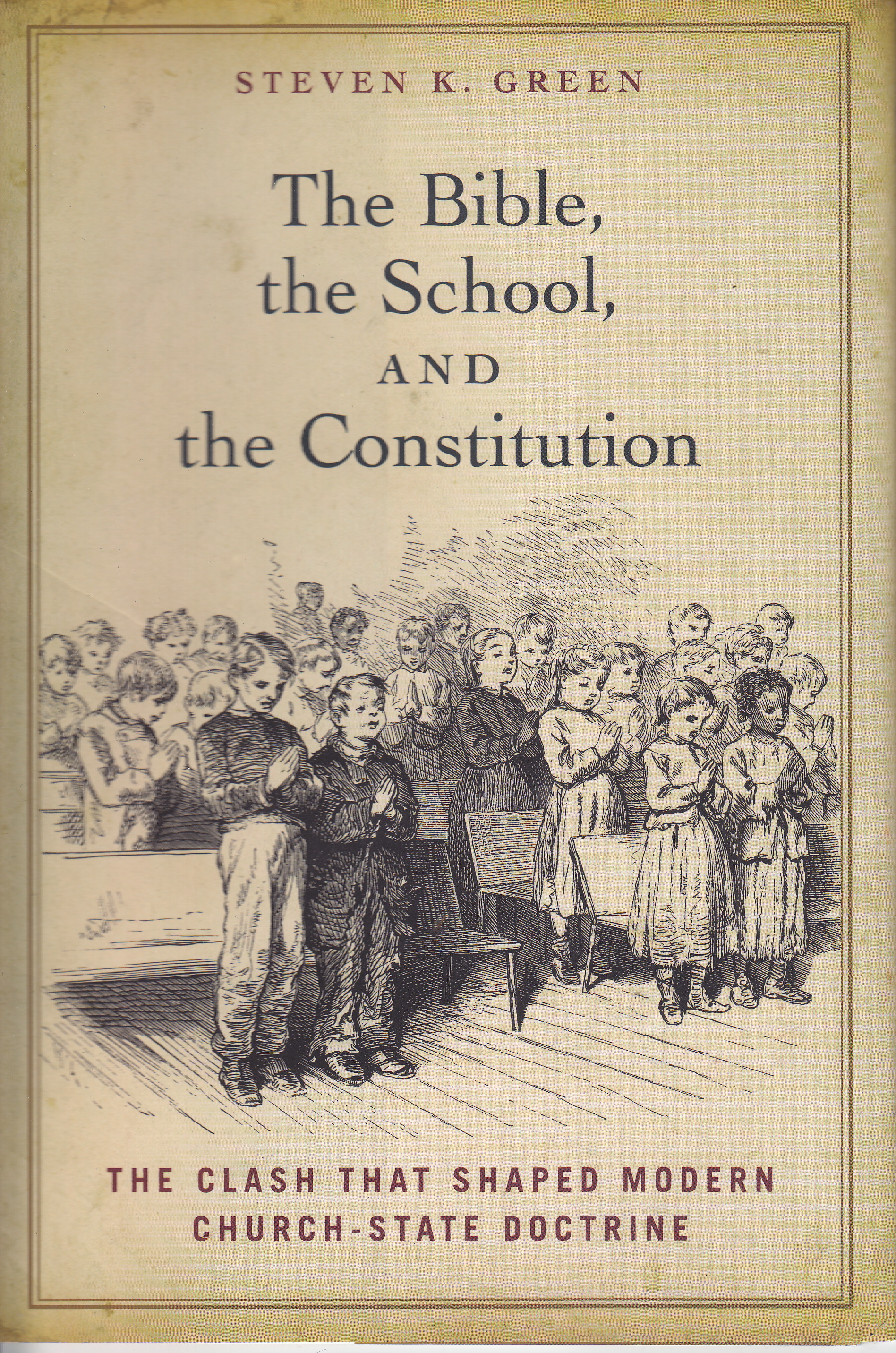
BibleSchoolConstittnAs a very young scholarlet, I recall the horror expressed when some form of prayer was expelled from public schools. It had to have been in the late ’60’s. Maybe early ’70’s. The nation, it seemed, was headed for Hades in a hurry. Little did I know that this was part of a long, drawn-out—tired, even—battle. Steven K. Green’s The Bible, the School, and the Constitution: The Clash that Shaped Modern Church-State Doctrine gives pretty close to the full story. Bible reading in public schools was foundational, in the beginning. In the early days of public education, the Bible was ubiquitous. It was considered non-sectarian since practically everyone was a Protestant. When the religious mix of the country began to diversify in the mid-1800’s, a new dynamic emerged. People got upset. There were riots. People were killed. Legislation was proposed that would explicitly add God—Jesus even—to the Constitution. Who knew?

Green’s study takes a close look at the various cases that arose around the time of the Civil War regarding the Bible in school. Protestants, it seems, didn’t appreciate that Bible reading, in the King James Version, without comment, violated Roman Catholic policy. The first to challenge Bible reading in public schools were Christians. Secularists only joined the fray later. I’m oversimplifying, of course. Some Catholics wanted equal time, the reading of the Douay Bible instead of King James. Others wanted Catholic schools to receive state funding. Nobody was really aware of other religions such as Hinduism or Buddhism. It was a country of limited religious imagination. Various groups tried in various ways to get God—their God only—into schools as the default deity. And so the fun continued.

For me, it was eye-opening to realize that all of this isn’t new. The legislation, since long before my grandparents were born, has been heading in the direction that led to the aggrieved tears in my youth. Green points out, however, that the conflict has never been completely resolved. School vouchers and a long spate of evangelical presidents have had their impact on our children. The Hades that we feared has only come with the weaponizing of our culture, largely by those who want Bible reading back in the schools. The thing we fear finds us through the thing we love. Ironically the issue never seems to be education. God or guns—it’s the power that we want. The early debates revolved around morality. How could kids be moral without Bible reading? How the definition of morality has changed. We, as a nation, still can’t figure out religious freedom or how to let kids be kids.