
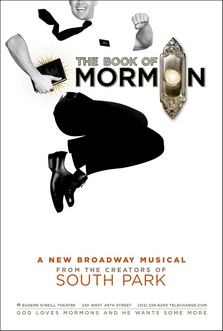
Some time ago we went to see Book of Mormon on tour. I really knew very little about it other than it was consistently praised as being very funny. I’m always a little concerned about poking fun at anyone else’s religion because I know people take their beliefs very seriously. As I reflect on the show (which was quite funny) it seems that it wasn’t so much poking fun at the Latter-day Saints so much as it was poking fun at religion itself. That’s less problematic as it’s not singling anyone out for ridicule. It’s a system that’s being made light of. Or at least any religion that is an effort to convert others. There’s a kind of violence to it. And if Book of Mormon is about anything, it’s about missionaries. Amid the laughs it makes some valid points—trying to convert people without first trying to understand their culture is a fraught activity.
People want religious specialists who thoroughly understand their tradition. I can say from experience, both as an erstwhile seminary student and a seminary professor, that the time given to become an expert is insufficient. The older I’ve grown the wider the perspective I’ve tried to step back to see. To be an expert on a religion really requires some facility with understanding other religions. To understand, say, Methodism, you need to understand Anglicanism. To understand Anglicanism, you need to understand Catholicism. To understand Catholicism, you need to understand early Christianities. To understand early Christianities, you need to understand Judaism. And so the widening concentric circles go. Nobody can be an expert in all of them, and each of these religions mentioned has, in its own right, sub-specializations that have their own experts. Who has time to learn the religion of those they intend to convert?
Any religion that makes supernatural claims (and many of them do; it’s their nature) makes extraordinary allegations. Those allegations, when examined closely, reveal some improbable elements. Trey Parker and Matt Stone, two of the authors (most famous for South Park) apparently said that they had no intention of making fun of anyone’s religion and a spokesperson for the Latter-day Saints indicated that no real offense was taken, acknowledging that it’s parody and parody is only offensive if it’s taken seriously. Many religions have thin skin when it comes to parody or satire. The serious part is that some religions, in real life, take conversion of all others with a zeal that could (and does) become dangerous. Still, this musical is very funny, as long as it’s not taken too seriously.

 Steve A. Wiggins