Acts of Apostles

“Manifesto,” the poem that launched Banned Book Week 2010, was written by banned author Ellen Hopkins. As a perspicacious undergraduate I know pointed out, each stanza of this poem addresses an aspect of that strange cultural fear known as Banned Book Week. Her line, “false
patriots who live in fear of discourse,” in stanza one makes me tremble each time. You see, it is easy to believe that censorship applies only to Nazis goose-stepping around bonfires with books flying through the air like a Steven Spielberg movie, or even, more recently, The Book Thief (the book is better than the movie), or godless Communists. That fear, however, travels both forward and backward in time. The Patriot Act has been at work effacing liberty for several years now, and people too fond of fear are unwilling to withdraw it. The world of frightening ideas in which we live, however, is nothing new. Literary artists bring us to uncomfortable places. That’s why we read them.

If we turn history’s pages back to the Nazis, we find ourselves sitting in judgment over their cowardly act of book burning. Those who never read of the phoenix are swift to recreate the myth. But we do history a disservice if we stop there. I was recently reminded that burning books has a biblical precedent. According to Acts 19.19, while Paul was performing miracles in Ephesus, those who were converted brought out their books of magic and burned them, to the approval of the nascent Christian movement. A Bible that advocates the burning of books is ironic, for the Bible itself has been banned in parts of the world. What greater crime against humanity can there be than the deliberate destruction of its own cultural heritage? We don’t believe in magic any more, but we still burn books.
NewYorkSocietyForTheSuppressionOfVice

Owen Davies, in his book Grimoires, shows that the practice goes back even further, with Romans burning books of magic as early as 186 B.C.E. There is a perverse symbolism at work here. As someone who admires, but can’t afford, antique books, the thought of ancient documents intentionally destroyed appears as one of the most easily preventable of cultural crimes. Sometimes as I hurry through the Port Authority Bus Terminal to reach my gate, I see the military guards with machine guns and full combat fatigues and I hope that they don’t stop me to search my bag. The only thing I’m carrying is books. Books, however, convey ideas. Banned Book Week reminds us each year that ideas are essential to the life of the mind. They may be burned or banned, but they will live on. The cost, however, may never be fully recovered by the society that permits its ideas to be incinerated.
2013 in Books

Screen Shot 2014-01-05 at 6.03.10 AM

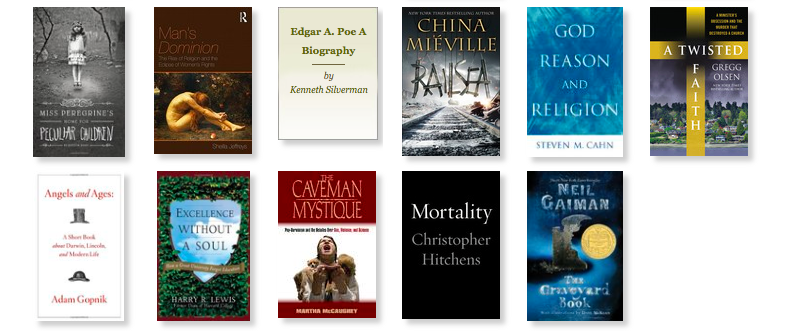
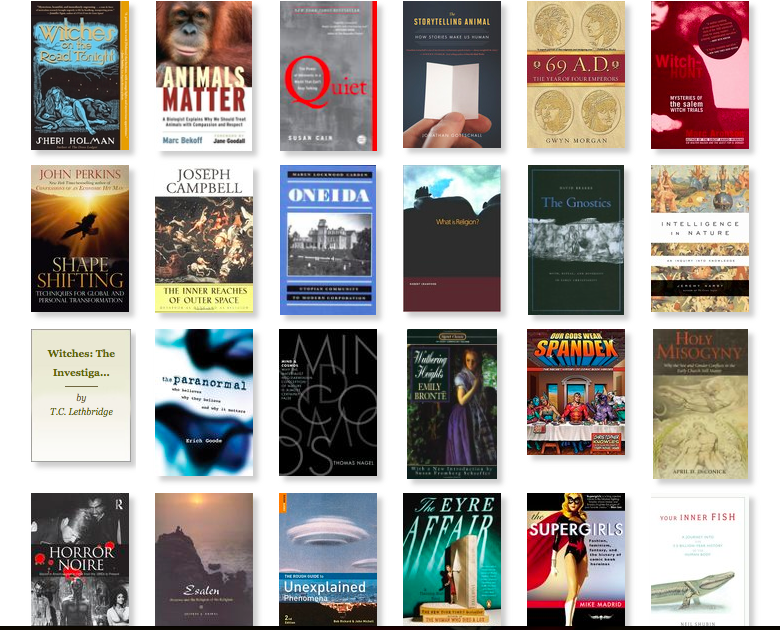
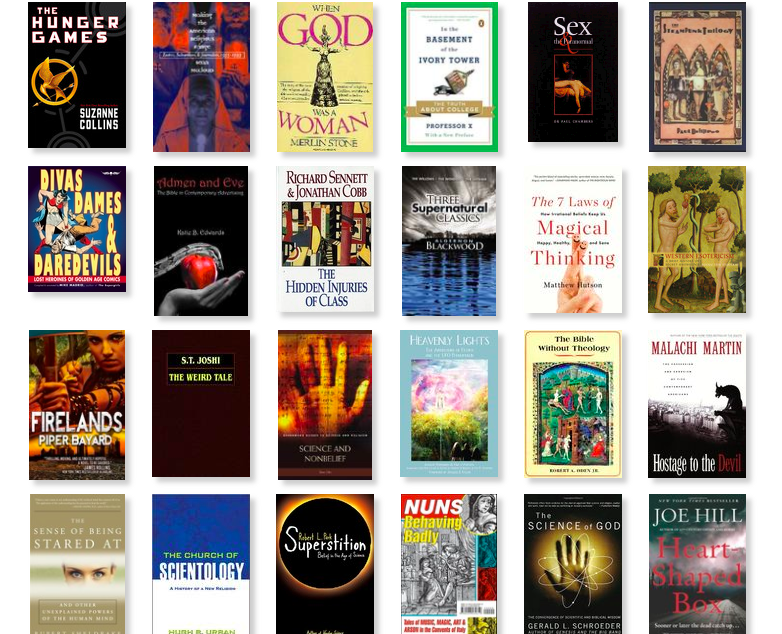
According to goodreads.com, I read 83 books in 2013. The beginning of a new year seems a good time to assess what is memorable among the reading material of the previous twelve months. I am an eclectic reader: this informed my research when I was teaching in higher education—nobody can know everything, and it doesn’t hurt to keep an eye on what fellow researchers in “unrelated” areas are doing. I always throw in a healthy dose of novels as well. Among the novels, some of the most profound were those written for younger readers (each of the books discussed here, by the way, can be found discussed in more detail by selecting the category “books” at the right on this blog). Neil Gaiman’s The Graveyard Book, Ransom Rigg’s Miss Peregrine’s Home for Peculiar Children, Suzanne Collins’ The Hunger Games, and Markus Zusak’s The Book Thief all stand out as particularly profound. They are all, as young adult books tend to be, stories about coming to terms with the adult world. The theme of death weighs heavily in all of them. In none do the children take refuge in religion.

Screen Shot 2014-01-05 at 6.02.33 AM

Among the non-fiction offerings, revisiting my most memorable also reveals trends, I think, in how religion might be usefully applied to an increasingly secular culture. It is no easy task to choose favorites, but I see that I read three books about comic books: Mike Madrid’s The Supergirls and Divas, Dames, and Daredevils, and Christopher Knowles’ Our Gods Wear Spandex. The work of Jeffrey Kripal started me on the quest of taking superheroes seriously as sublimated religious figures. Clearly that is the case, as has become increasingly apparent in top-grossing movies. Another set of books (Thomas Nagel’s Mind and Cosmos, John Angell and Tony Marzluff’s Gifts of the Crow, and Curtis White’s The Science Delusion) highlighted some of the deeply rooted flaws of a materialist reading of the world, whether they intended to or not. Robin Coleman’s Horror Noire, and Susan Hitchcock’s Frankenstein indicated that monsters are among the most eloquent of social critics, even when they have little to say. I would recommend any of these books without hesitation.

Screen Shot 2014-01-05 at 6.02.02 AM

Some of my reading was on specific religious traditions. Maren Cardin’s Oneida, Hugh Urban’s The Church of Scientology, Sean McCloud’s Making the American Religious Fringe, and Andrew Chestnut’s Devoted to Death each showcased either a single or several traditions that have emerged in the last century or two that have had a striking impact on America’s religious morphology. Katie Edward’s Admen and Eve is a great example of how businesses have figured out that a religiously hungry society will buy, if marketing pays attention to religion. Among the most powerful books I read were Susan Cain’s Quiet and Jonathan Gottschall’s The Storytelling Animal. Being human is, after all, the most religious of experiences. Starting with fiction, I’ll end with fiction. The novels for adults I remember most vividly are those with strong female protagonists: Sheri Holman’s Witches on the Road Tonight, Piper Bayard’s Firelands, and Elizabeth Kostova’s The Historian.

Screen Shot 2014-01-05 at 6.01.24 AM

This blog offers me a chance to give brief sketches of books that have much more to say than a few words might summarize. The fact that religious ideas and themes might be found in such a range of books underlines once again that we live in a religious milieu, whether we want to admit it or not. Read on!


Honorable Theft

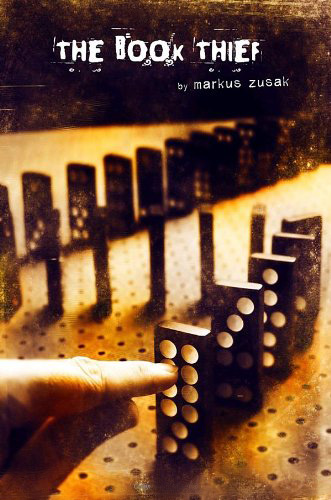
The_Book_ThiefYoung adult literature can be amazingly profound. My curiosity about Markus Zusak’s The Book Thief bubbled to the surface after the movie was released last weekend. I didn’t see it, along with thousands of others, because of its very limited theatrical release. I’m sure you know that distressing feeling when you type your zip code into Fandango and come up with zero results. Short of going all the way into New York City just to see a movie, I was pretty much out of luck. The silver lining is that it made me read the book. I’m not sure what I was expecting (I can also be the victim of hype), but what I found was deeply engrossing while also being deeply disturbing. Spoiler alert!

The Book Thief is set in Nazi Germany. It is narrated by Death. The protagonist, Liesel Meminger, represents the plight of all people; we have no control over when, where, or to whom we’re born. With parents considered enemies of the state, the Book Thief is raised by foster parents who are German, but who are also poor. They are good people, and much of the tension in the book revolves around their hiding a Jewish friend in their small house. The convention of Death as a narrator predates George Pendle’s Death: A Life, by three years. Although in the end Death is the only survivor, he is remarkably sympathetic to the human condition. Death also supplies the main religious observations in a book otherwise devoid of God. When Death attempts to pray during the horrors of war, a devastating conclusion is drawn: “God never says anything.” Is that why Veteran’s Day celebrations tend to be so silent? There may not be any atheists in foxholes, but there’s no God there either.

As Death stalks all those who are dear to her, Liesel finds her comfort in books. Although she begins the story illiterate, and although books are difficult to find in a poor family in a nation at war, Liesel discovers that words have a power that even dictators can’t steal. Her love of reading saves her life as her street is obliterated in an air raid. Even Death has to question the futility of war. In my most idealistic of moments, I hold the conviction that many of the world’s evils would be eliminated if people just read more. We would discover, for example, that even the devastation of war can be overcome by words. The only book Death is portrayed as reading is the Book Thief’s life story. And this gives Death pause, because even young adult literature can be amazingly profound.