A Century of Horror

I’m not a magazine reader.  When I go to a waiting room (which is quite a bit lately), I tend to take a book.  The October issue of The Christian Century, however, caught my eye.  As a more mainstream/progressive Christian periodical, CC used to circulate in the office of one of my employers since it features books, the way progressives generally will.  This October, however, it featured five articles on “faith and horror.”  I had to take a look.  I know three of the five authors, one of them without realizing he was a horror fan.  An article by Brandon R. Grafius, “The monsters we fear,” discusses the commonalities between fear and religion, ground that he treats in Lurking under the Surface.  “The wisdom of folk horror” was written by Philip Jenkins—I didn’t know his horror interest—and it engages, briefly, The Wicker Man.  He’s making the point that folk horror is often about somebody else’s religion.
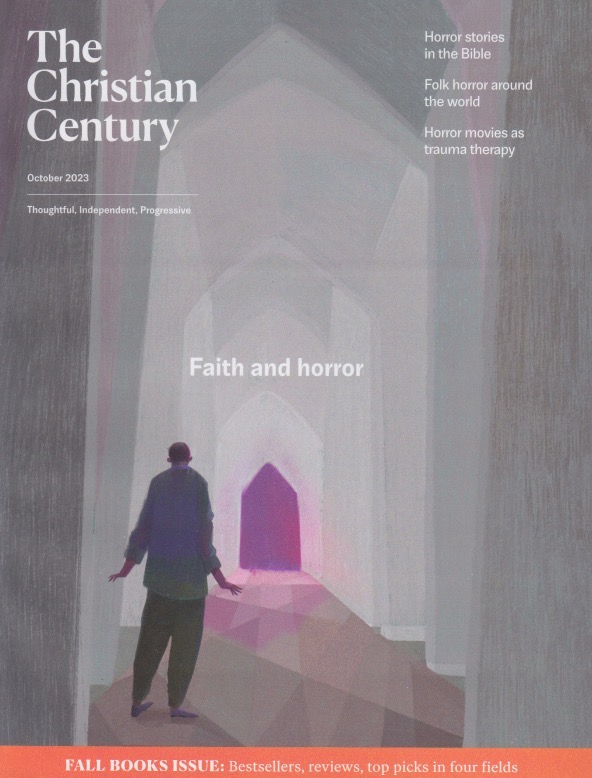
It was “Horror movie mom” by Jessica Mesman that really hit me.  Mesman was traumatized in her youth, and like many of us who were, has turned to horror for therapy.  This is a moving piece and is worth the cover price of the magazine.  Gil Stafford’s “A theology of ghosts” also gave me pause.  Stafford is an Episcopal priest who considers ghosts to be more than just woo.  In this very personal piece he thinks about what that means.  The last feature, “God’s first worst enemy,” is by Esther J. Hamori, one of the colleagues who talks monsters with me.  The piece is adapted from her recent book, God’s Monsters.  Taken together these pieces are quite a mouthful to chew on.  While numbers in mainstream Christianity are declining, Christian Century is still a pretty widespread indication of normalcy.

When I wrote Holy Horror I only knew about the work of Timothy Beal and Douglas Cowan as religion professors writing on monsters and horror.  That book admitted me to a club I didn’t know existed—the religion and monster crowd.  Since I’m not welcome in the academy, I’m particularly drawn to pieces like Mesman’s since she’s writing from the heart (as is Stafford here).  I’m just glad to see this topic getting some mainstream coverage.  I know I’m a guppy in this coy pond, but I do hope they’ll consider, over at the Century, turning this into the theme for their October issues in coming years.  If they do, they can count on at least one extra counter sale.

Horror Therapy

It’s Friday the 13th.  Like Barbra and Johnny I’m driving to rural western Pennsylvania to visit a cemetery.  It must be October.  I’m not a magazine reader (this has probably hampered my development as a writer [I prefer books]), but the October issue of The Christian Century is devoted to religion and horror.  This morning I watched an interview with Jessica Mesman on her article on horror as therapy.  In it she discusses her mother’s death.  Since we have this in common, I was intrigued.  Mesman states that studies substantiate that watching horror functions as therapy for people with PTSD.  It has been suggested to me more than once that my career malfunction at Nashotah House led to PTSD.  It may be no coincidence, then, that I started watching horror after that happened.  When The Incarcerated Christian podcast was still going, I was interviewed three times and the topic was, broadly, how horror acts as therapy.

Until today I’ve had to work daily and then make arrangements for an unplanned trip to celebrate my mother’s life as I could.  I’ve never met Jessica Mesman, but I sense that she would understand what I’m going through.  As I grapple with grief, loss, and relief (my mother was ready to die, but I had been unable to see her for a few years because of the pandemic and other circumstances) what I feel I really need is to watch a horror movie or two.  I have found—and 2023 has been a traumatic year for me—that when I’m feeling overwrought, taking ninety minutes to watch a horror film can get me back on track.  It helps me cope.

None of this is intended as any disrespect for my mother, whom I love deeply.  Although she didn’t read my books, she knew I watched monster movies as a kid.  She occasionally grew annoyed with me when such things made me too clingy—she had two other sons and her own dying mother in our home and she was trying to keep it together with my father gone.  Looking at photos of my young self, I wonder if that early loss of a parent translated to a kind of childhood PTSD.  Once I’d successfully (?) made it to adulthood, Mom told me—“you were the one I worried about; you seemed to have difficulty adjusting.”  I sought therapy in religion.  I’ve dedicated my life to it.  Until it too became a source of grief, horror, and pain.  As I prepare to drive to her funeral, I’m pretty sure that Mom understands.


Seminary History

Seminary is where you go to learn what they didn’t tell you growing up.  Many people have rather idealized views about clergy and somewhat untrained views about their church (the same may apply for religions outside Christianity, but I wouldn’t be so bold as to say so).  Since church membership is declining, albeit not drastically, seminaries are finding themselves less in demand.  Meanwhile all manner of political candidates can claim a biblical literacy they don’t rightly deserve, and who’s to challenge them?  It is sobering to read The Christian Century and see just how sickly theological education appears to be.  Seminaries closing, seminaries merging, seminaries not really appearing on anybody’s radar scope.  As the founding institutes for nearly all the Ivy League universities (which are not closing), it seems that few people appreciate just how much our seminaries have contributed to our culture.  Our culture, however, is focused on more material pursuits now.  Let history bury the dead.

IMG_2694

The days when clergy were a step away from royalty and political power are long gone.  Figures like Increase Mather could personally pull cords with the crown to select a governor for colonial Massachusetts.  Rev. Martin Luther King, Jr. could almost single-handedly lead to the beginnings of the demise of one of the greatest social injustices in a democracy.  Even Fred Rogers could daily assure us that it was a beautiful day in the neighborhood.  Seminary graduates all. None of that matters now, as long as my back pocket’s heavy with greenbacks and one of the rich elite inherits the White House.  The thing is, seminary helped many of our past leaders to mature.  Not just spiritually, but intellectually.  Obviously seminaries aren’t perfect.  They can leave you with PTSD just as easily as a PhD.  Still, I wonder at the loss.

I didn’t know about seminaries, growing up.  Those who attend fundamentalist, non-denominational churches seldom do.  When I learned that there were specialized schools to attend to become a minister, I was intrigued.  I guess the idea of a monastery was somewhere in the back of my head.  Little did I realize that seminary was about forcing you to think about things you’d always assumed.  Yes, seminaries have their casualties.  Some leave with as simplistic an outlook as when they entered.  For the majority, however, it is the opportunity to find out that the world of religious belief is much more complicated than people would ever, ever imagine.  Angels dancing on the head of a pin, this is not.  Any computer could calculate that with the right algorithm.  Those who think deeply about what they say they believe are rare.  They do a service to society in general, but only if we are willing to listen.  When the doors are closing, this will become increasingly difficult.  As long as the money flows, I guess it really doesn’t matter.