Final Rites?

The Conjuring: Last Rites, aka The Conjuring 4, is more of the same.  Reusing tropes that have ceased to be scary, it draws Annabelle back into the story and sets up the possibility of future films by getting the Warrens’ daughter Judy involved.  It is kind of a downbeat to pick up the Smurl haunting since this is widely considered to have been a hoax.  And the movie pulls out all the stops.  Levitation, upside down crosses, and demonic faces suddenly appearing have all been done before.  The conceit that a demon is using ghosts to torment the Smurls is familiar from earlier films in the series.  The franchise, however, remains quite Protestant despite its Catholic trappings.  The somewhat heavy-handed suicide of Father Gordon once again demonstrates the lack of deep comprehension of how Catholicism operates.  It is meant to parallel the suicide that starts the movie, but really adds nothing to the plot beyond shock.
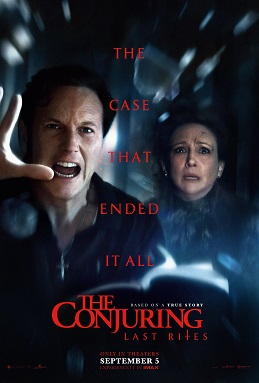
The film tries to do too much and loses any pathos among the Smurls because of the strong subplot, if not the main plot, of the threats against Ed and Judy Warren.  To do this they had to make the real life Judy much younger than she is in real life and cast the unnamed demon threatening the Smurls back to an attack on Lorraine, while pregnant with Judy, in the 1960s.  This allows for a Stranger Things aspect of the 1980s for the action.  It also strangely misrepresents Pennsylvania.  The script seems to presume West Pittston is near Pittsburgh (it’s not, but rather close to Scranton) and it shoots the location in England, obviously for cinematic reasons.

There’s a lot of insider knowledge presumed here—you need to know the fictionalized backstory the series has been building up over eight films.  This comes to a head in the revisiting of actors from the past Warren cases at Judy’s wedding.  Perrons, Hodgsons, and a Glatzel attend, valorizing the often controversial work of the Warrens.  (They were ejected from the Perron house and visited the Hodgsons for maybe part of a day.)  The other movies in the series tend to hang together better but the lack of deep understanding of Catholicism remains perhaps the largest hurdle.  Interestingly, at the box office this has been the highest performing film in the franchise so far.  Since the Conjuring universe is encroaching on 3 billion dollars (2.7 at the moment) gross profit, clearly it strikes a chord.  And there’s every reason to suppose, prequel or sequel, it’s not really the last rites after all.

Nun too Soon

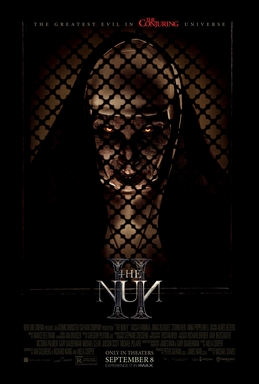
Following a horror franchise from the beginning is a rarity.  At least it is for me.  Now that I’ve seen The Nun II, I’m caught up on the Conjuring universe, for now.  I’ve written an article, still awaiting publication, on the Catholicism in this cinematic universe, and The Nun II has me wondering: how hard is it to find out the basics about Catholicism?  The movie is okay for big-budget horror, but not great.  The Catholicism in it feels like it’s imagined by writers who speculate on what it might be without ever, say, attending a mass to find out.  And the demon Valak isn’t exactly rank and file either.  The idea of using St. Lucy’s eyes as a relic was, however, pretty creepy.

So, after The Nun, Sr. Irene has gone to a convent in Italy.  A series of bizarre clerical deaths sweeps across Europe and all the Vatican can think to do is send the one young nun who’s faced this demon before.  No priest this time because Fr. Burke is dead, rather laconically stated.  Sister Debra sneaks along and the two nuns find themselves facing a demon that immolates priests because it can’t find a relic it wants that will make it even more powerful—the eyes of St. Lucy.  Said eyes are buried in a ruined chapel in a Catholic girls’ school in Aix-en-Provence.  This is the school where Frenchie (from The Nun) now works as a handyman.  We all know he was somehow possessed at the end of that film.  The girls’ school used to be a winery and Valak is defeated when the nuns consecrate a pool of wine that banishes the demon.

At this point in time, the Conjuring universe has grossed over two billion dollars.  All of the films are explicitly religion-based horror.  Putatively in a Catholic setting, they feel like Protestants trying to guess what Catholicism must be like.  At least they feel that way to me.  The Nun sequence in particular, has demons responding to defenses that would not, in a Catholic world, work.  As much as I may disagree on the theology, nuns can’t consecrate wine.  And it turns out that Sr. Irene is a descendant of St. Lucy, one of the virgin martyrs.  Although that title is sometimes given as an honorific, it does generally mean that such saints had no progeny.  Death by thurible is fairly clever, though.  Like all the films of the franchise, The Nun II is worth watching, but it fails to convince on the religion front.  It just doesn’t feel Catholic.


Incorporeal

I’ve been struggling with the concept of incorporeality.  Well, not me personally, but in how it fits into demon movies.  Specifically the Conjuring universe.  I’ve recently been watching the series through again and the corporeality of demons strikes me as problematic.  As spiritual entities demons don’t have bodies—that’s why they possess people.  Yet in these films they can be contained by blessed spaces, or objects.  The doll Annabelle, in particular, has to be kept in a locked glass case to prevent the demon (apparently Valak) from gaining its full power.  Annabelle Comes Home discusses this directly.  After the priest blesses the doll, Lorraine Warren says it’s not enough.  The evil has to be encased in another layer.  In this case, glass from “Trinity Church” which has, ironically, been torn down.

Watching the entire series, as it currently stands, Annabelle appears in four of the eight films and is named in a fifth.  Annabelle: Creation implies that the demon in the doll is Valak (a.k.a. “The Nun”), and she has her own movie as well.  In each case the demon has to be contained within a sacred space.  Once out, it manifests in corporeal form with the ability to harm, or even kill, human beings.  Now, I know this is movie magic.  I also know these movies have been carefully pieced together.  The corporeal/incorporeal question is a standard of seminary training.  While the topic of ghosts, and demons for that matter, was never raised in the curriculum, we did have to deal with God and angels and what it means for a being without a body to become incarnate in one.  These movies could use some seminary.

Is it like this?

In Holy Horror, and especially Nightmares with the Bible, I wrote quite a bit about The Conjuring and the universe it’s building.  I’ve seen demons physically attacking characters, and even taking on classic demon shape.  The viewers wants to see the monster.  If they’re truly incorporeal they can cross between glass cases, doors, windows, and walls.  Some of them do, when it suits their purpose.  Yet they can be quieted by being locked into a glass case, as long as it’s been blessed.  Of course, I’m trying to figure this out on my own.  There are entire fandom wikis out there based on the films and they probably have much more detail than I could ever find on my own.  But then, in a sense, information on the internet is, well, incorporeal.