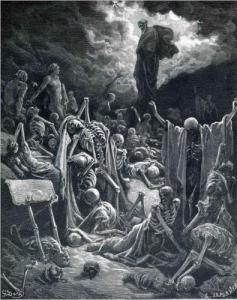
Prophets and Exiles

One of the scariest passages in the Bible is Ezekiel 33.7-9.  I first read this before I was a teenager and it scared me deeply.  In case you don’t feel like clicking over to BibleGateway and searching, the pericope is a section where Yahweh is warning Ezekiel about the dangers of giving up hope (in the larger context).  Ezekiel, you see, had lived through the fall of Jerusalem.  Many people of Judah felt that the destruction of the temple was the end of the relationship between Yahweh and the chosen people.  Ezekiel here is being warned to deliver good news.  If Ezekiel doesn’t call out the lie (the sins of Israel weigh it down) he will be punished as if he were the sinner himself.  I knew evangelical friends in college who lifted that verse out of context and said God would punish them if they didn’t warn the people.  They weren’t so worried about the fall of Jerusalem—that was old news by the 1980s—but about some other issue they deemed important at the moment.

Taking verses out of context has a name.  It’s called “prooftexting.”  It can be done to just about any piece of writing, including this blog post.  All it requires is finding a passage that says what you want it to and claim that it means what you say it does.  The Bible’s a big, big book.  Trying to understand its contents in context takes years of dedicated work.  Even then biblical scholars don’t have all the answers because if they did we could all stay home and surf the net for the rest of our lives.  No, engaging with sacred texts is a never-ending task, by definition.  That warning to Ezekiel was for Ezekiel.  What was that message?  Stop saying the exile is the end!  There’s more to the story.  Read the book to the end and see.

The problem with prooftexting, if I might engage in a bit of it myself, is that it takes away from the totality of the Good Book itself.  Not adding too or taking away from the Bible is a biblical command (taken out of context), which means that with the Bible it’s all or nothing at all.  And if it’s the former, it means Ezekiel’s condemnation is contingent upon what follows.  Back in biblical times there wasn’t as much reading material as there is today.  It turns out, however, that there’s a lot more written down than we used to assume.  If we’re going to read it we should do so within its context.  But just in case, please be assured that the exile isn’t the end of the story.


Springing up Moses

“Springsteen’s work and person invite analysis in terms of the biblical themes of exodus and promised land,” so wrote Kate McCarthy in “Deliver Me from Nowhere: Bruce Springsteen and the Myth of the American Promised Land” (conveniently in a Routledge title, God in the Details: American Religion in Popular Culture, second edition, 2011). Having just finished Bruce Feiler’s America’s Prophet (not Routledge), I am attuned to the exodus theme at the moment. Feeling an unaccountable, personal connection to the other Bruce (Springsteen), I have felt the sense of exile in his songs since I was a teenager. I had no idea who Springsteen was when “Born to Run” made it to the charts. Living in a nowhere town at the time (population less than 1000), I felt the burning need for a personal exodus that eventually landed me in the largest city in the country. But still the sense of exile remains.

Lest readers be too confused, it might be politic to point out that the biblical concept of exodus likely had its origins in the Exile. Without rehearsing too much history, the Babylonian Empire, under Nebuchadrezzar, conquered Jerusalem in either 587 or 586 BCE, leading to the deportation of a significant number of Judahites who would become, over a generation, the “Jews.” These people were exiles, forced to live under the watchful eye of a political overlord with whom they shared only the most basic of heritages. Their religions had grown apart over the centuries, and as the Jews began to think back on their homeland, the exodus came to mind. Archaeological evidence for an exodus of biblical proportions (literally) does not exist. Why, then, the story of the exodus? Did not the desire to return home involve crossing the desert, with a divinely appointed leader? One who carried the law (Torah) with him? When Ezra led returnees home in the fifth/fourth century, he had the Torah in hand. Like Moses, he led the people out of bondage under the Persian plan. Exile and exodus are twin children of oppressive regimes.

So, how do ancient desert wanderers come into the orbit of a very damp New Jersey, and in particular, it’s arguably most famous resident? Alienation is home. Very few teenagers don’t understand this. As we attempt to integrate them into adult life, something vital, essential, is left behind. Consider all the long-haired artists of the ‘60’s and ‘70’s who still perform, now shorn to conservative acceptability and sometimes churning out very conventional songs. The fire has gone out. It is difficult to escape exile when you carry it with you. That’s something I think Bruce understands. His look may have changed, but his message has not. America has always been a haven for exiles. Simply because an exile moves into a new setting, however, does not mean that the promised land has been reached. As McCarthy seems to be saying, and as I have often felt, the promised land disappoints. The seeking is what must persist. America may have its Moeses, but it will find, from atop Nebo, that the path is where your feet already are.

Look carefully at your prophets!