
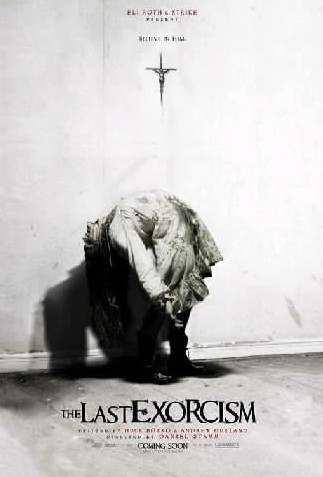
 The latest in my spate of scary movie viewings is The Last Exorcism. The press when it was released last year made claims of extreme fright, but my impression was that I’d seen it all before. The “found footage” fantasy is difficult to maintain—although the camera work in the film is good—and the premise of demonic possession is frightening if the viewer is a believer. The hook for this movie, however, is that the exorcist himself doesn’t believe and becomes a victim of his own unbelief. The pattern overall follows The Exorcist, but without the creepy soundtrack and staged lighting effects, The Last Exorcism relies heavily on the viewer’s willingness to believe. The demonic possession is presented as extreme contortionism and self-destructive behavior, as well as the uncharacteristic violence by the victim. When Nell Sweetzer gives birth to a demonic child, a la Rosemary’s Baby, the role of good Christian gone occult feels a little hackneyed.
I’ve tried to analyze what scares so many people with movies of demonic possession. The core fears seem to come down to two: belief in the reality of demonic possession and the fear of being out of control. Historically the concept of possession was originally relegated to the gods with demon possession apparently arising as a pre-scientific attempt to explain epilepsy. The fact that most Christian denominations no longer recognize physical demon possession (a fact exploited by The Last Exorcism) makes it more frightening still. For a generation of media-saturated viewers convinced that cover-ups are common the credibility of the church, struggling with its own metaphorical demons, is suspect. Perhaps demons are out there—a common enough assertion on the reality show Ghost Hunters—and the church has lost control over them. When Jason and Grant explain what demons are, however, they are pretty far afield from Legion being cast into a herd of swine.
If the Internet is any kind of reliable measure of people’s fears, zombies and demons appear to be nearly on a level when it comes to belief. Both are supernatural and neither stretches credulity to the point of humans growing fangs or matted fur. Both participate in the idea that there is more to be feared beyond death. Both fail in the court of science. The Exorcism of Emily Rose raised the ambivalence of demonic possession to the level of the courtroom. One thing I learned on jury duty last week is that the truth is measured on the basis of the judgment of a quorum of rational individuals. The implications of this are frightening indeed: those who accept the reality of non-physical monsters (the jury is still out on ghosts) are fully capable, in a legal setting, of deciding the truth of the matter. The only corrective to witch-hunts and state-sponsored exorcisms would seem to be education. Today education comes via the media where zombies and demons freely roam.


 Steve A. Wiggins