Falling

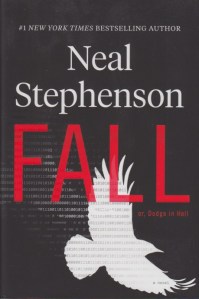
Time.   It’s a resource of which I’ve become acutely aware.  If I probe this I find that among the assorted reasons is the fact that I’ve finished my fourth book and I realized I’m much further behind that I’d hoped to be at this point.  It took me a decade to get Weathering the Psalms published and Holy Horror seems never to have gotten off the ground.  I’ve pretty much decided to try to move on to writing that people might actually read, and academic publishing clearly is not the means of reaching actual readers.  I can’t help compare myself with prolific writers like Neal Stephenson.  (It helps that he’s a relative.)  I just finished Fall, Or Dodge in Hell, and was wowed by the impact of both the Bible and mythology on the story.  I’ve always admired the way that writers like Neal can not only comprehend technology, but also can project directions into which it seems to go. 

Not to put lots of spoilers here, but the story of one generation of gods being conquered by another is the stuff of classic mythology.  Many assume it was the Greeks who came up with the idea, what with their Titans and Olympians and all.  In actual fact, these stories go back to the earliest recorded mythologies in what is now called western Asia.  For whatever reason, people have always thought that there was a generation of older gods that had been overcome by a younger generation.  Even some of the archaic names shine through here.  Like many of Neal’s books, Fall takes some time to read.  It’s long, but it also is the kind of story you like to mull over and not rush through.  Life, it seems, is just too busy.

There’s a lot of theological nuance in Fall, and the title clearly has resonance with what many in the Christian tradition categorize as the “Fall.”  (Yes, there are Adam and Eve characters.)  Those who are inclined to take a less Pauline view of things suggest that said “fall” wasn’t really the introduction of sin into the world.  Anyone who reads Genesis closely will see that the word “sin” doesn’t occur in this account at all.  One might wonder what the point of the story is, then.  I would posit that it is similar to the point of reading books like Fall.  To gain wisdom.  Reading is an opportunity to do just that.  And if readers decide to look into matters they will find a lot of homework awaits them.  And those who do it will be rewarded.


The Falls

I can’t recall if I’ve been to Mexico City before. You see, back in the late 1980s I frequently read the novels of the existentialists, and although a copy of The Fall has been on my shelf since then, I don’t recall if I read this Camus classic. It’s sometimes that way with existentialists. In late 1980’s Back Bay, a used bookstore called the Boston Book Annex charmed my days. The Annex has sadly closed, but I do remember buying my Camus novels there. This one, however, I don’t remember reading.

So, unsure of my past, I decided to read it. Perhaps again. The existentialists make sense to me. I have to say that in today’s rushed and harried lifestyle it’s a little more difficult to find time to spend in Mexico City. Although the book is short, it’s not quick. There’s much to ponder as you wend your way through an evening bending elbows with Albert. Perhaps that’s an unwonted familiarity regarding a man who died before I was born, but existentialists know that kind of thing happens.

One of the more compelling aspects of this literature is that the existentialists often address religion. The Fall is a first person narrative throughout, and about four-fifths of the way through Jean-Baptiste Clamence begins to address Christianity explicitly. Since this is a retelling, in secular terms, of the biblical “fall,” this is not unexpected. Jean-Baptiste is a lawyer who is making his confession. He states that his clients “probably feared that heaven could not represent their interests as well as a lawyer invincible when it came to the code of law.” Genesis, of course, is attributed to Moses, himself a law-giver. From this point until the end of the chapter he reflects on the fact that although no one is innocent, all are glad to find the crime in others. He describes torture devices of the Middle Ages, exonerating God from their invention. He respects Jesus, but not what people have made of religion.

Reading, perhaps re-reading, this reminded me of why I found the existentialists so compelling as a seminarian. They force you to think. I read Kafka, Camus, and Duerrenmatt, pondering how much wisdom could be crammed into such brief books. Ironically, it takes time to read them. Our world is crowded with concerns about money over meaning. Matter over mind. Once in a while we need to step back, spend an evening or two in Mexico City, and consider how we’ve become a fallen race.


Wall-E of Separation

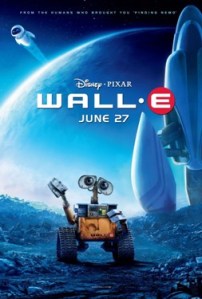
io9 is a progressive website. Its futuristic stories delight and entertain. When a friend sent me a story on io9 titled “New Fan Theory Asks the Obvious Question: Is Wall-E Satan?” I had to read. Then wonder. People know so little about the Bible. The idea is simple: in Wall-E the people live in an undisturbed paradise until Satan (in the form of EVE’s plant) tempts them to leave paradise and return to an earth they’d forgotten existed. Okay, so the Genesis parallels are blindingly obvious (Peter Gabriel was even formerly a member of a band named with the title of that very book). What’s wrong is that there’s no Satan in the Bible’s first book. I give Katharine Trendacosta credit—she discounts the connection of fat, immobile future humans and paradise. The idea that the snake of Genesis is Satan, however, is about as biblical as original sin.

Genesis never calls the snake Satan. It doesn’t mention original sin. In fact, many (Christians, especially) don’t realize the event isn’t called “the fall” in the Hebrew Bible at all. The gaining of knowledge by the first human beings is painful yes, but can be a good thing. Some Jewish interpretations of Genesis 3 suggest precisely that. The story goes that Eve and Adam were living, stupidly, in the garden. The snake points out that the fruit will make them wise—and it does. They do not immediately die as God said they would. Instead they lose a blissful ignorance and have to grow up. The serpent is never said to be the Devil until the very last book of the Christian revisionist scripture, Revelation. Sometimes a snake is just a snake. That’s the way it is in the book of Genesis.

Christian interpretation, however, took over the story of humanity’s awakening and made it into the fall into sin and evil. Things have been so bad ever since than that we have to elect Trump to start a war that’ll end it all. That’s Christian revisionism writ large. Read Genesis again. Slowly. The snake is not said to be Satan. “The fall” isn’t sinful. In fact, the word “sin” doesn’t occur until the story of Cain and Abel in the next chapter. So, is EVE inspired by Satan to end the paradise of the Axiom, unaware of its true origins? Only in a revisionist history of the Bible. The idea existed long before io9, and, according to Genesis, it was wrong even then.


Response

Chaz,

I am not sure if this cycle has a name—sociologists have noticed it, I’m sure—but is as old as at least civilization itself. My experience with it has been in the realm of religious studies. A number of years ago I read a study that indicated that within a decade of the founding of a religion it will have changed beyond the recognition of its original form. In other words, it will evolve. I suspect this is true of most memes. In literary studies this recognition goes by the sobriquet of “Reader Response” theory. Once an author (or any initiator of something new) produces a written work s/he has lost control over what it “means.” Each reader interprets a piece in the light of her/his own context, some perhaps close to the original intent of the author, some far distant. In the broadest sense of the word, this is a corruption. According to Reader Response theory, it is natural and to be expected.

On a larger scale, human endeavors are often beset with divergent agendas. A founder may start a school with the intention of training teachers. Soon interest and clientele grow and further program options are offered. The teacher’s school becomes a college. If the college meets a larger societal need, it becomes part of a university. Universities, despite all posturing and muttering, are becoming very much alike through the mediation of the Internet. Is this a corruption? Perhaps not in the sense of being a benign development, but it general terms it reflects the dilemma of changing ideals. Various religions point in different directions to explain it, but most explanations are mythological. The “fall” in Eden does not fit the view of the Hebrew Bible, but it is a popular Christian explanation for why corruption sets in.

A more humanistic response might call it “human nature.” We are fully capable of lofty ideals. In my admittedly limited experience, I have found that those with such ideals are often ill-equipped to realize them. Those who grow such ideals into institutions tend to have an entrepreneurial outlook that benefits from following the greatest returns. To court investors, a tangible payback must be included. We see this all the time in churches: popes, archbishops, televangelists—soon they find themselves powerful people with access to great wealth. A far cry from a working-class carpenter preaching love. The pattern is ubiquitous throughout history, and there seems to be no cure other than, as you suggest, to begin again.

Chaz and I would like to invite comments and discussion on this issue. Idealists and more pragmatic types are both encouraged to reply!