Early Ghosts

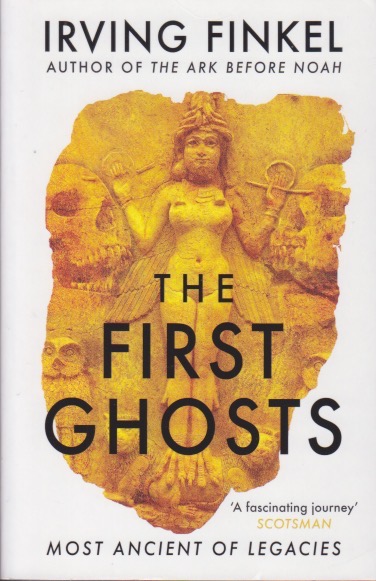
I’m not the most impulsive person in the world, but certain books I know, as soon as I see them, I will read.  Irving Finkel’s The First Ghosts was one of those books.  This wasn’t an easy book to get.  I’m guessing it was some minutiae about transAtlantic rights or some such nonsense, but it was announced a couple of years before it became available in America.  Then, of course, it had to wait its turn on my reading pile.  For those of you who don’t recognize his name, Finkel is a well-regarded Assyriologist who works at the British Museum.  Assyriology (which encompasses Babylonian and Sumerian studies as well) is, perhaps unavoidably, a highly technical field.  The languages are complex and a lot of that has to be explained before a reader can figure out what’s going on.  Some parts of this wonderful book are, unfortunately, technical.

The idea, however, is brilliant.  Ghosts have always been with us.  Finkel is well-placed to open the cuneiform world and he presents the earliest recorded ghost stories in history.  They’re not exactly modern horror, be warned.  Nevertheless, they demonstrate that from as soon as people figured out how to write, ghosts were one of their favorite topics.  Or at least, ghosts were assumed to exist and were written into many myths and legends.  Non-judgmental books like this are rare from academics; indeed, it’s difficult to imagine anyone else having written this particular book.  Even in the small world of academia not too many people read these languages and those who do are busy trying to impress tenure committees and businessmen deans.  (The reboot of Ghostbusters demonstrates this in a comical but too serious way.)

There are plenty of takeaways from this book.  A good general point in that myths do not reflect the everyday beliefs of individuals.  It’s easy to forget that.  Another striking idea occurred in his one chapter on the Bible where Finkel notes that the Good Book tends not to dwell on things considered “detestable,” such as foreign gods or demons.  That makes it an outlier concerning everyday information from antiquity.  After looking through that one window for so long, I suppose that’s why I focused by doctoral work on a “foreign” goddess.  If you can handle the technical bits and try to keep in mind multiple multi-syllabic names from forgotten languages, you’ll find a lot of really surprising and fascinating information here.  I’ve known for years that I’d be reading this book, and as autumn approached the time felt right to seek ancient ghosts.


Ghost Publishers

Ancient Near Eastern studies, where my academic work has the widest recognition, is still an area of fascination.  I have to hold myself back when I see a new book published in the area.  You see, I learned when I researched in this field that there is little academic opportunity in it.  As per usual, the public seems quite interested so academia is not.  A few practitioners, however, have been able to break through.  One of them is Irving Finkel, a curator at the British Museum.  He’s been writing popular books about ancient ideas and getting respectable press for doing so.  His most recent book (The First Ghosts), as described in an article in the Smithsonian, deals with the earliest depiction of a ghost.

Perhaps because of copyright complications, his book on the subject doesn’t seem to be widely available in the United States, despite having been published by a trade house.  It could be that the publishers don’t think anyone will be interested.  Hello?  Ghosts and Mesopotamia?  Haven’t you been paying attention?  This is part and parcel of the academic publishing world.  The editorial board has to decide which books see the light of day and which won’t.  And how to price them.  Is this primarily a library book or can it somehow claw over into the crossover market?  Academic publishers will casually add five or ten dollars to the price, assuming it won’t hurt sales.  Guess what?  It does.  As much as I’d like to read Finkel’s book, my interest doesn’t hover around the 60 dollar range.

When I first studied Hebrew I wanted to buy a textbook my professor mentioned, but it cost nearly $100 in the US.  This was back in the 1980s, so that really was steep.  When we moved to Scotland I discovered the same book was available there is paperback for a reasonable price, so I bought it.  That’s when I began to realize copyright laws direct the shape of scholarship.  Publishers decide what makes it into reputable book form and who will be able to afford it.  That’s power.  You see, people have believed in ghosts from as long as we could convey the idea.  The dead never really leave us.  Finkel’s book examines a clay tablet used to exorcise ghosts and may contain a line drawing of a spirit.  Who wouldn’t want to read such a book?  It’s getting press coverage but those who make such decisions have decided, apparently, there’s no market for it.  When that happens a book hasn’t a ghost of a chance.

Postscript: Checking Amazon one last time before clicking “publish,” I see the book has now come down to the $30 range. I can’t take credit for that, but my point still stands.