Existing Stance

You know, I’ve referenced eXistenZ several times on this blog without really writing about it.  How rude of me!  Well, the fact is eXistenZ is one of my “old movies”—those that I knew from the days before I started this blog.  I have watched it since 2009, but early on I didn’t review movies unless they had religious elements.  Having recently referenced eXistenZ yet again, I figured it was time to look directly at it.  When I first watched this movie I had no idea who David Cronenberg was.  The film was recommended to me by one of my students at Nashotah House.  In those days there was no streaming so I had to purchase the DVD.  The movie is a science fiction horror film, primarily body horror, which is kind of Cronenberg’s shtick.  It’s also about gaming and I’m not a video gamer at all.  Still, I really like this film.
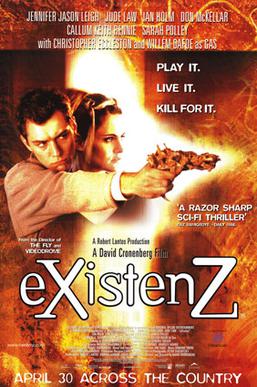
Perhaps presciently, Cronenberg set the movie in 2030.  Computer gaming has become biological with organic ports that have to be punctured into players’ spines so they can use an “UmbiCord” to connect to the pod.  Rewatching it, this seems almost too plausible.  In any case, as the movie goes on it becomes less and less clear what is real and what is part of the game.  Reality becomes distorted.  eXistenZ came out about the same time as The Matrix (probably why my student suggested it to me).  Given the very high profile of the latter film, eXistenZ never really broke out.  Cronenberg seldom breaks through to the mainstream, but I know a lot of people were talking about his remake of The Fly in 1986.  I even saw that one in the theater with some seminary friends.  In those days I didn’t know enough about horror to know what to expect from a Cronenberg film, which may be why it had such an impact on me.

In any case, eXistenZ remains underrated.  I see more recent films that appear to nod to it.  The horror aspects tend to be the slimy, gooey aspects of the game world which—spoiler alert—is, diegetically, the one in which the viewer resides.  There are indeed a few parallels to The Matrix, but eXistenZ has creatures and horror themes.  Sci-fi horror is a sub-genre that often works.  Critics tend to refer to such things by the older category of “science fiction,” but it is close kin to horror, a genre only separated out in the early 1930s.  Now as AI takes over the world, it might be a good opportunity to watch eXistenZ and ponder just how far you want to let it go.
Learning to Fly

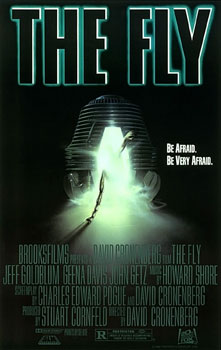
“Be afraid.  Be very afraid.” This quote originates with David Cronenberg’s The Fly.  Of course, after watching the original, how could I not watch its successful remake?  I initially saw this one upon its 1986 release in a Boston theater.  I hadn’t seen it in some 35 years but some of the scenes were as fresh in my memory as if I’d seen it last year.  It’s safe to say that it made an impression on me.  Even usual critics of horror gave the film high marks.  Both it and its predecessor with the same title were quite successful in the financial department and became part of popular culture.  The remake ends without the philosophical statement of Vincent Price in the original, choosing despair instead.  I’ve never seen the sequel.

I picked this up as a used DVD many years ago.  Mainly I wanted to have it on hand in case the mood struck to see it again.  I did recall that, as a Cronenberg film, it was a gross-out of body horror.  So much so that it’s difficult to classify it as science fiction.  It, along with its near contemporary Alien, demonstrated that the fusion of the genres was possible.  Perhaps inevitable.  At the same time, movies, like most other media, have proliferated to the point that such standouts are rare.  Yes, there are still Academy Awards and Golden Globes, but who but a professional can see all the offerings out there?  It feels like we’ve moved beyond the time when a movie could define a generation.  But on a deeper level, that’s why The Fly is about.

We, on the far end from the white male oligarchs, are blending.  We’re no longer simply accepting what we’re told.  We’re becoming more global and more people are starting to break into the power structures.  Even if they sometimes transform if they do.  I saw a recent newspaper article about what to do with your second home, as in decorating it.  Second home?  The majority of us are having trouble up keeping our one home, and that’s if we’re even owners.  Society needs a telepod.  The end results may be messy, for sure, but we need to stop thinking in exclusive terms.  Cronenberg indicated back in the eighties that the movie was about disease and aging and letting those we love go.  That gives the film its poignancy, in a kafkaesque way.  At the same time it may be a teaching tool.  Yes, we can be afraid, very afraid, and still learn.


Original Fly

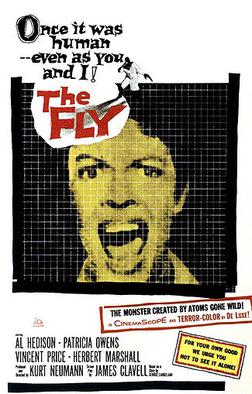
Thinking about it made me do it, I suppose.  Watch The Fly, that is.  This is a movie I grew up knowing about.  I knew the basic plot but somehow was never in the right place at the right time to see it.  Until now.  For a movie from 1958 it remains strangely affecting.  I was wondering whether religion would enter into it, and indeed, in a moment drawn from Frankenstein, André Delambre expresses that he knows what it feels like to be God.  No thunder to drown it out this time.  A short while later his wife Hélène asks him what he’s doing as he is relaxing in the back yard.  He says he’s looking at the sky, or maybe looking at God.  In the light of other mad scientist movies this is a somewhat self-aware moment.

The Fly is one of those movies that had great influence on popular culture.  Although critics at the time thought of it as a gross-out (they obviously had no idea what David Cronenberg would do!) it nevertheless managed to find its way into dialogue with other movies.  The correlation to Willie Wonka and the Chocolate Factory’s Mike Teevee’s scene is remarkably close.  (Adult’s who’ve read Roald Dahl and who’ve paid attention to the movie know that this is kid-friendly horror.)  I’m also pretty sure some of the writers from The X-Files knew The Fly as well.  The Fly, coming during the atomic age, is clearly a warning about using technology that we don’t understand.  Although the movie made a great return on investment for the time, the message still hasn’t been received.

In many ways The Fly set Vincent Price’s trajectory toward being a horror star.  After all, just two years earlier he’d been in The Ten Commandments.  Isn’t he another connection between religion and horror?  Although not the lead in The Fly, as André’s brother François, Price has the most philosophical line: “The search for the truth is the most important work in the whole world and the most dangerous.”  Like the warning about technology, this is a bit of information that might have usefully been heeded.  The political events of 2016 to 2020 demonstrated just how important the search for truth is (and demonstrated religion and horror).  Even with a partial fly brain, André Delambre destroys his notes after making Hélène promise never to reveal what happened.  The truth gets out, of course, leading to the observation behind many mad scientists’ ravings: what is really being sought is the rush of knowing what it feels like to be God. 


When Bible Met Horror

My colleague (if I may be so bold) Brandon Grafius has recently published a piece titled “What Can Horror Teach Us about the Bible?” in Sojourners.  Brandon and I have never met in person, but we’ve worked together a number of times.  We share an interest in horror and we both teach/taught Hebrew Bible.  We’re not the only ones who’ve got this fascination.  When I was able to attend the American Academy of Religion and Society of Biblical Literature annual meetings in person, I would often meet up with others who, apart from their respectable jobs, have a real interest in horror.  There are quite a few of us.  Some journals, like Sojourners, are starting to ask the obvious question: what do these things have in common?

I can’t claim to have watched all the horror movies ever made.  It’s actually pretty difficult to access some of those I’d like to see and, believe it or not, I’m actually a selective viewer.  Often my choices are dictated by research.  Back when I was young, in college and seminary, I’d go to see horror movies with friends.  Since I was living alone in seminary that sometimes led to sleepless nights.  I recall vividly being unable to sleep after watching David Cronenberg’s remake of The Fly.  (To this day I still haven’t seen the original with Vincent Price.  I see that it’s available to stream on Amazon Prime, and since we’ve got the internet back perhaps it’s time I do that.)  What I can claim is that I’ve always watched movies for religious elements and that I often find horror isn’t lacking in that department.

The point of Brandon’s article is that there are horror stories in the Bible.  Indeed, the more I ponder the Good Book the more I see that makes it a frightening text indeed.  Once you get past the sugar coating, there’s fear of substance inside.  Funnily enough, it seems Jesus didn’t often play the fear card, although even he did so from time to time, according to the Gospels.  Religion, which gives us such hope, also makes us so very afraid.  I’m really glad to know that I’m not the only one who’s started to come to that conclusion.  So maybe it’s natural for those raised religious to be fond of monsters.  Getting others to admit it can be tricky, and I’m sure some genuinely don’t like them.  Still, when you’re in a scary place, it’s best not to be alone.