
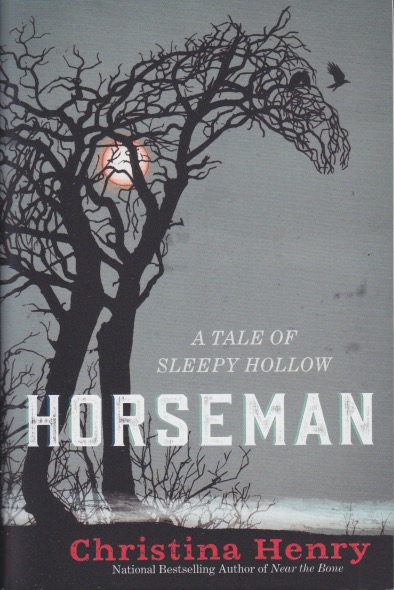
Washington Irving’s tale, “The Legend of Sleepy Hollow,” perhaps due to its being the earliest literary American ghost story, has been retold time and again. When I saw that Christina Henry had a take on it that came out last autumn, I knew I’d be reading it. I’d read her The Girl in Red late last year, but I couldn’t wait until fall to read this one. Henry has a way of taking traditional stories and making them relevant. Horseman is set two generations after Ichabod Crane and Brom Bones and Katrina Van Tassel, but they all appear in it. According to Irving’s story—and this is often changed in cinematographic treatments—Brom and Katrina wed. The narrator of this tale is Ben, who in today’s terms would be considered transgender. He (his preferred pronoun) is the grandchild of Brom and Katrina.
Henry is a master of magic realism. There really is something in the woods of Sleepy Hollow and it’s taking children’s heads. Some influence from Tim Burton’s film version is found here, but the story has its own trajectory and inner logic. Ben actually sees the monster, but nobody will believe him. Not until it’s too late. The one person who does believe is Katrina, Ben’s grandmother. She, however, wants Ben to act like a girl because he was born female. She wants him to stay home and learn sewing and cooking. Ben’s hero, however, is Brom. He’s a good man, if rowdy. He married Katrina for love, not wealth. Ichabod Crane does appear, later in the story, but since how he appears is a spoiler I’ll need to let you read for yourself.
Americans are often raised with the wrong-headed notion of canon as the one way a story goes. Retelling is as ancient as writing itself. Homer, Apollodorus, and Ovid were retelling stories. So were many Bible writers. People tell one another tall tales. Washington Irving didn’t invent the Headless Horseman out of whole cloth. Neither did the people of Tarrytown. How the story goes is a matter for discussion. Bet yet, it’s also a matter for retelling. Henry’s version could be made to fit with Irving’s, but with a bit of prior assumption, some posthumous collaboration. Hers, however, is a tale for our times. Just like in Red, the protagonist isn’t conventional, according to conservative sexual standards. Both are, however, authentic. And although both may be flawed in various ways, there’s no denying that they’re heroes.
 Steve A. Wiggins