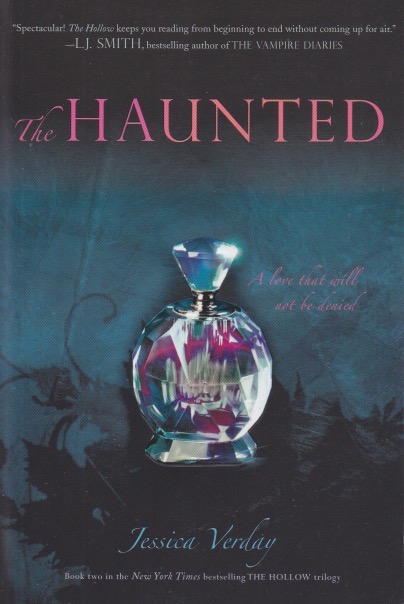
More Young Fear

Okay, so the second one has a cliff-hanger ending.  I should’ve seen that coming.  This installment of Jessica Verday’s The Hollow Trilogy moves the story pretty directly into the realm of the dead pervading the everyday world of Sleepy Hollow.  For young adult literature from the era of Twilight, it does raise issues that, although they were around when I was young, have become more prominent in the thinking of teens.  Overdoses, college choices, attempted rape (or at least threatened), seem like things our society might’ve either overcome or matured about.  Instead, we start putting these pressures on our young and wonder why society has a hard time coping.  Sometimes I wonder if we’ve made society too complex.  As an adult it’s become so complex that I’m never quite sure if I’m getting things done correctly, or if they might come back to haunt me later.

In any case, in the first novel of the set, The Hollow, the protagonist/narrator, Abbey, discovers that her boyfriend has been dead all along.  The Haunted, volume two, is about how she copes with that.  I read many years ago that certain narratives are something like preloaded in human brains.  Given even the most basic pieces, our minds fill in the blanks.  When girl meets boy and likes him, our thoughts go toward getting them together.  Of course, a story is all about the difficulties that threaten to prevent that from happening.  For most of us, we start to experience these things as teens and even as adults we remember it well.  These are intense emotions and society complicates them because just when we think we know what we want at high school age, college separates us and we start over again.  Thus college visits.  It’s even more complicated when your boyfriend is a shade/ghost.

How the material and spiritual relate is an unresolved issue.   Materialists have already decided by cutting the spiritual out altogether, but the rest of us, perhaps trusting our feelings more, wonder.  Although these books are more paranormal romances than philosophical musings, they nevertheless raise questions that even adults struggle with (or should).  We don’t have all the answers and we hope that our children might get further along this path than we did.  Young adult literature helps them do so.  Some choose to respond by banning books.  The rest of us know that literature can help to discuss difficult topics in a world we’ve made far too complicated, for young and old alike.


The Clairvoyant and the Demonologist

As a special bonus, here’s a post by a Guest Author. Enjoy!

For almost half a century, the couple known as a clairvoyant and a demonologist investigated thousands of paranormal cases that led to film franchises and book deals. You can find films based on their investigations wherever there are streaming horror movies.

Although the Warrens’ wider-known cases spent half a century splashing the headlines, there’s more to their legacy than how Hollywood portrays them.

Ed and Lorraine’s Spooky Origins

Even as children, the two were destined to unite over the supernatural. Ed grew up in a haunted house, witnessing apparitions of his deceased relatives while Lorraine experienced clairvoyant visions. 

After dating as teenagers, the two later married while Ed served in the Navy during World War II. They had a child, Judy. 

Despite Lorraine’s skills as a trance medium, she remained a skeptic until she witnessed more substantial first-hand accounts through their business.

Haunted House Hunters

The couple’s haunted house hunting began as a means for Ed to make a living as a landscape artist. The project quickly grew bigger as they traveled across New England painting potential haunted sites

Ed’s sketches became a friendly gesture to gain entry for tours and then investigations. Their novel networking attempts and cases eventually led to newspaper coverage and TV appearances.

Religious But Not Occultists

The Warrens’ religious beliefs as Catholics both hindered and aided their cause. As self-taught investigators, they aspired to balance their religious beliefs with scientific research.

“The Haunted” TV Series

Though much about The Warrens’ work is showcased in The Conjuring franchise and features spawned from their experiences at Amityville House, Hollywood also adapted an unsung investigation with a television show called The Haunted (1991). 

From the smell of rotting flesh to the sounds of anonymous screams, Jack and Janet Smurl experienced diabolical activity in their Pennsylvania house for years. After going public with their encounters, they gained national attention and then reached out to the Warrens. 

The Warrens confirmed a dark entity inhabiting the Smurls’ house and tried to expel it. Unfortunately, the evil presence refused to vacate.

The Warren’s Occult Museum

The couple founded the New England Society of Psychic Research (NESPR) in 1952, which solved thousands of cases over 50 years. They also opened their home to the public with a museum of the occult featuring artifacts such as the possessed Raggedy Ann doll that inspired Annabelle

Following their deaths over the past decade, their son-in-law now manages NESPR, but the museum closed in 2019.

Today, there is still more ground to cover learning about the supernatural and paranormal. Without the Warrens bridging the gap between the living and dead, vast mysteries about the afterlife could’ve been buried in the dark. 

Their legacy ultimately encourages believers and skeptics to continue searching for answers.


Spiritual Walls

I often ponder what a difference walls make. Perhaps our ancient, cave-dwelling DNA just runs away with imaginations, but walls make us feel safe. Most of the time. As I was reading the ensemble-written The Haunted, by Robert Curran, Ed and Lorraine Warren, and Jack and Janet Smurl, the concept of walls showed its other face. In the mid-to late-1980s, the Smurls lived in a haunted house. The West Pittston duplex in Pennsylvania was also home to their four daughter’s and Jack’s parents. And the entity that harassed them there was deemed a demon. It’s easy to be skeptical about such accounts—no physical proof exists, after all, and proving anything is pretty near impossible anyway. Although I wasn’t aware of it at the time, apparently this become quite a media event. It’s easy to question the whole thing. Then I think about walls.

Although there are public haunted buildings, I often wonder about specific residences that foster claims of haunting. If spirits are, well, spiritual beings that can pass through walls, why would they stay in a house? In the case of the demon that everyone in the family saw, what does it mean to see physically a being that has no physical reality? And when the priest exorcised their house, why did they look to see where the incorporeal being might be hiding? It seems that the demon needed walls too.

Human beings are natural actors. We behave differently at home than we do in public. We act differently with friends than with strangers. Even closer to home, we act more natural with our families than we do even with friends. Beneath all these layers of pretending, most of us still act differently when we’re alone. That’s where walls come in. Although knowing someone’s in the next room might temper our behavior, the family unit within its walls is one intimate collective. What was happening within the walls of the Smurl household three decades ago? Any recounting will involve retelling. Interpretation. And we all know what a difference walls can make. The neighbors, according too this book, could hear demonic screams. Some even experienced invasions of their own during the height of the haunting. Books like this have a way of drawing you in, opening windows and doors through the walls into someone else’s life. What actually happens to them, however, is something we’ll only learn when walls begin to talk.