Haunted Life

It’s funny what a difference that a few years can make.  I can’t seem to recall from where I sourced my movies in the noughties.  Streaming was extremely tenuous in our Somerville apartment—the plan didn’t include the required speed for it.  Like in the old days when it took twenty minutes to upload a photograph through dial-up.  In any case, I know I’ve watched The Haunting before.  I know it was in Somerville, but having watched it again I have to wonder if my mind is playing tricks on me.  I read Shirley Jackson’s The Haunting of Hill House there, and I saw the movie.  But how?  It’s all about mind games, but the mind games are played on a woman who has an abusive family, one that damages her psychologically.  Escape is important to her, even if it is to a haunted house.
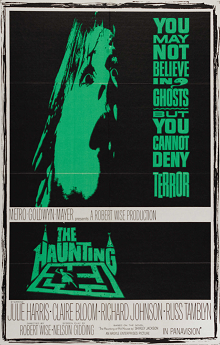
I think the last time I watched this I was looking for something that might scare me.  That phase was one of thinking not much frightened me—but this movie is scary.  Even with its “G” rating, its lack of blood and gore, and black-and-white filming.  It scares.  One thing I’ve noticed when reading about these older movies after I watch them is that many improve with time.  Shirley Jackson was known during her life but you become a classic writer only AD—after death.  The Haunting has aged well.  I suspect it has something to do with Robert Wise, the director.  What must the psychology of a man be who directed The Sound of Music, The Day the Earth Stood Still, and The Haunting?  The latter is all about psychology.

Movies that make you think are those, I believe, that may become classics.  And perhaps there’s a bit of Eleanor inside all of us.  Wanting to be noticed but eschewing publicity.  Needing someone to love us, but pushing away those who try.  Children in bad environments learn unorthodox, and often unhealthy, coping techniques.  Eleanor has difficulty accepting that John is married when she thinks she’s finally found a place that accepts her for who she is.  Even if it’s a haunted house.  Especially if it’s a haunted house.  As a child I’d no doubt have found the movie boring.  There is, however, much for adults to absorb.  And, I expect, I’ll need to go back and read the novel again.  One of the reasons for watching horror is that the viewer is seeking something.  It’s not just thrills.  I didn’t write about the movie the last time I saw it so I don’t recollect when it was.  Or even how.  My thoughts now, however, are that I should’ve paid closer attention the first time.

Haunted States

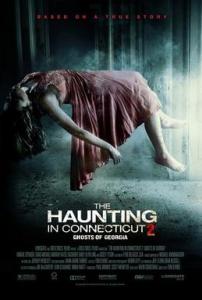
I’ve been going through a spate of watching “The Haunting” movies.  Just to be clear, I don’t mean The Haunting, by Robert Wise (1963), which is excellent.  Instead I mean movies spun off of the Discovery Channel’s series A Haunting.  Several years ago, between jobs and too near an FYE store, I picked up a cheap two-fer.  This set contained the television movies A Haunting in Connecticut and A Haunting in Georgia.  I watched them once and then traded them in to get something else.  The first one really bothered me.  The Connecticut story deals with a childhood cancer victim, and that alone is scary enough.  It had the limitations of a television movie and left me thinking it wasn’t too satisfying.  The Georgia haunting was more of a documentary, but it was also open-ended.

Then someone got the idea to make a movie out of the two.  The Haunting in Connecticut blows the plot over the top.  I kept thinking as I watched it, isn’t it in bad taste to make a horror movie based on the true life horror of tragic disease?  The protagonist of the story, Philip Snedecker, died about three years after the movie came out.  Although the plot generally followed the first movie an entire subplot was added to pad it out.  A nineteenth-century funeral director has enslaved a young man to be his medium.  The undertaker steals and marks dead bodies to enhance the boy’s powers.  These completely fictional characters intermingle with the real life tragic Snedeckers.  As you might expect, chaos ensues.

The oddly named The Haunting in Connecticut 2: Ghosts of Georgia also had to add an entire fabricated story to the troubles of the Wyrick family.  In real life the Wyricks moved into a house where their daughter started seeing things, including a kindly ghost named Mr. Gordy.  She also saw some sinister spirits.  So much so that her family invited a parapsychologist to investigate.  The theatrical version adds in a stationmaster on the underground railroad who was also a taxidermist.  Instead of helping all the slaves to freedom, he saved some for stuffing later.  No real motivation is given, beyond his enjoyment of sawdust and thread and death.  

While these two movies really didn’t help much, I generally find watching horror during a pandemic therapeutic.  Horror films sometimes help viewers envision worst-case scenarios and figure out how they might deal with them, learning from the victims’ mistakes.  I suspect that’s why, a few years back, the CDC posted instructions on what to do in case of a zombie apocalypse.  It was all about disaster preparedness.  Of course, in those days we had no idea what was really coming to Connecticut, and Georgia, and to every state of the union.