Closure of a Trilogy

So the final part of Jessica Verday’s Hollow trilogy really moves into supernatural explanations of life after death.  At least for those destined to become shades.  Since we’re at the end here, I won’t worry about spoilers.  Also, the series has been out for over a decade now, so we’re fairly safe, I think.  (Young adults aren’t my demographic, I don’t imagine.)  To recap, Abbey is in love with Caspian, who is a shade.  Caspian isn’t seen by many people, but he does appear to Abbey.  Throughout the story she mourns the death of her best friend Kristen.  As the action builds, Revenants begin to appear in Sleepy Hollow.  Revenants are beings that assist people who are to become shades as they die.  This indicates to Abbey that she won’t live to graduate from high school.  She will, however, get to be with Caspian—“complete him”—in a form of life where few will see them but they will live on in a limited sense.

The universe here isn’t particularly Christian in background.  Revenants operate in pairs, one tending toward good, the other evil.  They are sent to do a specific job and when it’s over they move on.  As in the movie Dogma, however, one Revenant doesn’t want to move on.  He figures that if he fails to do his assigned task he’ll continue on as an immortal on earth.  At the end he reveals that he killed Kristen in Abbey’s place so a difficult decision’s in order.  To straighten out the mess that’s been made on some cosmic scale, Abbey can die, history will be altered, and Kristen will be the one who survived.  This will involve self-sacrifice, which kinda does bring us back into Christian territory.

This trilogy emerged following the obvious success of Stephanie Meyer’s Twilight saga.  Teen paranormal romances were in, and publishers hearkened to the demand.  It does reflect our times that writing for young readers has taken on an impressive quality.  This trilogy is a great example of how someone who recollects well what it was like to be a teen is able to transport many of us back to that stage of life.  The awkwardness.  The constantly making wrong decisions.  The bewilderment of falling in love.  And of course, if you throw in some ghosts and some light violence, you’ve got a winning combination.  I enjoyed getting to know these characters.  I knew, once I put volume one down that I would have to see how the rest of this story unfolded.  I’m glad I did.  I have a sense of closure, for this series at least.

More Young Fear

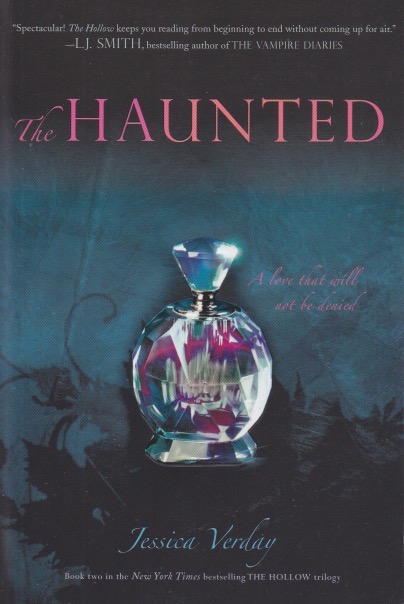
Okay, so the second one has a cliff-hanger ending.  I should’ve seen that coming.  This installment of Jessica Verday’s The Hollow Trilogy moves the story pretty directly into the realm of the dead pervading the everyday world of Sleepy Hollow.  For young adult literature from the era of Twilight, it does raise issues that, although they were around when I was young, have become more prominent in the thinking of teens.  Overdoses, college choices, attempted rape (or at least threatened), seem like things our society might’ve either overcome or matured about.  Instead, we start putting these pressures on our young and wonder why society has a hard time coping.  Sometimes I wonder if we’ve made society too complex.  As an adult it’s become so complex that I’m never quite sure if I’m getting things done correctly, or if they might come back to haunt me later.

In any case, in the first novel of the set, The Hollow, the protagonist/narrator, Abbey, discovers that her boyfriend has been dead all along.  The Haunted, volume two, is about how she copes with that.  I read many years ago that certain narratives are something like preloaded in human brains.  Given even the most basic pieces, our minds fill in the blanks.  When girl meets boy and likes him, our thoughts go toward getting them together.  Of course, a story is all about the difficulties that threaten to prevent that from happening.  For most of us, we start to experience these things as teens and even as adults we remember it well.  These are intense emotions and society complicates them because just when we think we know what we want at high school age, college separates us and we start over again.  Thus college visits.  It’s even more complicated when your boyfriend is a shade/ghost.

How the material and spiritual relate is an unresolved issue.   Materialists have already decided by cutting the spiritual out altogether, but the rest of us, perhaps trusting our feelings more, wonder.  Although these books are more paranormal romances than philosophical musings, they nevertheless raise questions that even adults struggle with (or should).  We don’t have all the answers and we hope that our children might get further along this path than we did.  Young adult literature helps them do so.  Some choose to respond by banning books.  The rest of us know that literature can help to discuss difficult topics in a world we’ve made far too complicated, for young and old alike.