Resurrecting Color

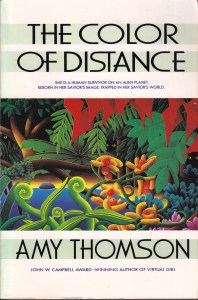
ColorOfDistanceIf you’re one of those people who’s attached to books, you know the frustration of someone who borrows a book and never gives it back. Many years ago I stopped lending out books for that very reason. I do, however, sometimes give them away. A friend recently reciprocated the gift of a book, giving me Amy Thomson’s novel, The Color of Distance. It is a profound story involving, as is common on this blog, themes of resurrection and transformation. A science fiction tale, it is set on another planet where something has gone wrong with an Earth survey team. The humans are dying on this alien world when one of them, Juna, is transformed by the alien into something like one of them. She comes back to life transformed. It wasn’t until I finished the book that I read the cover blurb that reads “Reborn in her savior’s image, trapped in her savior’s world.” Not a bad summary, capturing as it does the deep religious elements in the story.

The religious aspect, however, comes through most clearly in the environmental elements of the novel. Humans, somewhat optimistically, had set in place protocols not to interfere with alien life. So much we know from Star Trek’s prime directive. What makes this so interesting in the case of The Color of Distance is that Thomson knows that any contact is contamination. Two worlds cannot meet. They must collide. There is a gentleness, however, in her narrative. Juna, marooned (long before The Martian) on a foreign planet, has to learn to see things through alien eyes. And every little thing that humans have done has left a footprint on the planet. Protecting our own planet is a profoundly religious undertaking.

It is clear that Thomson has influenced later writers and stories. Not only does The Martian pick up on the stranded aspect, but Avatar clearly presents a world similar in many respects to the planet of the Tendu. The Color of Distance is a book not easily forgotten. The world into which the reader is drawn is indeed one of transformation and resurrection. I suppose spoilers aren’t an issue with a book two decades old, but I will satisfy myself merely with noting that another resurrection takes place as the story winds to its close. Deeply hopeful, and almost prophetic, this novel should be more widely read, for the sake of the world on which it arose.

What Do Sheep Know?

We trust those we see in the media. You see, those who have the longest reach can bring in the most advertising dollars and therefore must have a wisdom the rest of us lack. The cult of celebrity is perhaps the truest cult of all. Don’t get me wrong, I like reading books by bestselling authors once in a while, and I like movies by talented directors and writers. The problem with the cult of celebrity that it often confuses fame with knowledge. If someone knows how to get you to pull your wallet out, they must know about all kinds of things, right? It stands to reason. A recent article in The Guardian features an interview with Ridley Scott. Forever in my mind typecast as the director of Blade Runner and Alien, I think of Scott as one who understands science fiction. He, of course, gave us a version of Exodus that many didn’t buy, and now that The Martian has been gaining attention, people are once again wondering what they might learn from the director.

Blade_Runner_poster

Ironically, like the recently late David Bowie, Scott considers himself an agnostic. As the Guardian article says, that doesn’t stop him from having a lot to say about God. Catherine Shoard notes that religious questioning runs throughout Scott’s movies. The big issues, it seems, still matter. People will crowd to his movies and perhaps not even know that they were facing the questions that motivate people like Scott. Taking up such questions in the hopes of making a career out of it all is still not a wise choice, but if you can put it in fiction without people knowing it, you might become famous.

I’ve always been of the opinion that everyone is an expert when it comes to religion. Believer or not, everyone knows what to believe and is pretty certain about it. The people I find most fascinating in this mix are those who dare to question. While many doctrinaire religions call questioners “doubters” and suggest curiosity is some kind of sin, there are both religious and non who face the world with questions rather than answers. To me, this seems a more honest approach to things. The funny thing about this appreciation is that it is seldom reciprocal. Of course, people might be interested if I’d directed a block-buster movie or if I were a star. Until that happens, I’m an expert just like everybody else.


Martian Ethics

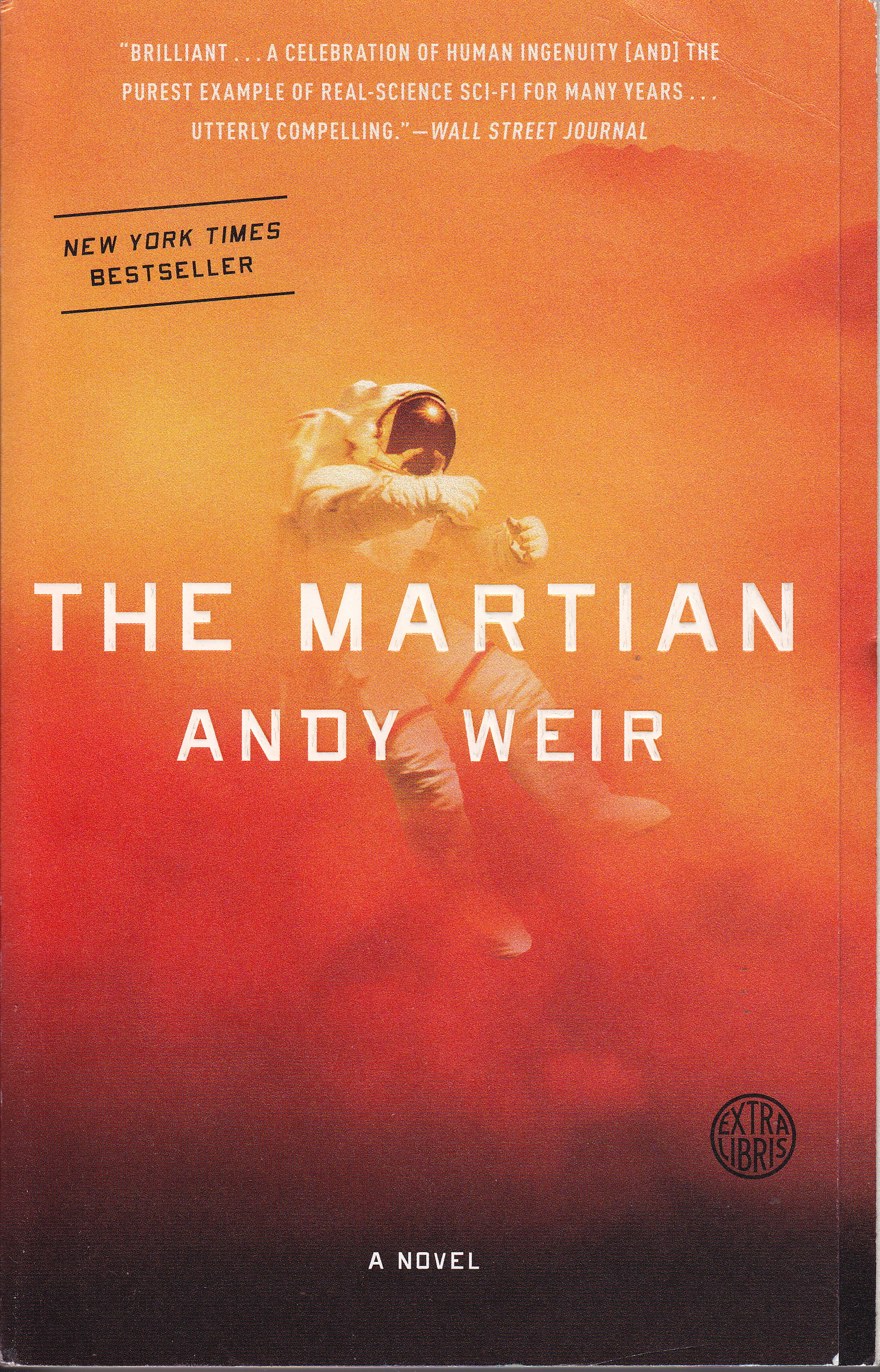
MartianIf you need a boot of optimism, look to Mars. Or, more specifically, read Andy Weir’s The Martian. Not that it’s the greatest literature ever produced, but it is a story brimming with humanity. Mark Watney is accidentally stranded on Mars. His crew-mates, in the midst of their multi-month-long return journey, adjust their course to go back for him. Naturally, nothing goes as planned. Although much of the story is far beyond the believability scale, Weir has the technical background to make it all sound plausible. As an engineer, Watney fixes most problems with an optimism that would leave many humanities specialists weeping in the dust. Time after time a potentially fatal situation develops that is solved by technological ingenuity. Relying on his will to survive, and good humor, the protagonist makes a remarkable journey across the surface of the Red Planet to a potential means of escape. I shouldn’t throw too many spoilers into this post since the book is fairly new. I will say it left me feeling good about being human.

Part of being human is thinking about larger issues. Often, throughout the book, Watney wonders about belief in God. Not enough to make it a main theme, but enough to merit mention on this blog. In a somewhat humorous moment, one of the mission controllers says that he’s Hindu, so he believes in lots of gods. In contrast, Watney, alone on Mars, has a vastly different perspective. Without divine intervention, or even any aliens, he finds a way to persevere when the Fates (or the author) have stacked the odds against him. Mark Watney believes in himself, and he believes in human goodness.

The decision of his crew-mates to return for him is one of potential self-sacrifice. There are no guarantees that they’ll survive. Nevertheless, there’s no second thoughts. When they learn Watney is alive, they decide to go back, no matter what might happen to them. The story awoke a strange optimism in me. Although people are capable of horrendous acts against each other and the planet, I do believe that we are basically good. The bad ones make it into the news. We could all be better, I’m guessing. Still, we will help others when we can, even if all we get from it is the good feeling that we’ve done the right thing. Unfortunately, the only people, it seems, that don’t have the best interests of others at heart are our politicians. Watching the posturing before the primaries I do have to wonder if one wouldn’t stand a better chance abandoned on Mars than in the land of the free. This may be one of the times, it seems, that trusting in human goodness might well be equated to a prayer.