A Different Village

If I’m honest I’ll admit that I first found out about John Wyndham’s The Midwich Cuckoos from The Simpsons.  In one of the episodes, “Wild Barts Can’t Be Broken,” a “clip” is shown of a horror movie called The Bloodening.  A spoof on Village of the Damned, the scene caught my imagination and I was able to learn that it’d been taken from this movie.  This was many years ago, of course.  In any case, I went out and found a DVD of Village and found it less frightening than anticipated, but it left me curious.  It was easy enough to find out the book it was based on (it’s in the credits).  Now, well over a decade later I finally read it, but I’d forgotten nearly everything about the movie but the glowing eyes.  Having read the novel, I had to see the movie again.
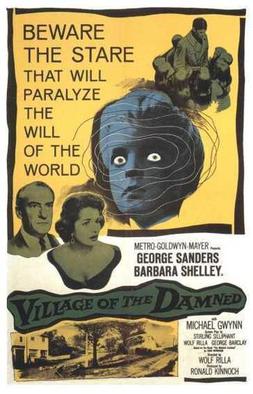
Interestingly, the book is generally considered science fiction and the movie horror.  The two genres are closely related, of course.  The explanation for the children in the movie is a little sci-fi, but the framing is horror.  So much so that in Britain in 1960 it was nearly given an X rating (the censors didn’t like the glowing eyes).  As typical, when compared to today’s fare this is a tame little piece about some unruly children.  Of course they do get blown up at the end.  That may have been a spoiler.  I guess I can be unruly too.  In any case, sequences of self-harm, and even suicide, make this a reasonably scary movie.  The film has the same stiff upper lip that the book does, but otherwise it’s a modern horror classic.  I haven’t seen the 1995 remake, but it didn’t get very good reviews.

The movie doesn’t have as much moralizing as the novel does, but it raises the very real issue of how we socialize children.  I do suspect, however, that blowing them up when they’re all together is probably not the message they wanted us to take home.  Although far from a flawless film, this is quite intelligent for horror of the period.  Consensus is that horror “grew up” in 1968, but there were some premies, it seems.  Night of the Demon is another one from the period.  Horror has, I would argue, been intelligent from the start.  Dracula, although not a perfect story, has become a bona fide classic, and Frankenstein before it, had already been a literary touchstone for decades by the time the former was published.  Not bad for watching an episode of The Simpsons.

Cuckoo’s Roost

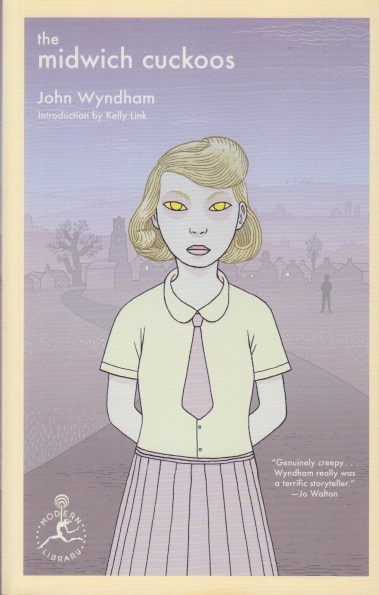
John Wyndham is someone I discovered through movies.  Often considered a science-fiction writer, his works cross over into horror, particularly on the silver screen.  Many years ago I read Day of the Triffids and, having seen Village of the Damned, wanted to read The Midwich Cuckoos.  It was a pretty long wait.  I kept thinking I might find a copy in a used bookstore, but it never happened.  When I saw a reprint edition I ordered it with some Christmas money.  There are some horror and sci-fi elements to the story, but there’s also a bit of thriller, as it’s called now, thrown in.  The book is quite philosophical because of the character Gordon Zellaby, a Midwich resident who keeps thinking about what is happening in terms that don’t match the expectations of other, more prosaic thinkers.  In case you’re not familiar:

Midwich becomes unapproachable for a period because an alien ship (the sci-fi part) has covered it.  Everyone in the village is asleep for a couple of days.  When they awake, generally no worse for wear, they soon discover that all the women of childbearing years are pregnant.  They all give birth about the same time to children that look eerily alike and have bright golden eyes.  The officials know this has happened but adopt a wait-and-see attitude.  Meanwhile, the locals get on with things but they discover these new children develop about twice as quickly as humans do and they can control people with their minds.  They also have collective minds so that their brainpower is quite above that of Homo sapiens.  Zellaby makes the connection with cuckoos—birds that lay their eggs in the nests of other birds and after they hatch shove the other chicks out of the nest.  Indeed, this is a story about what if cuckoos were humanoid aliens who tried the same thing with people.  Told with a British stiff upper lip.

The story slowly unfolds and gets scary as it grows.  I saw the movie quite a few years ago and the details were lost on me, so I was learning as I read.  I suspect that it differs from the book quite a bit.  Perhaps it’s the Britishisms that make this story less of a horror tale.  There’s a kind of jocularity to the style, at least for a good bit of it.  The serious issues of how governments and individuals interact is raised and discussed to a fair extent.  Even though the book is fairly short, there’s a lot going on here.  But now I need to watch the movie again.