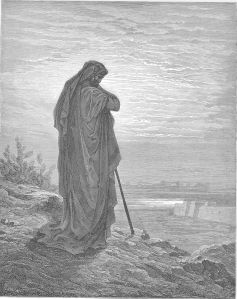
Words and Belief

Why do we care so little for the poor?   Part of the answer is surely the misguided idea of meritocracy—if you merit good you will be successful.  This kind of thinking emerges from the wrong end of a bull.  There may be poor people who are lazy but the vast majority of the poor are those for whom our systems make it impossible to thrive.  It’s very easy to put them out of mind as long as we can keep them out of sight and just let our prejudices do the thinking for us.  The poor are the victims of capitalism.  Loud voices proclaim them to be a drain on the system, despite the fact that many of them work—some multiple jobs—and remain unable to keep up.  Capitalism is kind only to the wealthy.

The Rev. Dr. William Barber is one of the organizers of the Poor People’s Campaign.  The full name is the Poor People’s Campaign: A National Call for Moral Revival.  The initial part is taken from an initiative that Martin Luther King, Jr. started before his assassination.  He was shifting towards a movement meant to address the entrenched unfairness deep in American society.  These nearly six decades on, we are just as deeply entrenched.  Barber is doing amazing work, organizing, speaking, and advocating.  He’s trying to give a voice to the people.  I do wonder, however, if using the word “Revival” doesn’t work against the goals of the movement.

Certain words have been poisoned by their abuse among various religious groups.  Especially among the young.  The word “revival” may fall into that category, calling to mind, as it may, repressed people working up to an emotional fever under the banner of Hellfire and brimstone.  Believing a bit too literally a message that was contained in a book viewed magically.  Names can be important.  Many of the younger generation are put off even by the word “church” since so much hypocrisy (something the Republican party has openly embraced) has come to light over recent decades.  I fully agree that we need a moral revival, we need people to wake up and demand that our government promote the justice it claims to seek.  I do wonder if religion, as previously packaged, has the credibility to do it.  No matter how we take on the task, it’s clear that the poor have been abandoned by the system, through no fault of their own.  And some in the church have begun to find their voice in the Poor People’s Campaign.

Photo by Katt Yukawa on Unsplash

Moral Compass

Recently I was introduced to The Poor People’s Campaign, in its most recent iteration.  I was drawn in because I was raised in a poor family and have struggled to make up the shortfall my entire adult life.  Those raised in middle class (and above) households often don’t realize that when you start below zero, in a humanities-based career it may take literally decades to catch up, if you ever do.  There’s no safety net and there’s no inheritance.  You begin with years of higher education debt and sub-standard pay in your profession.  But I digress.  The Poor People’s Campaign: A National Call for a Moral Revival is non-partisan and it is about more than just the poor.  It’s about restoring true morality to our political system.  Organized by the Rev. William J. Barber II, it has had some success in presenting the plight of the poor to a congress that has largely failed to care.

Politics is full of dirty money and lobbying to the point that many people are cynical and convinced that morality has no chance of survival in this city set on a hill.  The pony and puppet show in a White House run by an entrenched narcissist shows just how far concerns for justice are from the aims of our government.  Barber and his colleagues actually read from the Bible (which, it turns out, advocates justice) rather than just saying that they do.  Compared with Martin Luther King’s 1968 campaign by the same name, The Poor People’s Campaign today is smaller, but growing.  More and more citizens with a conscience realize that our government requires rescue if any semblance of fairness is to throw its hat into the political arena.  We’ve become the victims of to government’s bread and circuses, but without the bread.

The most disturbing aspect of our current political spectrum is the complete lack of a moral compass on the side of politicians who cynically use issues to win elections only for personal enrichment.  We have an Oval Office occupant who refuses to divest himself from his own business interests while using his position to increase his own wealth.  Others in his party follow suit.  The Poor People’s Campaign is non-partisan because corruption easily crosses the political aisle.  At least one party seems to be aware that the poor really do suffer even as the White House tells them tax breaks for the wealthy will make everything better.  When a government proposes “camps” for the homeless to get them off the streets, we should see that we’re clearly in trouble.  And unless someone sounds the alarm the wealthy will never bother to take notice.