Poe Day

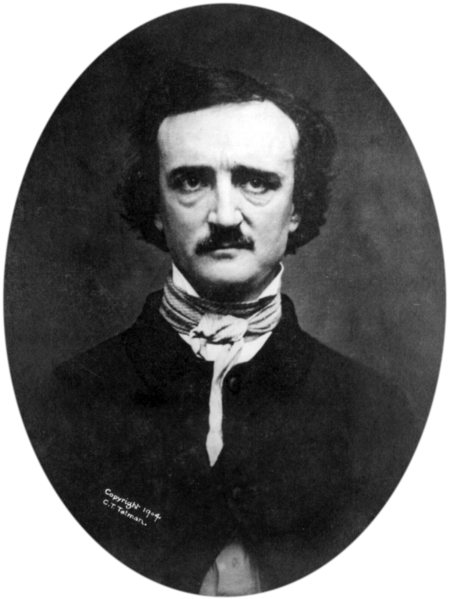
Perhaps best known for his rabidly racist The Birth of a Nation, D. W. Griffith was nevertheless influential in early filmmaking.  I’m fascinated by how literature made its way to celluloid, particularly in the early days.  It was thus that I discovered Griffith’s Edgar Allen [sic] Poe, a silent film from 1909.  A dramatized version of Poe’s writing of “The Raven,” this seven-minute movie opens with Virginia Poe—the “Lenore” of the poem—in the process of dying at the Poe’s hovel.  Not able to keep warm or to find nourishment, she languishes on a cot until Poe arrives home and covers her with his coat.  At that moment a raven appears on the bust of Pallas above the chamber door, leading Poe to write the poem in a white heat.  He knows it’s a masterpiece and leaves Virginia promising success.

In a scene only too familiar to any writer, Poe takes the poem to the publishers, three of whom simply dismiss him, the third laughing at his work.  This particular scene rings so true.  A fourth editor buys it from him on the spot.  This is, in fact, how publishing works.  I’ve had 33 short stories either published or accepted for publication.  By far the majority of them were rejected multiple times.  One of them, previously turned down by six editors, ended up winning a prize.  So it goes.  You’ll never find an editor who “gets” you every time.  Even those who like your work may eventually start sending you elsewhere.  I often wonder how many writers of what would be classics died unpublished because of some editor’s choice.  But back to Poe.

Screenshot: public domain,

Newly paid for his work, he buys food and a blanket and returns home jubilant.  Of course, it is only to find Virginia dead.  Poe’s life did have its share of intense drama.  His death remains mysterious all these years later, and Virginia’s death was a severe blow to him.  “The Raven” was published in 1845 and Virginia died two years later, with Poe himself passing yet two years beyond that.  This film, which I learned about from Jonathan Elmer’s In Poe’s Wake, was made sixty years after Poe’s death.  He’d already become an icon by then, instantly recognizable in pancake makeup.  But even now, more than a century later, publishing is still a matter of the same process.  One of my own novels has been declined over 100 times, despite having once been under contract.  I do know the feeling of being rejected by publishers, even as I participate in a ritual as old as writing for publication.  Happy birthday, Mr. Poe.


Black Bird

Although we prefer typecasting—it’s so much easier!—Edgar Allan Poe had both depth and width as a writer.  He penned funny as well as scary, love poems and detective stories, even something like a scientific treatise.  One thing I’m sure he didn’t anticipate was his name being suborned for cheap horror movies.  Roger Corman is a Hollywood legend—a good example of a guy making it in the film industry on his own terms.  He paired Vincent Price with a number of Poe titles that had little to do with the actual works of the writer.  One that oddly stayed with me since childhood is The Raven.  This was well before I’d read the poem.  It’s funny how very specific things will stick in your mind.  I remembered the strange hat Price wore.  And I remembered—misremembered, actually—Price using a spinning magical device with sparklers.  Misremembered because that was Peter Lorre’s character, not Price.

That was it.  I didn’t remember that Boris Karloff was also in the film.  I was too young (as was he) to recognize Jack Nicholson as well.  Although I watched The Twilight Zone, I didn’t realize the script was by Richard Matheson.  This film was loaded with talent, but it really was goofy.  I recollected Price was a magician, but I didn’t know this was a rather silly battle to become chief magician.  Lorre’s ad libbed lines were surprisingly funny, even after all these years (I was about one when the film came out).  Surprisingly, the movie did well at the box office, despite its taking a sophomoric approach to perhaps Poe’s most serious poem.  

I’d avoided watching it again for all these years because of that sparkler scene.  I’m not sure why that particular moment wedged itself so firmly in my young brain.  It seemed so not Poe that I couldn’t get back to the movie, apparently.  With Price and Lorre camping it up—Karloff was, by all accounts, most professional as an actor—and Nicholson uncharacteristically timid, the cheap special effects, it’s obvious that viewers enjoyed a good laugh at this one.  It’s not true to Poe, of course.  It’s true to Roger Corman, however, a filmmaker who knew how to deliver cheaply and quickly and still earn some money at it.  I’d last seen The Raven about half a century ago.  I may be tempted to watch it again, after having seen it as an adult, but if I wait too long I’ll need to leave that duty to someone who’s read this and who isn’t afraid of sparklers. 


Learning too Late

Threads of this, crumbs of that.  My life has been a grasping at small bits.  I know the things I like, but which circumstances keep me from.  Nobody is paid to read only, and writing brings in so very little money.  I’ve read Edgar Allan Poe since I was a child, but I haven’t read all of his written works.  (The same is true of the many other writers I admire.)  When I wrote Nightmares with the Bible, I tried to tie the theme of demons to Poe.  I began a chapter with an epigram from “The Raven”—“And his eyes have all the seeming of a demon’s that is dreaming.”  At this point in my life I had not read, or if I had I’d forgotten, “Alone.”  Not published in his lifetime, Poe wrote the poem at 21.  It ends with words that would’ve been appropriate for my Nightmares venture:

From the lightning in the sky

As it pass’d me flying by—

From the thunder, and the storm—

And the cloud that took the form

(When the rest of Heaven was blue)

Of a demon in my view—

Some printed editions end the poem with a period.  The ambiguity of that final em-dash, however, would’ve made particularly well the point I was struggling to convey.  Demons are not what we think they are.  As I continue to read about The Exorcist and its impact, it becomes clear that media mediates reality.  That view of demons has become canonical, but many, from Poe both backward and forward, have wrestled with them.  Not every entity with which we struggle through the night ends up blessing us in the morning, disjointed hip or not.  “Demon” is a very slippery word.  And concept.  In a materialistic world we boldly claim there are no such things.  As Poe wrote, “Of a demon in my view—”

There’s more going on beneath the surface than most people would be able to guess.  This is perhaps why I have a penchant for staring at the ocean.  Misunderstood, certainly.  But never, I hope, shallow.  There are great depths to be explored, but as the ocean teaches us, humans can’t stand the immense pressure at the bottom of the sea.  No, our lives are more like the bits and pieces of seashells plucked from beaches.  We don’t have the whole picture.  All writing reflects a stage on a journey.  Those who embark must earn their keep as they go.  And finding validation after the fact is one of the small joys of life that keep the traveler moving forward.


Nevermore

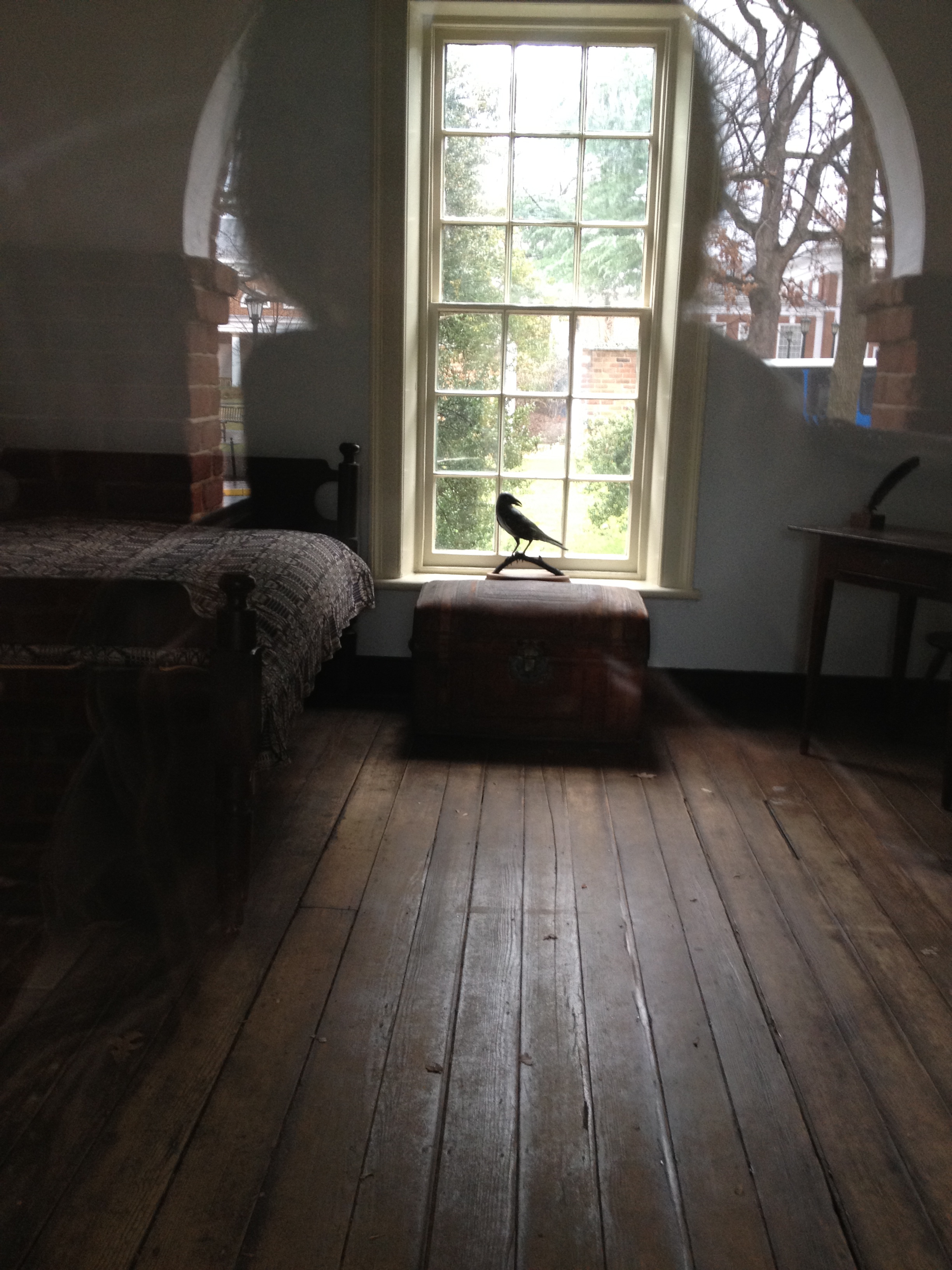
Once in a while an uncanny clarity penetrates this fog of an asphyxiating miasma that passes for a life in higher education. It was a rainy, gray day in February when I stood outside 13 West Range at the University of Virginia, looking into Edgar Allan Poe’s restored room. Poe, who is right up there with Melville and Moses among the greatest writers of all time, lived a life that was short, sad, and silenced. Or so it seemed. Dead by 40, with a career that never really got a foothold, Poe would seem to be the ideal model of a failure. His currency, however, has preserved the voice of unrest that pulses like the very life-blood through American culture. Even as a teenager, I identified with Poe. Knowing that I could never attain his level of polish and perfection, even listening to the cadences of “The Raven” can still reduce me to tears. So, standing outside his room in the gloomy rain was a private epiphany.

13 West Range

Undefined was the sense of loose ends and hopelessly tangled threads of a life I tried to weave without the blessing of Athena. I ended up at a small seminary where my influence was limited to the few students with open minds. It was truly a gothic experience, living at Nashotah House with its medieval mindset and matching physical setting. Daily watching my learning being shredded by the staunch dictates of undying dogma, I never forgot Poe. When my own career was jettisoned by a bloated theology that had no room for questions, I spent many months in a depression so deep that life had almost lost that spark of hope that makes it worth continuing. Again and again the waves crashed over me—this was the doing of the church. Those who putatively followed the teaching of a man who said, “Do unto others—” Fill in the blank.

Poe was forced out of school by an unloving foster parent who valued money more than his adoptive son. Traveling up and down the east coast looking for a place to fit his writings into a slot for a little money, he died from causes that will never be identified. Today we know he was a meteor—a brief, brilliant light in a darkened sky. He is the patron saint of all those whose voices have been silenced by an unfeeling establishment. Even in my wildest dreams, I never hope to approach the depth and grandeur of his pen, but I can stand here in the rain and commune with him. The emblem of the Raven Society stands perched in that room, and its single word is the dying word of hope in the face of an uncaring world. And that one word will be the epitaph of society that refuses, even now, to listen.


Religious Raven

Having seldom achieved any sort of public recognition in my youth, I have been gratified to observe the approbation my daughter frequently earns. One such instance occurred yesterday as she won an Outstanding Presenter award at the state level of 4-H. For her presentation she introduced and recited Edgar Allan Poe’s “The Raven” from memory. As much as I like to take credit for some of her taste in literature, her remarkable memorizing ability that has impressed several judges and parents along the way is the result of her own determination. “The Raven” has always been among my favorite poems. As I listened to my daughter’s recitation yesterday, once again the wealth of religious and biblical images stood out.

Starting subtly with the perching of the raven on a bust of Pallas, Athena, the protective goddess of Athens itself, Poe adds the supernatural to his lamentation on the death of his wife. The bird’s origins on “the night’s Plutonian shore” also point the reader to the classical underworld toward which the poem inevitably points. The last five stanzas, where Poe’s verse turns directly toward his black thoughts at the decline of his wife, introduce the presence of seraphim—the turning point in the poem—angelic beings mentioned as attendants to God’s throne in Isaiah. The divine presence, however, offers Poe no comfort as the raven refuses to relinquish his memories of his love. Asking with Jeremiah (and citing the bird as prophet) if there is balm in Gilead, the poet is informed no such comfort exists. Calling God in Heaven as witness the bereaved asks if in Eden (Aidenn) he will be reunited with his bride, only to be informed such will not be the case. The raven, compared to devil, thing of evil, and a demon, represents for Poe the ultimate reality.

“The Raven” is a dark poem, tinged with religious imagery that was freely drawn upon in the nineteenth century. Having heard it recited many times over the past few months, I have come to believe that Poe would have been in accord with my belief that religion and fear are close siblings. When the climax of the author’s pain and sorrow is reached, the religious imagery predominates. This is a paradigm of many human lives. How many non-religious folk seek to make their peace with the supernatural when death is imminent? “Eleventh hour conversion” may be a trite trope, but it does point to something that Edgar Allan Poe recognized long before me—when we find ourselves most afraid religious impulses are frequently at hand.