
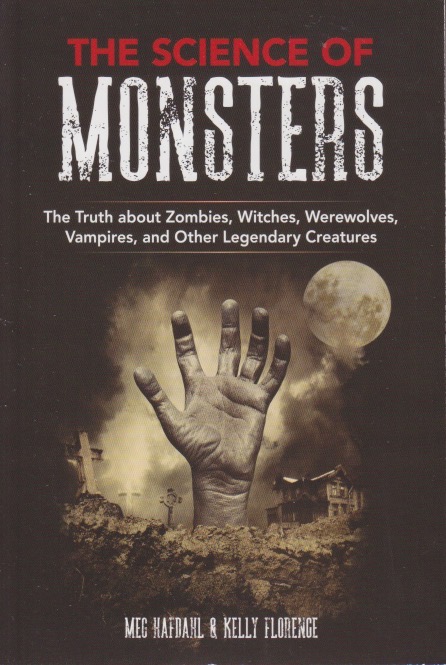
The rule is simple. If you buy something in the gift shop, you can get into A Nightmare in New Hope for free. So I naturally gravitated towards the books. I picked up Meg Hafdahl and Kelly Florence’s The Science of Monsters: The Truth about Zombies, Witches, Werewolves, Vampires, and Other Legendary Creatures. I noticed that the authors weren’t scientists, so I wasn’t expecting anything hard core. In fact, I mostly wanted it for fun. And also, I’m fascinated by anyone who can manage to get published by a trade press, the kind that publish books for under twenty bucks. (Lest you think that’s a random amount, I’ve been invited to events where I was told $22—the then price of Weathering the Psalms, my least expensive book—was too much for most of the audience.) The science in this particular book is akin to the science of various ghost hunters—the use of science as a framework, but not really being actual science.
Still, it’s a fun read. Divided into ten sections of three chapters each, it covers a range of horror movies and asks various questions about aspects of “could it happen?” Of course, in the sections featuring serial killers, we already know the answer. Sometimes the authors shift to the “why” question when something obviously does happen in real life. Now, I bought this book as a horror consumer and I have to say that it made me feel a sense of accomplishment that of the thirty chapters I’d seen all but one of the featured films. The one I haven’t seen is Cujo, but I’ve read the book. What I’ve noticed about other horror aficionados is that seldom have we all seen all the same movies. Since the advent of VHS and watching movies at home, and the various technologies that came after, those of us with an appetite can be starved for choice.
While I wouldn’t turn to this book for any actual science, I did get a few ideas for horror stories from reading it. One of them I’ve been working on since the chapter on The Tingler. Both for fiction and non, I often think about publishers and how to break into that below twenty market. This book is classified, in its BISAC code (the topic on the back of a book that tells you its genre) as science. The publisher doesn’t publish in pop culture, which is what horror movies are. There must be a science to getting publishers to buy into a good book idea like this. Maybe there’s a science to it.
 Steve A. Wiggins