
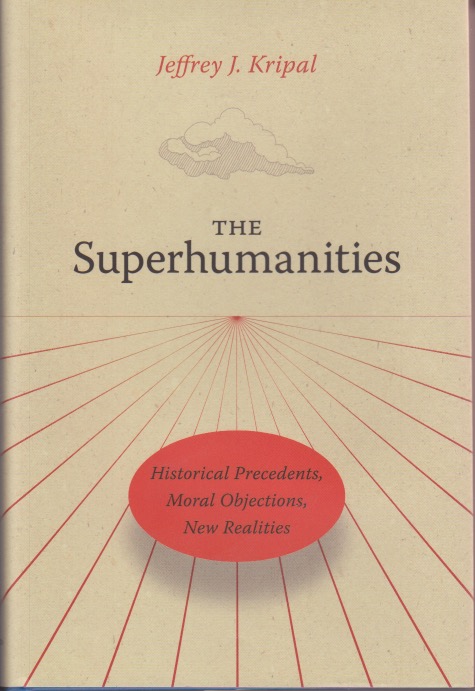
There’s a line in the musical 1776 where Stephen Hopkins says “Well, I’ll tell you. In all my years, I never seen, heard nor smelled an issue that was so dangerous it couldn’t be talked about.” Of course, there are many things that can’t be talked about; some of them so obvious that children can see the truth of the matter. One of those subjects is what Jeffrey Kripal calls The Superhumanities. Most of academia laughingly calls this the paranormal and dismisses it. I have been following Kripal’s work since first encountering Authors of the Impossible, back in late 2011. He is a brave scholar who argues that since encounters with the impossible have happened throughout human history, and still happen, we should study them. Mainstream science, which is necessary and good, proceeds by discounting anomalies. That doesn’t mean anomalies aren’t real, just that if you try to account for everything, well the engine stalls. Because of this, most academics have followed the general public in ridiculing these things as magical thinking.
That doesn’t stop people worldwide, however, from seeing ghosts. Or UFOs. Or experiencing things that just shouldn’t happen. Many of us are taught to brush off things like disappearing object phenomenon, precise coincidences that happen in a striking series, or episodes of picking up the phone to call someone you haven’t talked to in years only to have the phone ring and it’s that person calling you. We tell our friends but generally conclude that it’s just “one of those things.” Moreover, we don’t dismiss family or friends when they tell us about such things. We know them personally and trust their integrity. If a stranger walks in, however, we laugh about the event. Kripal makes the case that something is going on here. And we ought to pay attention.
The main idea of this book is that humans are “super.” In order to rescue the humanities, which Kripal teaches at Rice University, we need to acknowledge them as superhumanities. There’s a lot to ponder in this book. It’s not an easy book, but it is an important one. Kripal engages philosophers on their own terms, displaying an incredible depth of comprehension. I almost didn’t finish the book because it’s so closely argued that I had to put it down for a few months. It had become literally buried under a stack of other books I had in my to read pile. I’m glad I picked it up again. This is a profound book with important, essential conclusions. It includes dangerous ideas, but, like Hopkins, I believe there should be nothing that can’t be talked (or written) about, especially in the academic world. Ridicule is never good debate.
 Steve A. Wiggins