Re-Unborn

Some months ago I wrote a post about the possession movie The Unborn.  I don’t watch movies to pass the time.  I watch them to learn something.  And many horror movies are fairly smart.  In my blog post on this one I didn’t go into too much analysis because I already knew at that point that I wanted to share my thoughts on the larger venue, Horror Homeroom.  My piece, “Ecumenical Exorcism in The Unborn” has just been posted there.  The fairly small number of regular readers I have know that I post about horror movies with some frequency.  They help me to make sense of things, especially in this insane world where petty dictators keep rising to the top of the political spectrum because, apparently, we hate ourselves so much.  Horror helps prepare you for that.
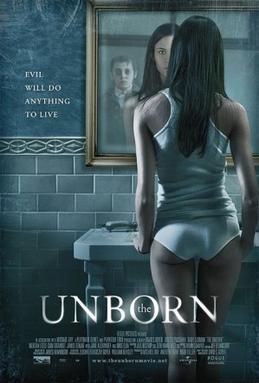
In any case, The Unborn is a good example of how religion and horror work together.  They cooperate very nicely, in fact.  Religion is pervasive enough in horror that it would be an error to say “religion-based horror” is a sub-genre of the whole.  No, the two go together as naturally as chocolate (vegan, preferably) and peanut butter.  If I had a million dollars I might go back to grad school to explore just this nexus.  (I wouldn’t be looking for a teaching job either, because “fool me once, shame on you; fool me twice…”)  I’m not the only one who knows that there’s something there.  Ironically, before horror films proper were even invented, many churches actively discouraged the movies.  Perhaps they were inherently aware that these represented competition.  And there was already too much competition, what with other denominations and all.  But some films do occupy the same space as religion.  Quite often horror.

If you’re interested in how The Unborn fits into this picture, head on over to Horror Homeroom.  And yes, there is a book-length project in all of this.  It’s one I’ve been chipping away at for years.  That’s because the connection is obviously there, but I haven’t, to my own satisfaction, been able to figure out exactly what it is.  Perhaps I need to add a degree in psychology to my bucket list.  These things meet similar mental needs for a cross-section of people.  I suspect that most horror fans don’t think about it too much, which may be why my blog isn’t exactly jammed with traffic.  That doesn’t mean that the connection’s missing.  There are many things in life yet to be discovered.


Hungry for Choice

I was recently asked to speak to a senior seminar about Holy Horror (many thanks for the invite!).  One of the questions asked was how/why I chose the movies I did.  The same question applies to Nightmares with the Bible.  The thing is, my avocation is an expensive one, particularly on an editor’s salary.  The number of horror movies is vast and our time on this planet is limited, so one thing any researcher has to do is draw limits.  Otherwise you get a never-ending project (some dissertations go that way).  I had figured, for both books, that I’d seen enough movies to make the point I was trying to make.  Neither book was intended to be “the last word,” or comprehensive, but were attempts to open the conversation.  Since none of my books have earned back nearly what resources I’ve put into them, a line has to be drawn.  Movies are expensive when they get to the bottom of the “outgoes” column.

All of this is to explain why I didn’t include The Unborn in either book.  (It fits into both.)  I was aware of the movie, but I had to decide what I could afford in order to get the books written.  I confess that I wish I’d watched this one sooner.  (Remember, it’s a conversation!)   This movie has so much in it that I may break my self-imposed rule of no double-dipping for blog topics.  Or perhaps I’ll pitch something to Horror Homeroom.  The Unborn is about a dybbuk.  Like The Possession, it features a Jewish exorcism.  Like An American Haunting, a holy book is destroyed.  (The credits include a statement that no actual Torahs were harmed in the making of the film.) Interestingly, the exorcism is a joint effort between a rabbi and an Episcopal priest.  Held in an asylum.  It’s also a story about twins.

The skinny: college-aged Casey is being pursued by a three-generation dybbuk.  Her mother, who died by suicide in an asylum, had been adopted.  Casey is unaware that she was a twin, her brother having died in utero.  She discovers her birth grandmother, a Holocaust survivor, who clues her in to why all the strange things are happening to her.  Her own twin brother was possessed by a dybbuk at Auschwitz.  It is now after Casey, having caused her mother’s suicide.  The plot is pretty sprawling, and the exorcism scene over-the-top, but I’m only scratching the surface here.  There’s so much to unpack that I wish I had a bigger movie-and-book budget.  But then we all have our demons with which to struggle.