Othering Offering

I get to feeling a bit anxious when nobody else publishes me for a while.  It’s a strange kind of validation, I suppose.  No matter my motivation, I knew as soon as I saw The Offering that I would have to write something about it for Horror Homeroom.  The article is now available here.  Horror, as one of the more intelligent genres, often has much to say about things such as religion and esoteric beliefs.  In the article I compare it to other recent Jewish horror such as The Possession, The Golem, and The Vigil.  All of them are worth watching.  Religion often addresses those things that scare us, whether secular or sacred.  Movies like these often make me ponder the sense of belonging that religious communities offer.  At least in the best of times.
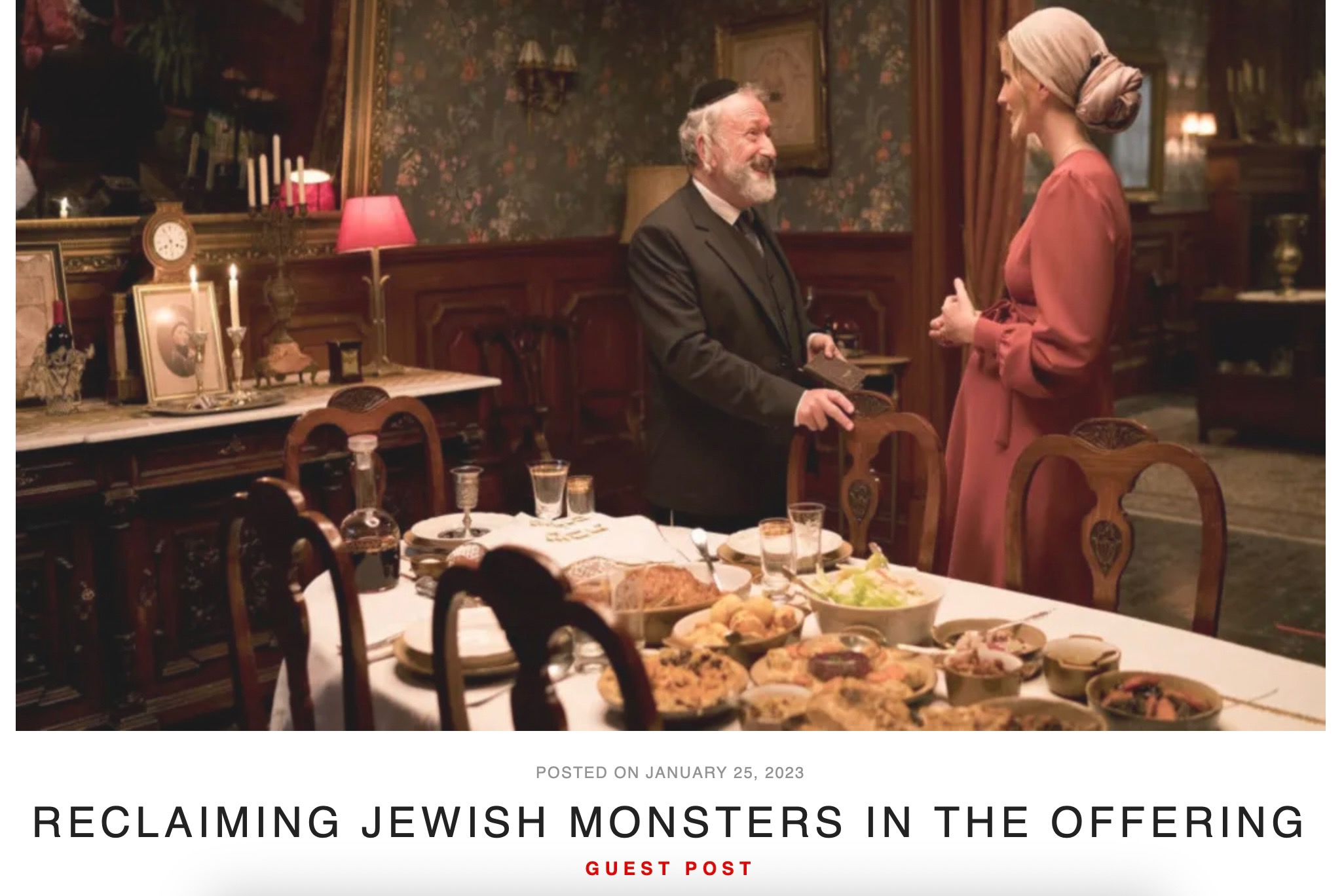
These three movies each have their own posts on this blog, but the point of the Horror Homeroom article is to try to look at them together.  Judaism can be a particularly delicate topic.  Not only the Holocaust, but also subsequent political developments have led to dangerous situations for Jews in the real world.  Theirs is an old and rich culture, persecuted largely by Christians who ironically blame Jews for their own salvation.  And hate them for it.  Nevertheless Jewish culture and belief persist.  It’s telling that even when they invent a protector, such as the golem, they come to realize that it too will turn on them in the end.  Most horror movies, if they participate in religious worldviews, do so from a Christian point of view.

Some colleagues recently asked me to name some Protestant horror movies.  That’s a tricky question to answer because the American context is still largely Protestant as a whole.  And when you want to take on monsters and demons you generally call a priest.  Even movies like The Last Exorcism have Protestant clergy using Catholic crucifixes.  As I’ve stated elsewhere, Asian horror movies have also come into their own, often reflecting Buddhist or Hindu outlooks.  So we find religion and horror intermingling worldwide.  Movies are more than just entertainment.  They can be, and are, teaching tools.  We should pay attention to what goes on in their classrooms.  Not only can we learn about ourselves, we can also learn about those that we, or society, tend to “other.”  Like high school, there are a variety of classes you might take.  The day always starts, however, with homeroom.

Being Vigilant

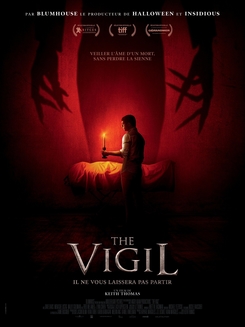
While keeping to a budget, I’ve been tying to sample some new movies as therapy.  Interestingly, Hulu has had three on my long-time “to see” list, including The Vigil.  I heard about this one as soon as it came out.  Religion and horror have been a recent area of fascination, so how could I not?  A horror film partly in Yiddish is a novelty for me, and the haunting, endlessly haunting holocaust is never far from the surface.  Jacov, a young man with psychological issues caused by the death of his much younger brother, has left Orthodox Judaism.  He’s hard up for money, however, and agrees to sit as a shomer, a watcher who keeps vigil with a corpse of a person who has no family to do it, for pay.  The rabbi informs him the shomer he hired left because he was afraid, but since Jacov has done this before, he’s sure he can handle it.

Sitting in a creepy Brooklyn house with a corpse is made even more difficult by the widow’s Alzheimer’s disease and Jacov’s seeing things.  Unsettling events take place.  The problem is revealed to be a mazzik, a kind of Jewish demon.  As I explore in Nightmares with the Bible, and Holy Horror, the Jewish idea of demons took quite a different track from the Greek-inspired Christian concept.  Jesus was Jewish, but living in a Roman context.  What we in the west understand as demons is largely based on The Exorcist.  In Judaism demons weren’t the same obsession they were for Christians.  The dybbuk tends to be the soul of an evil person that can’t rest after death.  A mazzik is more a demon sent to harm, as a form of divine punishment.

The Vigil presents Jacov in that pincer of having left a religion only to find himself needing it in a time of crisis.  His Orthodox upbringing hasn’t prepared him for the world of having to interact with women, or even gentiles (as wicked as they can be).  The mazzik has haunted the man who’s just died—a holocaust survivor—and is now looking for another broken person.  Ever since the death of his brother, Jacov has been broken.  The film make effective use of several horror tropes, and is quite claustrophobic in the small house.  Even though set in New York City, isolation is the real threat.  More than that, the movie eloquently articulates how religion and horror rely on one another.  And how they might learn from each other.


J-Horror

J-Horror better move over.  There’s a new kid on the block.

For many years those of us strange fans of horror have used “J-Horror” as shorthand for Japanese Horror.  With two highly successful films (eventually series) of the mid-nineties (Ju-On and Ringu) the Japanese contribution stormed back into American consciousness.  Those of us who grew up on Godzilla knew that J-Horror had been around for decades already, but these new movies were distinctly creepy.  So much so that English-language versions were remade for both original films (The Grudge and The Ring, respectively—rather like Let the Right One In and Let Me In).  So far, so good.  So why does J-Horror need to move over?

At least three separate friends have pointed me to another emerging J-Horror trend: Jewish horror movies.  These used to be rare.  With cases of early antisemitic themes in horror, and the real life horror of the Holocaust, this is certainly understandable.  “Christian” producers or directors delving into Jewish themes would seem to be in bad taste.  Still, some notable Jewish-themed horror has begun to emerge.  (I addressed one such film in my recent Horror Homeroom piece.)  The Possession (discussed in both of my most recent books) centers around the need for a Jewish exorcist in the case of a dybbuk problem.  For more information, you know where to look!  It seemed to me that the dybbuk box contents were reminiscent of the Holocaust, but that may not have been intentional.

I recently wrote a post about The Golem.  This is a recent Israeli movie that builds on the traditional Jewish monster.  Although set before the Holocaust, the fact that there’s a pogrom in the film shows that the concept is not far off.  The movie that people have recently been pointing me toward is The Vigil.  I’ve not had an opportunity to see it yet, but the press it’s received suggests it too will be another classic based on lived experience in Judaism.  I’m not sure if Jewish horror will eventually rival the numbers of Japanese horror films, but the offerings thus far have been noteworthy.  Horror often addresses the problem of human suffering.  With all the oppressions in “white” society, it’s no wonder that, along with Black horror, Jewish horror is beginning to garner attention.  Although it’s clearly not to everyone’s taste, horror is often a genre with a conscience.  It becomes a screen on which we can see our worst behaviors projected.  And if we’re wise, we’ll take steps to make such suffering become merely an unfortunate memory.