Of Wolves and Humans

Time has a funny way of distorting perceptions.  I remember when The Wolfman (2010; please, I’m not old enough to have seen the classic initial release in 1941) came out.  I’d already started this blog by then, and I was occasionally watching and writing about horror movies.  Initial reports said this reboot was too violent and bloody.  I had the impression that it’d done well at the box office, but I didn’t see it.  I found a used copy on DVD several years later and still I waited to watch it, a bit afraid from the initial assessments I’d read.  (I tend not to read reviews or watch trailers before seeing a movie—I prefer to come in fresh.)  All of this is to say I finally got around to seeing The Wolfman and I was disappointed.  I really wanted to like it too.  The wolf man was my favorite classic monster as a kid.

I do need to praise the gothic setting and landscape cinematography.  This is beautiful and well done.  Part of the problem is the way the story is changed.  Another is that, apart from The Silence of the Lambs, Anthony Hopkins doesn’t seem to fit the horror genre very well.  Claude Rains made a believable Sir John Talbot, despite being so much smaller than Lon Chaney.  Hopkins has trouble pulling it off.  It could be poor directing, I suppose, but it was difficult to take him seriously.  And two werewolves?  That suggests just a little too much CGI.  Still, there are some good moments.  I did appreciate Sir John encouraging his son to let the wolf run free.  I suppose if you’ve got a werewolf issue, having a dad to talk you through it would be a good thing.

Werewolves, like most classic monsters, are thinly disguised psychological tendencies.  Civilization isn’t always easy, even for social animals like our own species.  There’s a werewolf inside.  Transformation, however, always suggested redemption to me.  The ability to become something better.  I saw The Wolf Man as a parable.  That may have been unusual for a kid, but when religion and monsters come together strange things can happen.  The wolf may be angry, but it need not be dangerous.  It turns out that I really didn’t have to wait thirteen years to see this movie.  I’ll probably watch it again for the points it scores on the gothic scale.  The action features aren’t necessary for a good monster flick, though.  The 1941 version worked just fine.

Old Wolves

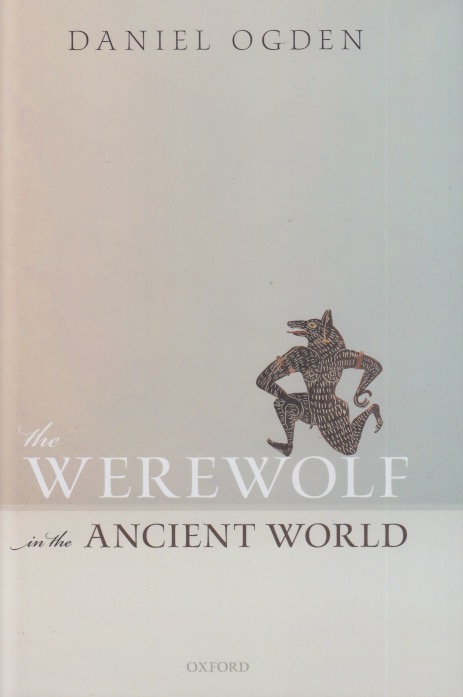
Among the classic monsters, the werewolf seems to suffer from lack of a foundational novel.  Yes, vampires are older than Bram Stoker’s Dracula, and antecedents can be suggested for Mary Shelley’s Frankenstein, but there isn’t a werewolf novel of similar stature.  Daniel Ogden, however, does us a service by providing an extended discussion of, as his title states, The Werewolf in the Ancient World.  His survey is intriguing and informative, and also insightful.  The werewolf is not always what it might seem.  Ogden is an able guide through sources from antiquity through some medieval tales, focusing mainly on the ancient ones.  He extensively explores their associations—witches, sorcerers, ghosts, and the like.  And related tales of human transformation.  He even suggests what some of those transformations may have been seeking.

The werewolf is perhaps the most obvious monster that expresses repressed desire for transformation—a kind of salvation.  Civilization comes with a cost and the werewolf is symbolic of the individual driven by animal desire, unrestrained by human convention.  It’s also an idea of great antiquity.  Although Ogden doesn’t go into it, stories of humans turned into wolves goes back at least to the Epic of Gilgamesh, one of the earliest pieces of literature we have in fairly complete form.  The idea is attested in writers such as Plato and Augustine, if only to refute it.  In other words, it is clearly something people have thought possible from very early times.  Our long association with the wolf, and its domesticated version—the dog—certainly plays a psychological role in such tales.

As Ogden points out, Guy Endore’s novel The Werewolf of Paris, published in 1933, is perhaps as close as we come to a foundational novel.  In the Universal monsters series that developed a canon for monster boomers, The Wolf Man was a somewhat late entry, appearing in 1941—a decade later than Dracula and Frankenstein.  Despite these tardy cultural appearances, the werewolf has been part of our collective psyche far longer.  Ogden shows that clearly.  When you stop to rethink stories like Little Red Riding Hood, the talking, humanized wolf appears so naturally that we don’t often stop to consider the implications.  I certainly hadn’t made the connection explicitly until reading it here.  Ogden’s work is readable but academic, so be prepared for citations and some technical talk.  Nevertheless, this is the clearest guide to lycanthropy and the magical ideas behind it from ancient times to have appeared in recent years.