Heavy Machinery

Funny how some things just stick in your mind.  And then come back at odd times.  Killdozer was a television movie from 1974.  I must’ve watched it pretty close to when it first aired.  Why it came back to me half a century later I just don’t know.  I haven’t been around any heavy earth-moving equipment lately, nor have inanimate objects been threatening me.  When I found it on a free (albeit with commercials, but hey, the original had commercials, so it’s a full circle kind of phenomenon) streaming service, I figured why not?  I was really expecting something cheesy, like I would’ve liked at eleven or so.  It wasn’t really that bad.  There’s actual characterization and the acting is believable.  Only the special effects of the meteorite and the blue glow were obviously low budget.  But you might not be familiar with the D9, so let’s go.
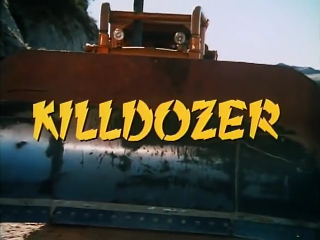
An uninhabited island off the coast of Africa.  Six guys on a construction job—building an airstrip for a petroleum company.  The supply ship’s a few days away and when the Caterpillar D9 hits the meteorite, it becomes a murderous machine, like Stephen King’s Christine.  You can outrun a bulldozer, for a while, anyway.  But if it never runs out of fuel, and you’re trapped on an island, your chances aren’t good.  They’re even worse if the thing is sentient and knows what you’re planning to do.  Six men were sent to the island, and only two make it back.  You get the picture.

As a child I had no idea who Theodore Sturgeon was.  When I saw that this was based on one of his stories, I had to ponder a bit.  Sturgeon wrote several of the original Star Trek series episodes.  His most famous stand-alone story seems to be Killdozer.  In fact, it’s become a cult classic.  I don’t have many friends, so I’m not always aware of what’s in during any given decade.  I think kids at school were talking about Killdozer, but nobody has really uttered that word in my hearing since Gerald Ford was president.  So if you don’t mind commercials, and you have a sleepy spare hour, some of us would be interested to hear what you think about this movie.  The sense of isolation and people being killed by something they construct to be basically indestructible struck me as a lesson worth pondering.  And I’ll continue to try avoiding heavy earth-moving equipment, just in case.

Believing Beyond

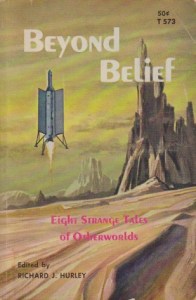
The closing line “I’ll come back to you—in the sunlight” is all I remembered from this little book.  Perhaps I hadn’t read it all the way through, but likely I did.  An unapologetic fan of science fiction as a kid, I must’ve picked up Beyond Belief at a fairly young age.  Although it’s a Scholastic book, it is appropriate for older readers as well.  I picked it up again because I start to get anxious when I can’t post about a book for a while.  My current reading projects are either very long or somewhat technical, meaning they take time to finish.  I’m running out of my ready stock of shorter books (mostly collections of stories from the time before book prices were hiked up and publishers felt the need to make them thicker so consumers wouldn’t feel so cheated.

I had put off reading this collection edited by Richard J. Hurley because of that one story I remembered.  As a kid I recognized the name of Isaac Asimov, but probably not that of Theodore Sturgeon, Richard Willey, or Richard Matheson.  These stories were masterpieces of sci-fi in its golden era.  Although they seem antiquated—perhaps even quaint—now, they are the kinds of stories that inspired young pioneers of space travel and may have contributed in some measure to this strange world in which we live.”Phoenix” by Clark Ashton Smith, has stayed with me for decades.  This tiny tome is old enough that I’m not going to worry about spoilers.  I’m only grasping for an emotional thread with childhood.

The sun has gone out.  Two young lovers talk on the eve of the earth mission to reignite the sun by a series of thermonuclear reactions.  The male, of course, is on the mission, but he assures his love that he will return to her in the sunshine.  Something goes wrong, of course.  The ship crashes into the sun, reigniting it, but annihilating the ship and crew.  As the future lady looks out on the newly illuminated world, she knows her love cannot have survived, yet he has returned to her in the sunlight.  That powerful story of self-sacrifice and love left unfulfilled stung my young psyche.  So much so that reading the other seven stories in this book was like reading tales I’d never heard before.  Beyond Belief was a quick read interjected in much more  complicated literary endeavors.  Like childhood, it didn’t fail to bring a warm glow after far too many years.