Thinking Plants

Consider your sources.  As an erstwhile professor I grew accustomed to repeating that, and this was before the internet started up, making claims of all kinds.  Certain news sources—think New York Times, or the BBC—earn their reputations slowly, over many, many years.  That doesn’t mean they don’t make mistakes, but it does mean they’re often on the mark.  So an article on plant consciousness on the BBC is worth considering.  Consciousness is still something we don’t understand.  We have it, but we can’t always say what it is.  Many, if not most, people tend to limit it to humans, but it’s become very clear than animals share in it too.  Why not plants also?  A few years back I read a book by philosopher Thomas Nagel.  He made the argument that human consciousness must come from somewhere, and as we look down toward animals, and plants, what we see are smaller pieces of the same thing.

I’m not stating this as eloquently as Nagel did, but the idea has stayed with me.  The BBC article  notes how plants seem to react to human interaction.  And they seem to communicate back.  We lack the natural range to hear their responses, but some experiments indicate that plants at least communicate among themselves.  Being the BBC, the story reports but doesn’t necessarily advocate this point of view.  Still, it makes sense.  For too long we’ve supposed human beings to be the only intelligent creatures on this planet, taking the arrogant view that animals are automatons with no thinking ability.  To give them that would be to make them too human-like.

That particular viewpoint still exists, of course, but more and more scientists are starting to consider whether consciousness isn’t emergent from, as Nagel put it, smaller building blocks.  I tend to be on the more imaginative end of the spectrum—consider your source here—but it seems to me that plants could well have a consciousness too.  Trees move.  They do it too slowly for our species to notice it, fixated as we are on our own brief time in the world and our human affairs, but that doesn’t mean they don’t move.  It simply means that if we want to see it we need to shift our perspective.  Communication, it would seem, pervades nature.  If it does, isn’t consciousness somehow implicated?  Plants may respond when we pay attention to them.  To me that makes the world an even more wonderful place.

Kind Animals

How many people could it be?  That’s the question a pandemic naturally raises.  Last weekend my wife and I ventured to a Vegan Festival in Easton.  Since we vegans are a rare bunch anyway, and since we tend to be socially conscious, there wasn’t likely to be any dangerous behavior.  That, and how many people would actually show up for what is often considered a somewhat wobbly crowd who don’t like to “rise, kill, and eat.”  It felt like a safe place to be with socially distanced kindred spirits.  Everyone was wearing masks and there was no Trump bravado going on.  For a moment it reminded me of the kind of accepting country the United States used to be.

Veganism, you see, isn’t just about not eating and not exploiting animals.  It’s about honoring the wonder of life in all creatures.  I realize some of the issues—believe me, I try to think things through thoroughly.  It’s all about consciousness.  We’re still a considerable distance from being able to define it, and some people, like philosopher Thomas Nagel, believe it might go all the way down and through the plant kingdom as well.  Consciousness is one of the great mysteries of science.  We hardly know what it is, and how are we to know where it stops?  If we assume other people are conscious (with a few notable exceptions) based on their words and actions, might we not suppose at least some of the “higher” animals are as well?  Or are you just being a fool when you talk to your dog?

You see how this naturally suggests consciousness may lessen by matters of degree, but then we learn that even some insects know how to count and can understand a concept of zero (beyond most Republicans).  We like to put insects down at the bottom because we’re bigger and therefore more important.  Veganism suggests that we stop and think about these things.  We don’t necessarily take everything for granted.  It is clear that the largest polluter and environmental problem is industrial animal farming.  Rainforests are cleared for grazing land.  Profits from big agra are staggering.  Wandering through the stalls, keeping our distance from others who perhaps think too much, we partook of the counterculture in our own quiet way.  The street festival was small this year, but I do have hopes that it might grow, along with some serious thinking about the consequences of our actions.  


The Reading Bug

With the sunshine coming in my office can feel pleasantly warm in winter.  I chose this location not because of its southern exposure, but because it is a small room and it’s a good place for books.  Although it’s January, the sun brought a shield bug to life the other day.  At first I didn’t know what it was.  I’d hear a loud buzzing followed by a rather obvious crash, but I saw no insect.  Since we had a string of sunny days it kept reawakening in the mornings, warmed by sunlight on my windowsill and spent the days climbing on and sometimes attempting to fly through the glass.  I identified the beetle quickly once I saw it.  As I watched the poor creature’s progress (or lack thereof), I was sorry that I couldn’t release it outside.  It was still quite cold out, and I didn’t think it would survive.

Spending long hours in the same room with my perplexed insect friend, I came to ponder what its experience of life was like.  I’m no Franz Kafka or Thomas Nagel, but I had to wonder when it chose to spend the night on a clay replica I had made of an Ugaritic abecedary.  I’d made this clay model when I was teaching, and I used it as one of several visual aids to help students understand how writing had developed.  (I had even ordered authentic papyrus to pass around, and the single sheet of vellum cost more than an entire book in those days.)  My doctoral work largely focused on Ugarit, and in the 1990s it looked like that sub-specialization might be on the ascendant.  We often live to have our mistakes rubbed in our faces.  But why had the shield bug picked this very spot to roost?  It looked as if it were trying to learn to read cuneiform.  It needn’t bother.

Although I habitually awake quite early, it isn’t easy getting out of bed.  Especially in a cold house during winter.  My entomological friend, of course, had to wait for the sun itself to come back to life.  Night on the windowsill can’t be comfortable, especially when the radiator is under the other window in the room.  No matter how much I try, I’ll never know if I’ve succeeded in understanding the experience of that bug.  How it is enslaved to the sun, and how it keeps on climbing, even after it falls, raising a tiny geyser of dust.  How it flies full speed into a barrier it cannot see, and then tries again.  I may not be able to understand this beetle sleeping on my Ugaritic alphabet, but I do think there’s something here to learn.


Universal Growth

Maybe the universe isn’t expanding, maybe it’s growing. Always tinged with a healthy dose of pantheism, I’ve often opined to those who will listen that life might be more than animals and plants and microorganisms. But then again, I don’t have the numbers to back me up. These aren’t just the ravings of a guy who wanted to be a scientist but whose religion prevented him, they’re also pretty close to those of a scientist who became a religious guy. When more than one person sends me the same article I figure I’d better comment on it. Those who used to be professors can’t help but professing, after all. So I read Meghan Walsh’s Ozy story, “Jeremy England, the Man Who May One-up Darwin.”

England spent his education on science only to turn to religion along the way. That’s pretty unusual, according to the standard social discourse, but I suspect it’s more common than we’d like to let on. There’s no clause in science that says you can’t believe in anything. Even Richard Dawkins has beliefs. Many scientists have been suggesting, of late, that perhaps physics and religion are converging. (Some of us from the other side of the equation have been saying so for years, but who believes a religionist?) Before I’m misunderstood, I’d hasten to add that I don’t mean religion as in literal trumpets sounding as a white horse and rider descend through the atmosphere. Nor do I mean in the sense of the minutiae of the Talmud. What I mean is the symbol systems that religion has long used may have been in some sense in line with what science has been trying to tell us.

According to the story, England thinks that matter may be self-organizing. That means life occurs where matter exists. Before I become too close a friend with my sofa I have to remind myself that this doesn’t mean everything’s conscious. Although my reading of Thomas Nagel does have me wondering even about that. You see, religion has historically been one of those disciplines where imagination has had a valued role to play. Those who accuse it of being doctrinaire and evil need to talk to a few more people. Religion has always claimed there’s more to life than what the senses reveal. Science professionally limits itself to the inferences of those senses. And you can get away with paying religion specialists a lot less. What’s not to like about this situation? If the universe is growing, there’s room for us all.


Nature’s Voice

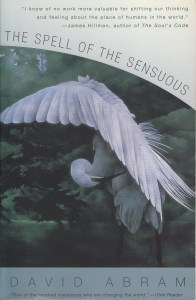
SpellSensuousCivilization isn’t all it’s cracked up to be. Sure, it’s got its moments—modern medicine, indoor plumbing, Honey Boo Boo—but often it’s artificial. It’s like somebody made up a set of silly rules and those who dare violate them are treasonous barbarians. Over the past few years I’ve been reading books that consider our biological development and what nature seems to indicate about how people might exist more holistically in the world. I don’t mean New Age outlooks, although, surprisingly, such treatments often aren’t far off base. I’d never heard of David Abram or his book The Spell of the Sensuous. (For those who think sensuous means only one thing, the subtitle is Perception and Language in a More-Then-Human World.) Although somewhat dated, this is an insightful book. The basic premise is that we are, by nature, part of a much larger world but we have, like spoiled children, decided to take it all for ourselves and isolate our species from all others, claiming a superiority that none dare challenge. In the process we’ve lost much of what it benefits us being animals, and have separated ourselves from the wonders of the world all around us. Working in Manhattan, I have to agree.

Basing his observations on having lived among aboriginal peoples, Abram notes that although anthropologists have denied the tenets of Christian missionaries on the religious front, they have continued in that teaching concerning biases against nature-based belief systems. Peoples who live close to the land observe things which seem superstitious to the “civilized,” but which are, in reality, simply astute realizations based on watching how the world works. Like Thomas Nagel, he notes that consciousness pervades the natural world. Animals, plants, even the earth itself displays forms of awareness that we ignore in our rush to exploit and gain “wealth.” In reality, we suffer for having made ourselves something we’re not.

There’s a lot in this book, far more than a single blog post can say. I don’t agree with all the points Abram makes—that writing may be responsible for our dilemma is a bit of a stretch—but there is great wisdom in this tome. At several points I had to stop and ponder the implications of what he was saying. Yes, nature speaks. Creating a world where “success” is measured in removing yourself as far from nature as possible requires elaborate rules. As far as I can tell, obeying the rules means that if you’re one percent of the one percent you’ll have nothing to complain about. If you have enough money—itself an artificial construct—you can run for president with no other qualifications. Meanwhile, nature suffers at our hands and may only recover once the world is forced from our hands and the sensuous once again takes over, doing what it has always done.


Intelligence, Evolved

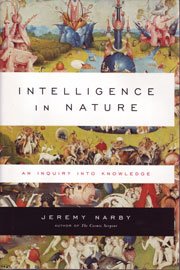
intelligenceinnatureAnyone who has looked into the eyes of a cat or dog can have little doubt that they think. What exactly they think is, of course, a matter of conjecture. I had been meaning to read Jeremy Narby’s Intelligence in Nature for a few years now. We are taught at a young age to eschew anthropomorphism—although our eschewers don’t use that word—as the childish way of perceiving the world. Animals don’t think because that’s reserved for people. We sit in the finest spots in the poshest corners of the animal kingdom and the sign says “No Dogs Allowed.” I never really outgrew this child-like belief because the minimal scientific evidence I’ve been able to infer supports the idea that like us, other animals think. Narby, an anthropologist, agrees. At least to a point. I don’t wish to make claims for Dr. Narby that he wouldn’t support, but he provides fascinating empirical evidence, “down” to the level of amebas and plants, that indicates intentionality. Nature is alive with thought.

As an anthropologist, Narby begins his consideration with the insights of shamans. Although scientists rarely countenance shamans, they are among the earliest of human religious specialists and they have long promoted the idea that humans are fully integrated into nature. We are not separate and above. From our brains to our bones, we are one with the natural world. If we think, should not animals think? Interestingly, this idea brings Narby into some of the same territory as Thomas Nagel; intelligence may be a cumulative process. Our brains’ ability to think may be the result of collecting together the thought processes of our fellow creatures to a point where our thinking becomes abstract. We’re told that dolphins and whales don’t think like us—they don’t build cities, do they? Maybe it’s because they didn’t evolve opposable thumbs. Maybe it’s because they’re smarter than we are.

There are, it seems, many thinkers on the outside of the hallowed confines of hard science that are chipping away at the strict materialist edifice. There can be no serious question that the empirical method explains much of what we experience in the universe. It has always amazed me, however, that we assume that humans are able to find the outer limits of existence with our limited senses. We know animals can see, hear, smell, taste, and maybe even feel in ways beyond our capabilities. Who’s to say that there isn’t other input well beyond our limited senses that we use to survive in this environment? After all, we didn’t evolve to know everything—we evolved to be able to thrive in our ecosystems. For that you don’t need all the answers—just enough to get by. If you doubt my reasoning here, I suggest you ask your dog or cat.


Mind Your Cosmos

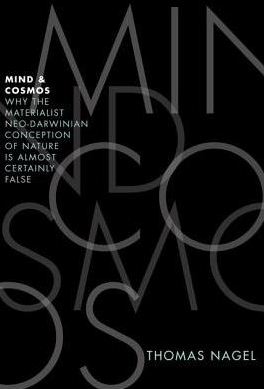
MindandCosmosSomething on your mind? How often do we bother to think clearly about our minds? One of the most dispiriting concepts ever invented is the idea that even our minds are merely part of a reductionistic, mechanistic universe. All those beautiful, frightening, sublime, and mundane thoughts are just noise, clutter. An inevitable side-effect of all that electro-chemical activity in the gray matter. Nothing more. It is an idea to which it is very difficult to warm. Philosopher Thomas Nagel, however, doesn’t use a soft approach to the concept of mind in his Mind and Cosmos: Why the Materialist Neo-Darwinian Conception of Nature is Almost Certainly False. This is not an easy read, but it rewards the reader well.

Some, I suspect, will accuse Nagel of being a closet creationist, but he addresses that concern up front. Nagel is an atheist, but he recognizes that the creationists have raised some valid points about the explanatory value of a materialistic, reductionistic view of the universe. Nagel, like all careful thinkers, realizes that the fact of evolution is not to be disputed. The mechanism driving mutations, however, is open to some speculation. I’ve read many books that suggest we are but (in a more than angst-ridden Kansas) dust in the wind. Particles and reactions and nothing more. That love you feel when your heart is thumping wildly over that special someone? Mere chemistry. And not the kind that implies a transcendent state. Just lab-coat chemistry. I read Nagel because this kind of reductionism just doesn’t fit reality as I’ve experienced it. I’m no physicist, but I’m all I’ve got. And my reason tells me that there’s something more too it.

Nagel approaches the issue by examining the origins of mind. Whence does consciousness emerge? Using precise, carefully selected reasoning, he demonstrates that there is a chance that consciousness is inherent in this universe we inhabit. Just as bodies are built of cells, and cells are built of proteins built of molecules built of atoms, the mind could be constructed of components as well. I can’t replicate Nagel’s elegance of expression, but his suggestion that we may be part of a universe beginning to awake is as much poetry as it is logic. And that, more than anything else, is a reflection on the complexity of being human. We are meaning-seeking creatures. Being told that we’re mechanistic automatons is like slamming a door in a two-year old’s face. If I am merely particles and tiny jolts of electricity, I’m going to take the particles that make Nagel’s book with me as I try to reconcile myself to a universe where nothing is really what it seems.