Keeping House

I really wanted to like The Innkeepers.  I’ve appreciated the Ti West horror that I’ve watched and Sara Paxton has a compelling screen presence.  The setting of a hotel that’s about to be shut down is a good set-up, and although the ghost story is somewhat conventional, it’s workable.  Part of the problem was clearly lighting.  Maybe I’m just too old, but when something important takes place in a scene that’s just too dark, well, it loses something.  So here’s how it goes: Claire and Luke are at the front desk for the final weekend of The Yankee Pedlar.  The guests are a woman and her young son, a psychic who used to be a television star, and an old man who wants to stay in the room where he had his honeymoon.  Claire and Luke are also ghost hunting at the hotel and a suicide-bride ghost is said to haunt the property.  When Claire finally does see the ghost, after the old man dies by suicide in the same room as the bride, Claire ends up in the basement where they get her.
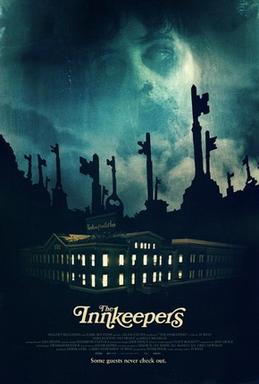
The chase through the basement is dark.  I didn’t realize, until reading a summary later, that Claire, who uses an inhaler throughout the movie, died of an asthma attack.  That gives the story a nice ambiguity.  I, for one, couldn’t see that because things just weren’t lit well enough.  The final sequence, before the credits, shows the room in which the psychic was staying (she had a tendency to gaze out the window) and then the door slams on the camera.  The summary said a very light image of Claire is visible, and that she turns toward the camera before the door slams.  I watched the ending twice and couldn’t see her anywhere.  That scene was too brightly lit.  Without those two bits, the ending really doesn’t make much sense.

Movies generally involve many, many people (thus the very long credits).  Although the director is the “conductor” of the piece, sometimes I wonder about the lighting decisions, and whether this was a lighting department decision or West’s.  Whoever it was, I’m sorry to say that it made my experience of seeing the movie a confusing one.  The movie did reasonably well against budget so I suspect plenty of people saw what I could not.  I would be willing to try it again, maybe in a darker room or on a bigger screen.  A ghost story where you can actually see the ghost seems like a winning combination for an October weekend.

To the Maxxx

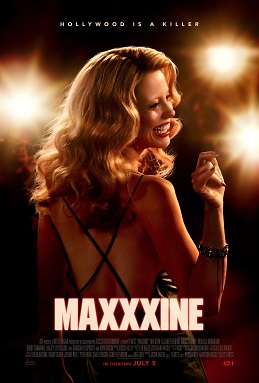
Okay, so Maxxxine will be difficult to discuss in my usual format here, but I’ll give it the old college try.  Ti West is quite a stylist when it comes to horror movies.  Friends recommended X a couple years back, and then it was revealed that it would be part of a trilogy, with Pearl coming next.  I’d seen these two and knew that I would watch Maxxxine when it came out.  More than just closure, these films all make heavy and obvious use of religion.  So much so that an extended piece could be written on that aspect alone.  I’ll try to restrain myself here.  Maxxxine is a direct sequel to X (Pearl was a prequel), following Maxine as an actress trying to break through in Hollywood.  Following the death of her X-rated film colleagues, she found an agent and has been trying to be cast in a horror film.  The movie starts with a home movie shot by her evangelist father advising her never to give up.

Just as Maxine wins the horror film role, a number of her friends in the adult entertainment industry are murdered.  Maxine refuses to assist the police, even when her best friend, who runs a video store, becomes a victim.  A private investigator is following her and she has him killed.  Those who saw X know she killed Pearl, and she’s willing to do as her daddy said, whatever it takes.  She decides to go to the PI’s client to try to stop the murders.  She discovers the man behind the violence is her father, who has learned about her X-rated work and believes she has a demon.  He has been killing her friends to lure her in and is about to brand her as a follower of Satan when the police arrive and a shootout occurs.

The publicity doesn’t hurt Maxine’s career prospects, even though she ends up killing her own father.  The movie is commentary on movie-making, fame, and Hollywood, as well as the potential evils wrought by religion.  My usual critique of the portrayal of religion applies.  Although Maxine’s father is made out to be a fundamentalist, when his plot is revealed it actually portrays him wearing a cassock.  He’s also shooting a snuff film to demonstrate the Devil’s doings.  A real fundamentalist wouldn’t wear such Catholic getup.  Many films that portray fundamentalists clearly don’t understand what separates them from other Christian denominations.  The entire X-trilogy is based on religion and how its constraints lead to horror.  There’s a lot to unpack here, even with the occasional gaff.